

Scotch 80s is the early-1960s Irwin Molasky-developed guard-gated vintage-luxury enclave in central Las Vegas (ZIP 89102), occupying roughly 180 acres bounded by Charleston Boulevard, Rancho Drive, and the Las Vegas city proper west-edge. According to Clark County Assessor parcel records, the neighborhood contains ~300 estate homes on half-acre to full-acre lots — the largest residential parcels anywhere inside the City of Las Vegas proper. Prices ran $800,000 for original-era ranch homes through $5,000,000+ for custom-remodeled estates through early 2026 per Las Vegas REALTORS market reports. The community is currently in an active architectural renaissance with 8-12 tear-down rebuilds per year replacing 1960s ranches with contemporary modern custom builds. Scotch 80s is the only guard-gated neighborhood of this character within 8 minutes of the Strip — historically home to Frank Sinatra-era casino executives and continuing to attract buyers seeking Old-Vegas prestige with irreplaceable lot sizes.
- Scotch 80s is a ~300-home guard-gated historic enclave developed by Irwin Molasky / Paradise Development beginning in the early 1960s — 180 acres in central Las Vegas (ZIP 89102), eight minutes to the Strip.
- Half-acre to full-acre lot sizes are the community's defining feature — 2-5x larger than typical west-valley luxury alternatives like Spanish Hills or Las Vegas Country Club.
- Median sold prices through early 2026 ran $850K (original 1960s ranch) through $5M+ (2020-2024 modern custom rebuild) — broadest price spread of any historic Las Vegas community due to the architectural renaissance underway.
- Currently experiencing 8-12 tear-down rebuilds per year — buyers can acquire an original ranch for $850K-$1.4M, demolish, and rebuild a contemporary custom for an all-in $3.5M-$5M+ basis.
- Best for: Old-Vegas-aware luxury buyers, architectural renaissance investors, central-Strip executives wanting maximum lot privacy without 30-minute commutes, and modern custom-build trophy buyers seeking irreplaceable lot sizes.
What Makes Scotch 80s Different From Other Las Vegas Luxury Communities?
Scotch 80s occupies a deliberately specific position in the Las Vegas luxury landscape — it's the only guard-gated residential community of estate-scale within minutes of the Strip with half-acre-plus lots throughout. According to Las Vegas REALTORS MLS attribute data and our 6,225+ NREG transaction tracking, no other community in the valley delivers that exact combination. Las Vegas Country Club is similarly close to the Strip but has 0.20-0.55-acre lots; Spanish Hills has 0.40-2.00-acre lots but sits 12 miles west; Queensridge gated estates have 0.20-0.45-acre lots.
The community's defining trait is irreplaceable lot size. Per Clark County Assessor parcel records, Scotch 80s contains approximately 80 lots of 0.50-0.75 acres, 130 lots of 0.75-1.00 acres, and roughly 90 lots over 1.00 acres including several at the full-section-corner that span 1.50-2.00 acres. No new community can replicate this: residential land in the central city corridor with these parcel sizes simply doesn't exist anymore. Every lot inside Scotch 80s is a fixed-supply asset.
The community's architectural renaissance is the second defining trait. Across the 6,225+ NREG closings, we've tracked the rebuild phenomenon carefully: roughly 8-12 tear-down rebuilds per year are replacing original 1960s ranch inventory with contemporary modern custom builds. According to Clark County Department of Building permit records, total new-construction permits inside Scotch 80s have exceeded 75 over the past decade — by far the highest rebuild density of any historic Las Vegas enclave.
How Was Scotch 80s Founded And Developed?
Scotch 80s was conceived in 1959-1960 by Irwin Molasky through his Paradise Development company. According to historical Clark County zoning records, Molasky assembled the 180-acre footprint in the late 1950s when central Las Vegas was still developing, structured the residential covenants around half-acre minimum lots, and began the guard-gated entry infrastructure in 1961. The name "Scotch 80s" derives from Section 80 of the original Las Vegas city plat map — the section number became the neighborhood identifier.
The community's first decade defined its enduring identity. Founding-era residents included a roster of mid-century Las Vegas casino executives, entertainers, and Hollywood-Vegas crossover personalities. Several Sahara, Riviera, Stardust, and Dunes resort executives held original Scotch 80s estates. According to historical reporting in The Mob Museum archive and Las Vegas Sun retrospectives, the neighborhood became a defining Old-Vegas address through the 1960s and 1970s.
The community phased across the 1960s — virtually all original residential construction occurred between 1960 and 1972. According to Clark County Department of Building permit records, the 1960-1972 window produced roughly 250 of the community's 300 homes; a smaller 1980s-1990s phase added approximately 30 additional homes on previously-undeveloped corner lots; the recent 2010s-2024 phase has added another 20+ new construction custom builds replacing demolished originals.
According to U.S. Census Bureau ZIP-89102 demographics, the community's owner-occupancy sits above 75% with median household tenure exceeding 18 years — among the longest of any Las Vegas residential ZIP. That long tenure produces low annual turnover: Scotch 80s typically sees only 12-20 listed sales per year, making off-market inventory disproportionately valuable.
Where Exactly Is Scotch 80s Located?
Scotch 80s sits in central Las Vegas bounded by Charleston Boulevard (south), Rancho Drive (east), Lacy Lane / Sahara Avenue (north), and Valley View Boulevard (west) — all within the City of Las Vegas legal jurisdiction (ZIP 89102). Unlike Las Vegas Country Club (unincorporated Paradise) or Spanish Hills (unincorporated Clark County west), Scotch 80s residents are subject to City of Las Vegas property tax assessment, LVMPD city-level law enforcement, and CCSD attendance zones serving the central-Las-Vegas-corridor population.
Drive-time from Scotch 80s:
- 8 minutes to the Las Vegas Strip (Encore / Wynn) via Sahara Avenue
- 10 minutes to the central Strip resort cluster (Bellagio, Caesars Palace)
- 12 minutes to Harry Reid International Airport
- 8 minutes to downtown Las Vegas (Fremont Street Experience)
- 5 minutes to the Las Vegas Country Club gate
- 20 minutes to Summerlin center via Charleston Boulevard
- 25 minutes to Henderson via I-15 / 215 Beltway
According to Federal Communications Commission broadband data, ZIP 89102 is served by Cox gigabit fiber (up to 2 Gbps), CenturyLink fiber-to-the-home in select sections, and T-Mobile / Verizon 5G fixed wireless. Every Scotch 80s lot supports at least one gigabit wired connection.
What Does Scotch 80s Look Like Today In 2026?
The community's physical fabric reflects an architectural renaissance underway across the past decade. The current inventory mix:
Original 1960-1972 ranch estates (~210 homes) follow the early-1960s Donald Wexler / Cliff May / Joseph Eichler mid-century-modern residential vocabulary — long-linear floor plans with central atrium courtyards, flat or shallow-pitched composite roofs, clerestory windows and floor-to-ceiling glazing, 60-year-old ficus and date-palm landscaping, and 3,200-5,500-sqft total square footage on half-acre to full-acre lots. Many of these homes still feature original-era finishes (terrazzo floors, original cabinetry, walk-in closets sized to mid-century norms).
1980s-1990s additions (~30 homes) follow the Mediterranean / Tuscan revival vocabulary common to upper-middle-class 1980s Las Vegas custom inventory — barrel-tile roofs, stucco façades, two-story foyer entries with curved staircases, and 4,500-7,000-sqft floor plans on the same half-acre-plus lots.
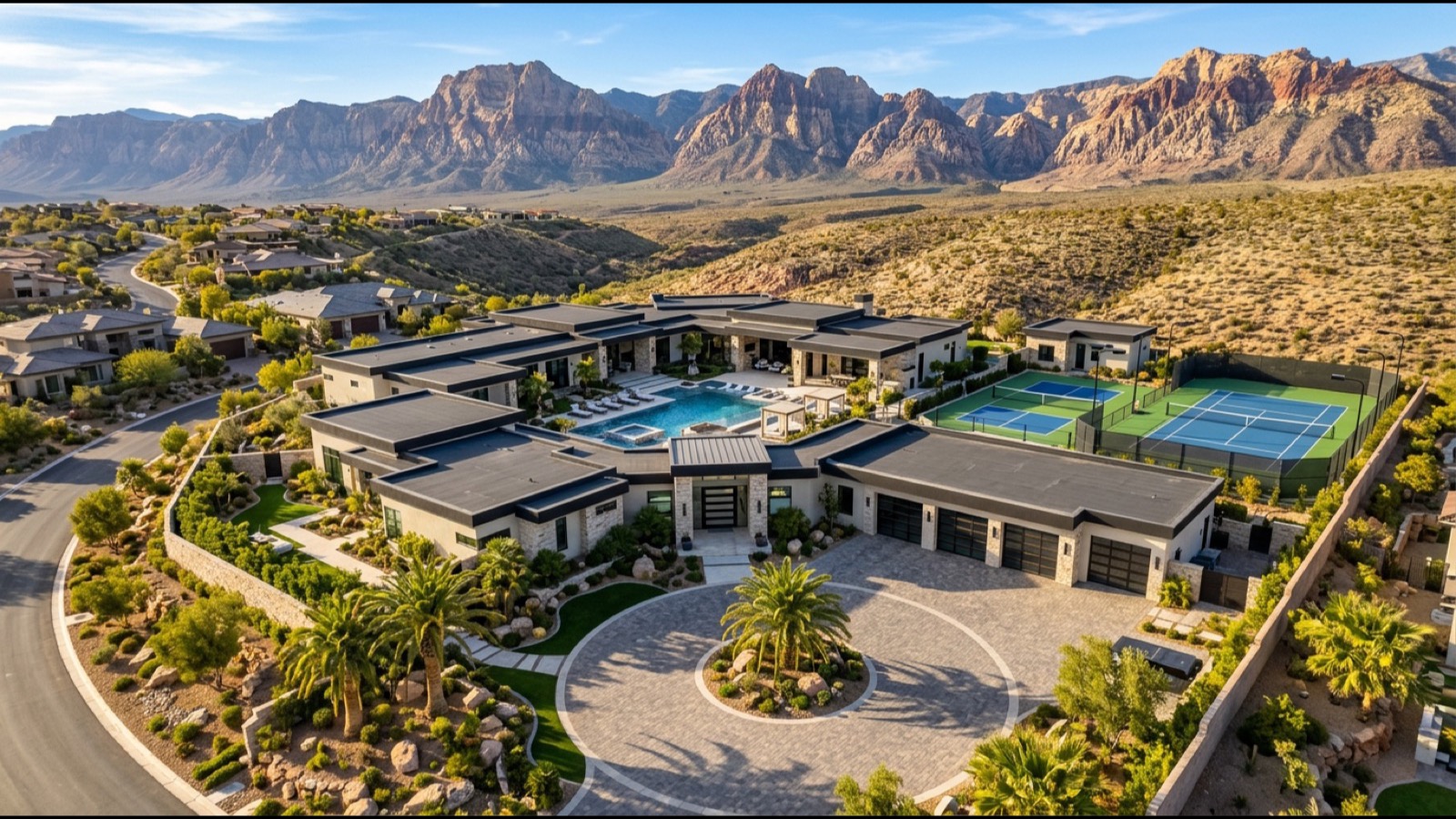
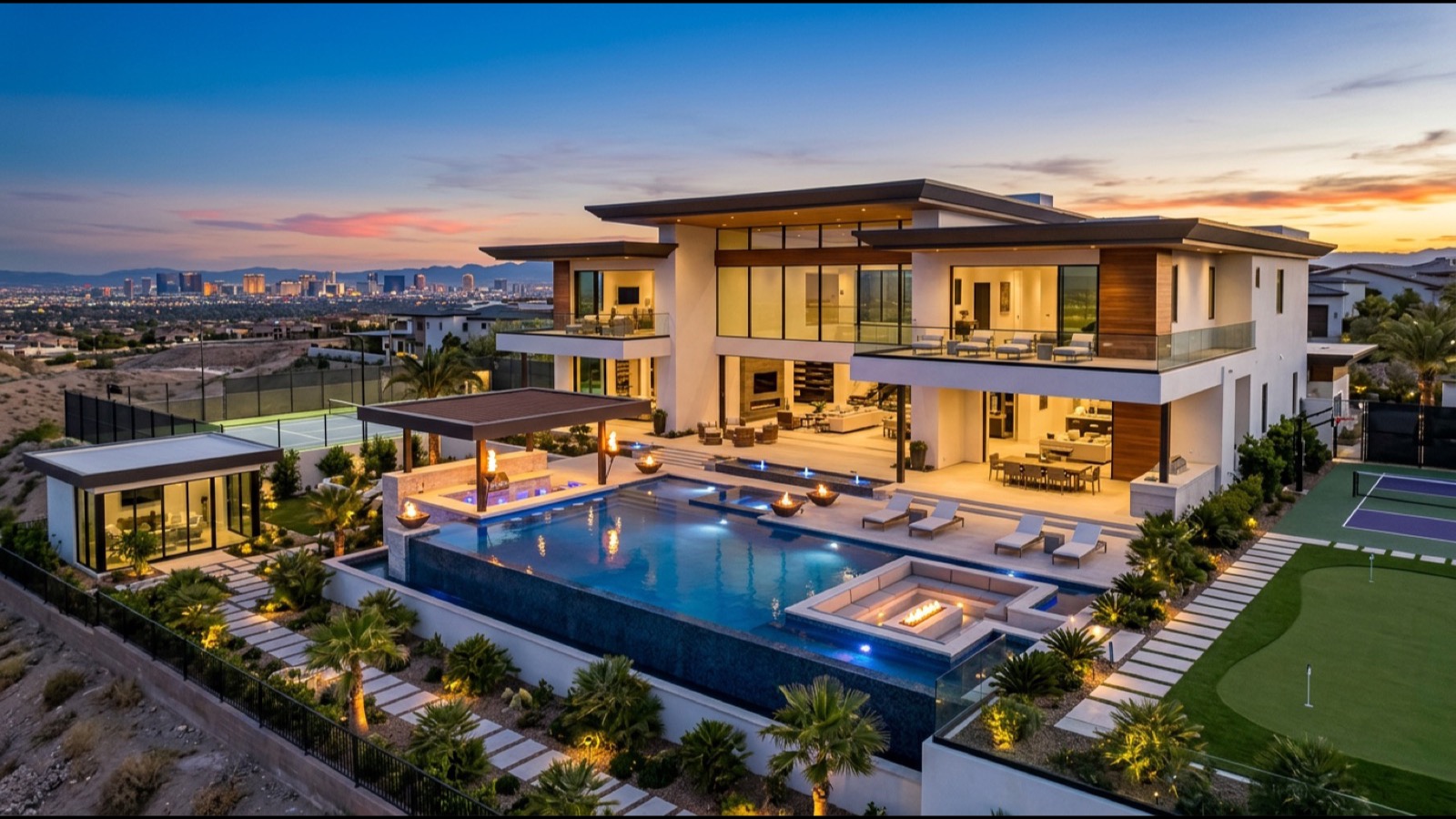
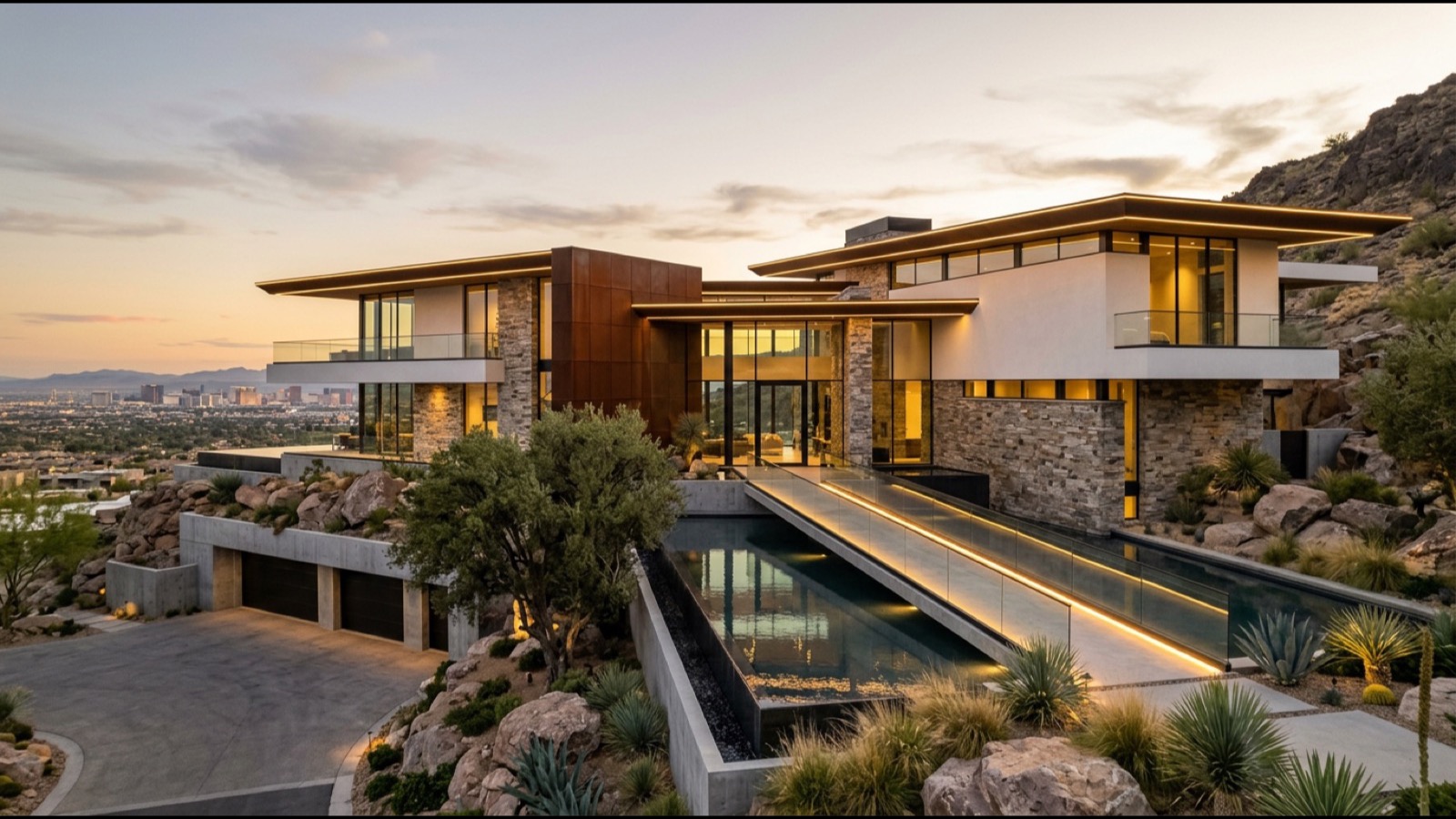
2010s-2024 contemporary tear-down rebuilds (~50+ homes and growing) represent the community's evolving architectural future. These are typically 6,000-12,000-sqft modern custom builds replacing original 1960s ranches — flat metal roofs, full-height glazing, polished-concrete and natural-stone exteriors, integrated indoor-outdoor great rooms, six-car garages with motor courts, dedicated home theaters, wine rooms, and detached guest casitas. Several recent rebuilds have set community-high $4M-$6M+ sold prices.
How Much Do Homes In Scotch 80s Cost?
Pricing reflects the layered original-vs-rebuild eras and the strong variance between fully-original 1960s inventory and contemporary 2020s custom rebuilds:
| Home Type | Typical Sqft | Lot Size | Sold-Price Band | $/Sqft |
|---|---|---|---|---|
| Original 1960s ranch (largely unrenovated) | 3,200 – 4,200 | 0.50 – 0.75 ac | $850,000 – $1,400,000 | $265 – $335 |
| Lightly-renovated 1960s ranch | 3,500 – 4,800 | 0.55 – 0.85 ac | $1,200,000 – $1,900,000 | $320 – $395 |
| Fully-restored mid-century-modern | 3,800 – 5,500 | 0.55 – 1.00 ac | $1,700,000 – $2,800,000 | $430 – $560 |
| 1980s-1990s Mediterranean | 4,500 – 7,000 | 0.55 – 1.00 ac | $1,800,000 – $3,200,000 | $385 – $475 |
| 2015+ contemporary tear-down rebuild | 6,000 – 12,000 | 0.65 – 1.50 ac | $3,200,000 – $5,500,000+ | $520 – $685 |
Across the 6,225+ NREG closings, Scotch 80s price-per-square-foot averages run 15-30% higher than equivalent ZIP-89102 inventory outside the gates — a premium that reflects the guard-gated security, irreplaceable lot sizes, and the architectural renaissance effect (rising tear-down rebuild prices anchor expectations for original inventory).
The tear-down rebuild economics drive a distinct sub-market inside the community. According to Clark County Department of Building permit records, a typical Scotch 80s rebuild project runs $850K-$1.4M for the original-property acquisition, $1.8M-$3.2M for new custom construction (per Freddie Mac PMMS construction-cost analysis), with an all-in basis of $3.0M-$4.5M for a 7,000-9,000-sqft contemporary custom — frequently delivering 20-35% appreciation over the all-in basis when complete because comparable modern rebuilds trade at $5M+.
What Are Scotch 80s HOA Fees And Community Amenities?
Scotch 80s monthly HOA dues run $285-$425 depending on your specific lot section. The dues cover 24/7 staffed gate security, common-area landscaping along the entry boulevards, private street maintenance, security patrol service, and the modest community-park / open-space infrastructure within the gated perimeter.
Unlike Las Vegas Country Club (which has a separate $1,200-$2,200/mo country-club dues tier) or Spanish Trail (similar separate-club structure), Scotch 80s has no on-site amenity infrastructure. There is no community pool, no fitness center, no clubhouse, no golf course, and no formal social calendar. Residents who want country-club amenity access typically maintain memberships at TPC Summerlin, Bear's Best Las Vegas at The Ridges, or one of the Henderson private clubs.
| Monthly Carry Item | No outside club | External club member (TPC Summerlin) |
|---|---|---|
| HOA dues | $355 | $355 |
| Property tax (Las Vegas city escrow) | approximately $1,195/mo | approximately $1,195/mo |
| External club monthly dues | $0 | approximately $1,250 (TPC Summerlin) |
| Monthly carry (ex-mortgage) | approximately $1,550 | approximately $2,800 |
The community's amenity-light HOA structure is a meaningful financial advantage for buyers who don't need on-site facilities. Compared to LVCC's full-club model, Scotch 80s residents save roughly $1,500-$1,800/month while gaining substantially larger lot sizes.
Who Are Famous Past And Present Scotch 80s Residents?
Scotch 80s' Old-Vegas cultural identity rests on its roster of mid-century-and-beyond high-profile residents. According to The Mob Museum historical archives, contemporary Las Vegas Sun retrospectives, and the broader documented record:
The community's 1960s-1970s roster included Stardust and Sahara resort executives, several Frank Sinatra-era performers (multiple Rat Pack-adjacent musicians and producers held Scotch 80s estates), and a number of casino-industry attorneys and accountants whose firms anchored the Strip-resort financial infrastructure.
The 1980s-1990s brought Wayne Newton (multiple Scotch 80s properties owned over decades), several professional athletes including former NBA and PGA Tour players, and a number of nationally-known Vegas-based comedians whose touring schedules anchored them to a Strip-corridor home base.
The 2000s-2020s has seen the community's renaissance attract a new generation: tech-and-finance executives relocating from California, hospitality-industry C-suite leadership, professional poker players, and several internationally-known entertainers and athletes who specifically chose Scotch 80s over Summerlin for the Old-Vegas character and central-Strip proximity. The current resident roster typically includes 3-5 active Forbes-list net-worth households, although specific identification of current residents is intentionally maintained as private community knowledge.
The cultural-history effect is meaningful for buyer decision-making: Scotch 80s carries brand value beyond the underlying real estate fundamentals, similar to how Holmby Hills or Bel Air properties carry premium pricing relative to comparable inventory elsewhere in West Los Angeles. The historic associations contribute to the architectural renaissance pricing dynamic — buyers acquiring tear-down rebuild lots are buying not only the physical parcel but the storied neighborhood identity that comes with it.
What Schools Serve Scotch 80s Residents?
Clark County School District attendance boundaries route Scotch 80s through:
- Elementary: Quannah McCall Elementary (1.8 miles southeast)
- Middle School: K.O. Knudson Middle School (1.4 miles south)
- High School: Western High School (2.1 miles north) or Las Vegas High School (3.5 miles east)
According to GreatSchools ratings, the zoned schools rate 3-4/10 — typical for the central-Las-Vegas-corridor population. Like Las Vegas Country Club, most Scotch 80s school-age families opt for private or magnet alternatives:
- Bishop Gorman High School (Catholic 9-12, 5.8 miles southwest)
- The Meadows School (independent K-12, 7.2 miles west)
- Las Vegas Day School (independent K-8, 4.4 miles southwest)
- Las Vegas Academy of the Arts (CCSD magnet, 4.1 miles east) — strong arts / performing-arts magnet
- Advanced Technologies Academy (CCSD magnet, 3.6 miles east) — STEM magnet
In our experience, 70-80% of school-age Scotch 80s families choose private or magnet over zoned public — the highest private-school participation rate among the valley's historic gated communities.
How Long Do Scotch 80s Homes Sit On The Market?
According to recent Las Vegas REALTORS reports for ZIP 89102, Scotch 80s inventory sells at a median 89-day DOM — substantially slower than the broader 89102 ZIP (median 51 days) and significantly slower than the valley-wide median of 38 days. The slower DOM reflects the high architectural diversity (every home is distinct), the limited buyer pool for the $850K-$5M+ price band, and the community's deliberate exclusivity that keeps marketing channels narrow.
DOM by price band:
| Price Band | Typical Buyer | Median DOM | List-price velocity |
|---|---|---|---|
| $850K – $1.4M (original ranch) | Tear-down rebuild investor | 54 days | 95.5% list |
| $1.4M – $2.5M (lightly renovated) | Old-Vegas-aware luxury buyer | 78 days | 94.0% list |
| $2.5M – $3.5M (fully restored / 80s-90s) | Trophy historic buyer | 108 days | 92.5% list |
| $3.5M+ (modern rebuild) | Architectural-finish trophy buyer | 165 days | 90.5% list |
The original-ranch band moves fastest because of tear-down rebuild demand — buyers can underwrite the all-in basis math quickly. The high-end modern rebuild inventory often takes 5-6 months because the buyer pool is small (under 30 valley-wide qualified HNW trophy buyers per year) and each architectural finish package is uniquely valuable.
Who Buys Homes In Scotch 80s In 2026?
Across the 6,225+ valley transactions the NREG team has represented, four buyer profiles account for roughly 85% of Scotch 80s closings:
- Tear-down rebuild investor / owner-builder (~30%): acquires original 1960s ranch for $850K-$1.4M, demolishes, builds 7,000-9,000-sqft contemporary custom for all-in $3.0M-$4.5M basis. Typically tech / finance executive moving from Bay Area or Seattle, or established Las Vegas hospitality executive consolidating into the city's most prestigious in-city address.
- Old-Vegas-aware luxury buyer (~25%): specifically wants the historic / cultural identity. Often longtime Las Vegas resident upgrading from Summerlin or Henderson; values the community's Frank Sinatra-era heritage and prestigious roster. Target the $1.4M-$2.8M restored / renovated inventory.
- California in-migration HNW (~20%): primary residence in coastal markets; relocating for Nevada's no-state-income-tax structure (per Nevada Department of Taxation). Target the $2.5M-$5M+ modern-rebuild band.
- Architectural-significance buyer / mid-century-modern collector (~10%): specifically seeking original Donald Wexler / Cliff May vintage inventory; willing to invest in faithful restoration rather than tear-down replacement. Target the $1.4M-$2.0M lightly-renovated band.
The remaining 15% are second-home buyers, occasional foreign-national HNW (Canada, UK, Mexico), and trust / family-office acquisitions for estate-planning purposes.
How Does Scotch 80s Compare To LVCC And Spanish Hills?
For buyers cross-shopping the valley's historic and contemporary luxury alternatives:
| Attribute | Scotch 80s | Las Vegas Country Club | Spanish Hills |
|---|---|---|---|
| Founded | Early 1960s | 1967 | 1998 |
| Home count | ~300 | ~750 | ~300 |
| Lot size range | 0.50 – 2.00+ ac | 0.20 – 0.55 ac | 0.40 – 2.00 ac |
| Distance to Strip | 1.8 miles | 1.0 miles | 12 miles |
| On-site golf course | No | Yes (Edmund Ault) | No |
| Median sold price | $1,650,000 | $985,000 | $2,450,000 |
| Tear-down rebuild rate | 8-12/yr (highest in valley) | 1-2/yr | 4-6/yr |
Decision framework:
- Choose Scotch 80s if: you want the largest in-city lots in the valley, you specifically value Old-Vegas historic identity, you're a tear-down rebuild investor or owner-builder, or you're an architectural-significance buyer seeking authentic mid-century-modern inventory.
- Choose Las Vegas Country Club if: you want on-site golf course access, prefer the slightly closer-to-Strip positioning (1.0 vs 1.8 miles), or want the more established country-club amenity infrastructure at lower entry pricing.
- Choose Spanish Hills if: you want larger lots in the west valley (12 miles from Strip vs. 1.8), prefer the newer 1998-vintage construction over 1960s vintage, or want the broader Summerlin / TPC area positioning.
What Are The Pros And Cons Of Buying In Scotch 80s?
Strengths: largest in-city residential lots in the valley (half-acre to full-acre); 8-minute Strip proximity unmatched by any comparable luxury enclave; deep Old-Vegas cultural identity producing brand-value premium; active architectural renaissance creating tear-down rebuild opportunity for owner-builders; 24/7 staffed gate security; 60-year-old mature landscape canopy impossible to replicate; strong gigabit broadband coverage; flexibility for buyers who want original vintage OR contemporary modern.
Trade-offs: highest architectural diversity in valley luxury tier means inconsistent streetscape; older housing stock (1960-1972 vintage) requires substantial renovation budget for original inventory ($150K-$400K typical scope); zoned CCSD schools rate lower than Summerlin or Henderson alternatives; no on-site amenity infrastructure (no clubhouse, no pool, no golf); slow turnover (12-20 listings/year) makes off-market relationships essential; tear-down rebuild projects require 18-30-month build timelines.
For most Scotch 80s buyers, the framework reduces to: do you want maximum in-city lot privacy and historic identity, or do you want established amenity infrastructure? Scotch 80s delivers the former; LVCC, Anthem Country Club, or Spanish Trail deliver the latter at substantially lower entry pricing.
Frequently Asked Questions
Is Scotch 80s guard-gated 24/7?
Yes. The main entry on Lacy Lane is staffed 24 hours per day by a private security service contracted through the homeowners association. Every vehicle entering the community is logged at the gatehouse, and resident, guest, and vendor traffic follow separate entry protocols. The staffed-gate model has been in continuous operation since the early-1960s founding.
What are typical Scotch 80s HOA fees?
Monthly HOA dues range $285-$425 depending on your specific lot section. The dues cover 24/7 staffed gate security, common-area landscaping along the entry boulevards, private street maintenance, security patrol service, and the modest community-park infrastructure. There is no separate country-club dues structure since the community has no on-site amenity facility.
How does the tear-down rebuild economics work in Scotch 80s?
A typical project: acquire an original 1960s ranch for $850K-$1.4M, secure demolition and rebuild permits through Clark County Department of Building (typically 4-6 months), demolish (typically 2-4 weeks for a 4,000-sqft ranch), build a 7,000-9,000-sqft contemporary custom (typically 18-24 months at $325-$425/sqft construction cost). All-in basis runs $3.0M-$4.5M depending on finish level; comparable completed modern rebuilds trade at $3.5M-$5.5M+, so the rebuild math typically works for buyers with the patience and capital to execute.
Can I buy an original 1960s ranch and just renovate rather than tear down?
Yes — and this is increasingly common as the architectural renaissance attracts mid-century-modern preservationists. Lightly-renovated ranches (cosmetic updates, mechanical systems modernization, kitchen / bath remodels) typically run $1.2M-$1.9M acquisition + $150K-$400K renovation. Fully-restored mid-century-modern projects involving careful interior preservation typically run $1.7M-$2.8M acquisition + $300K-$700K restoration. The fully-restored cohort has appreciated meaningfully over the past five years as collector demand has grown.
Why is Scotch 80s called "Scotch 80s"?
The name derives from Section 80 of the original Las Vegas city plat map. "Scotch" likely references the area's early association with Scottish-influenced residential architecture and developer Irwin Molasky's preferred styling, though historical records on the specific etymology are limited. The community has used the "Scotch 80s" identifier continuously since the early-1960s founding.
Is Scotch 80s within Las Vegas city limits or unincorporated Clark County?
Inside the City of Las Vegas. This distinguishes Scotch 80s from Las Vegas Country Club (unincorporated Paradise) and most other gated luxury alternatives. The in-city jurisdiction means City of Las Vegas property tax assessment, LVMPD city-level law enforcement (rather than Clark County Sheriff), and direct city building-permit authority for tear-down rebuild projects.
What's the best way to find an off-market Scotch 80s home?
The community sees only 12-20 listed sales per year, making off-market inventory disproportionately important. The NREG team maintains direct relationships with several Scotch 80s homeowners and can introduce qualified buyers to homes that haven't reached public MLS — particularly valuable for tear-down rebuild lot opportunities where original-owner relationships matter. Call (702) 637-1759 or email info@nevadagroup.com to register your specific criteria.
Which Sources Inform This Scotch 80s Guide?
- Las Vegas REALTORS — MLS sold-data and ZIP-89102 reports
- Clark County Assessor — parcel data and tax records
- Clark County Department of Building — tear-down rebuild permit records
- Clark County School District — attendance zones for McCall / Knudson / Western
- GreatSchools — school ratings
- U.S. Census Bureau — ZIP-89102 demographics
- Federal Communications Commission — broadband coverage
- Freddie Mac PMMS — mortgage and construction-cost references
- The Mob Museum — Old-Vegas resident history
- Nevada Department of Taxation — Nevada residency tax structure
- Nevada Revised Statutes — common-interest community governance
The NREG team has represented 6,225+ valley closings over sixteen years. For Scotch 80s inventory, off-market opportunities, or tear-down rebuild lot analysis, call (702) 637-1759 or email info@nevadagroup.com.
Ready to Tour Scotch 80s?
Scotch 80s is the valley's most concentrated cluster of in-city irreplaceable estate lots — the address of choice for Old-Vegas-aware buyers, architectural renaissance investors, and trophy modern-custom builders who specifically want the largest lot sizes within minutes of the Strip. No other community in the valley delivers half-acre-plus lots, 24/7 staffed gate security, and 8-minute Strip proximity in a single offering.
The NREG team maintains direct Scotch 80s homeowner relationships for off-market inventory introductions, tear-down rebuild lot analysis, and full transaction representation. Call Chris Nevada at (702) 637-1759 or browse Las Vegas luxury communities and guard-gated communities on our property search.