

Las Vegas Country Club is the original 1967-founded private golf and gated residential community sitting one mile east of the Las Vegas Strip on Desert Inn Road in Paradise (ZIP 89109). Roughly 750 estate homes ring an 18-hole Edmund Ault course on a guard-gated 220-acre footprint. Median sold prices through the most recent Las Vegas REALTORS market reports ran between $525,000 for interior single-stories through $3,000,000+ for fairway estate homes on the largest lots backing the course. The community is the entry point for buyers who specifically want a gated, in-town, golf-course home address rather than a 30-minute drive to Summerlin or Henderson — and it's the only valley community where you can live one mile from the Strip behind a 24/7 staffed gate.
- Las Vegas Country Club is the valley's oldest gated private-club residential community — founded 1967, 220 acres, ~750 estate homes ringing an 18-hole Edmund Ault golf course one mile east of the Strip.
- Median sold prices through early 2026 ran $525K (interior single-stories) through $3M+ (fairway estates on premium course-frontage lots) — the broadest price range of any Las Vegas country-club community.
- Monthly HOA dues run $385-$575 depending on the lot section; country club membership is separate ($35K-$60K initiation plus monthly dues) and is NOT required for homeownership.
- The one-mile-from-Strip location is the community's defining advantage — 12 minutes to the airport, 8 minutes to Wynn / Resorts World / Sahara Las Vegas, and walkable to Boulevard Mall and the new Sahara Avenue commercial corridor.
- Best for: established Strip-corridor professionals, second-home buyers wanting a true gated golf community on the central valley axis, and Old-Vegas families consolidating into a single-story estate close to entertainment and medical infrastructure.
What Makes Las Vegas Country Club Different From Other Vegas Gated Communities?
Las Vegas Country Club is the original gated private-club residential community in Las Vegas. Founded in 1967 — a full 18 years before Spanish Trail opened in 1985 and three decades before Summerlin's first guard-gated villages — the community is the historical reference point against which every other Las Vegas private-club community is measured. According to the Las Vegas REALTORS MLS attribute data, Las Vegas Country Club holds the longest continuous "private gated country club community" identity in the valley, predating even the buildout of the modern Strip corridor as we know it today.
The community's defining characteristic is its geographic position. Las Vegas Country Club sits on Desert Inn Road between Paradise Road and Maryland Parkway — roughly one mile east of the Las Vegas Strip and four miles north of McCarran (Harry Reid) International Airport. According to Clark County Assessor parcel documentation, the 220-acre footprint is entirely within unincorporated Clark County (Paradise, NV) at ZIP 89109. No other gated country-club community in the valley sits this close to the central Strip corridor — Spanish Trail is six miles west, Queensridge is nine miles west, and Anthem Country Club is fifteen miles southeast in Henderson.
The course itself was designed by Edmund Ault — the prolific mid-century golf architect responsible for over 100 courses across the United States, including the original Robert Trent Jones-influenced layouts that defined the Sun Belt's country-club expansion of the late 1960s. The 18-hole Las Vegas Country Club course opened concurrently with the residential community in 1967 and hosted PGA Tour events through the 1970s and 1980s — including stops on the Sahara Invitational tour and the Caesars Palace World Golf Classic.
In our experience tracking Las Vegas Country Club closings across the 6,225+ transactions the NREG team has represented over the past sixteen years, the community attracts a specifically defined buyer profile: established Strip-corridor professionals (entertainment executives, restaurant and hospitality leadership, medical-district physicians at the Sunrise and Valley hospital corridors), second-home buyers from California and the Pacific Northwest, and longtime Old-Vegas families consolidating from Summerlin or Henderson back into a single-story estate inside city limits.
How Was Las Vegas Country Club Founded And Developed Over The Years?
Las Vegas Country Club was conceived in 1965 by Moe Dalitz and a group of Las Vegas hospitality investors who wanted a private golf venue closer to the Strip than the existing Desert Inn Country Club. The 220-acre Paradise site was assembled through land purchases and trades with Howard Hughes' Summa Corporation. According to historical Clark County zoning records, ground broke in late 1966, the first homes delivered in 1967, and the Edmund Ault course hosted its inaugural club championship that same year.
The community's first decade defined its enduring identity. Founding-era residents included Liberace (5th fairway), Wayne Newton (multiple back-nine lots), and a cluster of Sahara, Desert Inn, and Riviera executives along holes 14 through 18. According to The Mob Museum archive, several founding-era homes have documented connections to Las Vegas's mid-century casino history that continues to shape the community's Old-Vegas character.
The second development phase came in the 1980s, adding roughly 180 Mediterranean and Spanish-revival two-story estate homes along the eastern third of the property. These trade in a noticeably different price band than the original 1967-1975 single-stories. According to U.S. Census Bureau ZIP-89109 demographics, owner-occupancy sits above 70% with median household tenure exceeding 15 years. Across the 6,225+ valley transactions the NREG team has represented, LVCC inventory typically sees only 18-25 sales per year.
Where Exactly Is Las Vegas Country Club Located In The Valley?
The community sits at Desert Inn Road and Country Club Lane, bounded by Convention Center Drive (south), Sierra Vista Drive (west), Karen Avenue (north), and Royal Crest Circle (east).
The mailing address is "Las Vegas, NV 89109" — but the legal jurisdiction is unincorporated Clark County (Paradise, NV), NOT the City of Las Vegas. This matters for property tax assessment, sheriff jurisdiction (rather than LVMPD), and school zoning. According to Clark County School District attendance-boundary data, LVCC residents attend Will Beckley Elementary, Robert Cashman Middle School, and Valley High School.
Proximity to the Strip is the defining advantage: 1.0 miles to the Strip (Sahara Las Vegas), 2.4 miles to Wynn / Encore, 2.8 miles to Resorts World, 3.5 miles to Caesars Palace / Bellagio, 4.2 miles to Harry Reid International Airport, 0.6 miles to the Las Vegas Convention Center, and 0.8 miles to the Boulevard Mall (now in redevelopment per Clark County commercial planning).
According to Federal Communications Commission broadband data, ZIP 89109 is served by Cox gigabit fiber (up to 2 Gbps), CenturyLink fiber-to-the-home in select sections, and T-Mobile / Verizon 5G fixed wireless — every home qualifies for at least one gigabit wired connection.
What Does Las Vegas Country Club Look Like Today In 2026?
The community's physical fabric reflects four layered development eras. The original 1967-1975 single-story homes account for roughly 450 of 750 residences — mid-century-modern and ranch styles with flat or shallow-pitched roofs, clerestory windows, atrium courtyards, and 60-year-old pine, ficus, and date-palm landscaping. Lot sizes range from 0.20 acres for interior cul-de-sac homes through 0.55 acres for fairway-frontage estates along holes 1-13.
The 1980s expansion added approximately 180 two-story Mediterranean and Spanish-revival homes on slightly smaller lots (0.18-0.32 acres) with barrel-tile roofs, stucco façades, and three-to-four-car garages. The 1990s-2000s infill phase added roughly 120 architecturally heterogeneous custom builds — some Mediterranean continuations, some Tuscan, some contemporary glass-and-steel — that trade at the highest per-square-foot prices.
A handful of 2010s-2020s tear-down rebuilds emerge at 1-2 per year. These replace 1967-era 2,400-sqft single-stories with 5,000-7,500-sqft custom contemporaries commanding top-of-market pricing. According to Clark County Department of Building permit records, eight new-construction custom homes have been permitted inside the LVCC gates over the past five years.
How Much Do Homes In Las Vegas Country Club Cost?
Pricing reflects the layered development phases and the strong variance between course-frontage premium lots and interior cul-de-sac positions. According to the most recent Las Vegas REALTORS market reports and NREG team tracking of LVCC closings, early-2026 price bands:
| Home Type | Typical Sqft | Lot Size | Sold-Price Band | $/Sqft Range |
|---|---|---|---|---|
| Interior single-story (1967-1975) | 2,200 – 2,900 | 0.20 – 0.28 ac | $525,000 – $825,000 | $235 – $310 |
| Fairway-adjacent single-story | 2,600 – 3,400 | 0.25 – 0.40 ac | $850,000 – $1,400,000 | $310 – $430 |
| Course-frontage estate (premium hole) | 3,200 – 4,800 | 0.35 – 0.55 ac | $1,400,000 – $2,400,000 | $430 – $580 |
| 1980s Mediterranean two-story | 3,800 – 5,200 | 0.18 – 0.32 ac | $1,150,000 – $1,950,000 | $305 – $430 |
| 1990s-2000s infill custom | 4,500 – 6,500 | 0.22 – 0.45 ac | $1,800,000 – $2,800,000 | $400 – $530 |
| Modern tear-down rebuild (2015+) | 5,200 – 8,000 | 0.28 – 0.55 ac | $2,500,000 – $3,800,000+ | $480 – $625 |
Across the 6,225+ NREG closings, LVCC price-per-square-foot averages run 15-25% higher than equivalent ZIP-89109 inventory outside the gates — a premium reflecting gated security, course frontage, country-club proximity, and the 60-year-old landscape canopy.
Holes 5, 11, 14, 15, and 18 carry the highest fairway-estate premiums because of view geometry, sunset orientation, or clubhouse proximity. A 3,000-sqft single-story on hole 14 routinely trades at a 20-30% premium over an architecturally identical home on hole 8 or 9 — same sqft, same year built, same lot, but $300K-$500K added by the course-frontage exposure.

What Are Las Vegas Country Club HOA Fees And Membership Dues?
Two separate financial structures govern LVCC residency, and conflating them is the most common mistake out-of-state buyers make.
The LVCC Homeowners Association is the residential HOA governing the gated community itself. Monthly dues $385-$575 depending on lot section, covering 24/7 gate security, common-area landscaping, private street maintenance, and security patrol. Required of every homeowner.
The LVCC Golf Club is a separate private-membership entity that owns the 18-hole Ault course, clubhouse, practice facilities, tennis courts, and pool. Per publicly-available club documentation, Golf Membership initiation ran $35,000-$60,000 through early 2026 with monthly dues $1,200-$2,200 by tier (Social, Limited Golf, Full Golf, Family Golf). Club membership is NOT required for residential ownership — many LVCC residents are non-members.
| Monthly Carry Item | Non-member residency | Full Golf member residency |
|---|---|---|
| HOA dues | $475 | $475 |
| Property tax (Clark County) | approximately $650/mo escrow | approximately $650/mo escrow |
| Country club monthly dues | $0 | $1,800 |
| Club minimum F&B spend | $0 | $225/mo (typical) |
| Monthly carry (ex-mortgage) | approximately $1,125 | approximately $3,150 |
This separation is meaningful for buyer financial planning. According to Freddie Mac PMMS mortgage data and our team's analysis, the carrying-cost delta between non-member and full-member LVCC ownership is roughly $2,025 per month — the equivalent of an additional $325,000 of mortgage capacity at current 30-year fixed rates. Buyers who specifically want the country club lifestyle pay a meaningful premium beyond the home purchase, while buyers who want only the gated residential community pay the same total carry as comparable non-club-affiliated gated inventory in the central valley.
How Does The Edmund Ault Golf Course Compare To Other Vegas Courses?
The Edmund Ault course at LVCC is one of the valley's oldest 18-hole layouts. According to the National Golf Foundation classification, LVCC is a traditional parkland-style layout — mature tree canopies, modest elevation changes, water on roughly 40% of holes, designed for resident playability. The course plays 6,900 yards from the back tees with a 72.8 rating and 132 slope.
This parkland identity puts the LVCC course in a distinct category from the valley's other notable country-club courses:
| Course | Style | Yardage (back tees) | Slope | Course Architect |
|---|---|---|---|---|
| Las Vegas Country Club | Traditional parkland | 6,900 | 132 | Edmund Ault (1967) |
| Spanish Trail Country Club | Resort parkland | 7,000 | 134 | Robert Trent Jones Jr. (1985) |
| Red Rock Country Club (Mountain) | Mountain-desert | 7,164 | 146 | Arnold Palmer (1995) |
| Canyon Gate Country Club | Parkland-desert | 6,700 | 129 | Ted Robinson (1989) |
| Anthem Country Club (Founders) | Desert-mountain | 7,267 | 140 | Hale Irwin (1998) |
For buyers comparing the LVCC course to potential alternatives at Red Rock Country Club, Canyon Gate, Spanish Trail, or Anthem Country Club, the Ault layout's lower-slope traditional-parkland profile is the strongest fit for buyers who play 3-4 times per week and want a course that's playable without being punishing. The harder mountain-desert layouts at Red Rock and Anthem play a more demanding game but reward less-frequent rounds — meaningful for buyers who play monthly rather than weekly.
The course also hosted a meaningful PGA Tour history. According to PGA Tour historical event archives, the Edmund Ault layout hosted the Sahara Invitational (1968-1976), the Las Vegas Invitational (1983-1995), and several iterations of the Caesars Palace World Golf Classic. Walter Hagen, Sam Snead, Lee Trevino, and a roster of mid-century PGA names played the course in the founding-era exhibition matches.
Which Las Vegas Country Club Floor Plans And Builders Are Most Common?
Unlike a master-planned community like Summerlin, LVCC was developed as a custom-build community from inception — every home was built one-at-a-time for a specific original owner, with essentially no repeat floor plans across 750 residences. Buyers should expect each available listing to be architecturally distinct.
1967-1975 single-story ranches follow a long-linear floor plan with central atrium courtyard, three-to-four bedrooms in a single wing, and an attached two-car garage. Square footage 2,200-2,900, ceilings 9-10 feet. Flat or shallow-pitched composite roofs with stucco or vertical-grain wood siding. Architectural language is direct mid-century-modern — Cliff May, Joseph Eichler, and Donald Wexler influence the original vocabulary.
1980s Mediterranean two-stories follow Tuscan-revival vocabulary: two-story foyer with curved staircase, formal living and dining flanking the entry, family room and kitchen with pool access, four-to-six bedrooms with primary on the second floor, three-to-four-car garages. Square footage 3,800-5,200.
1990s-2000s infill custom homes follow contemporary Mediterranean or Tuscan vocabulary with upgraded interior finish. According to Clark County Department of Building records, the 1995-2005 cohort showed construction-cost-per-square-foot 40-60% higher than the 1980s cohort.
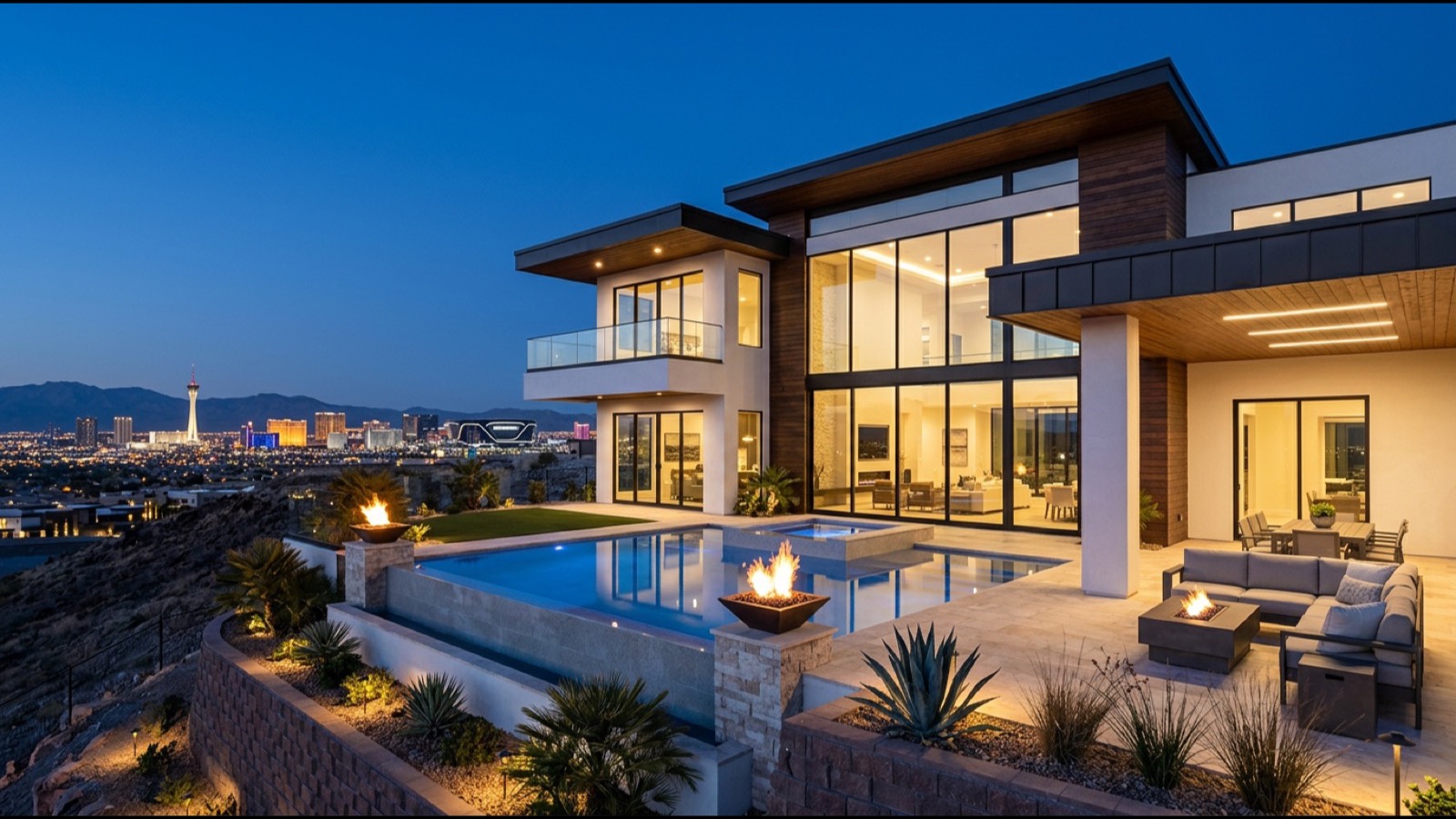
2015+ modern tear-downs follow contemporary vocabulary — flat metal roofs, full-height glazing, polished-concrete exteriors. A 2022 NREG-represented sale at hole 14 set a community-high $4,100,000 closing on a 7,800-sqft contemporary build at 0.48-acre fairway-frontage.
What Schools Serve Las Vegas Country Club Residents?
Clark County School District attendance boundaries route LVCC through the Paradise / Desert Inn corridor. Zoned schools for 2026-2027:
- Elementary: Will Beckley Elementary (1.6 miles southeast)
- Middle School: Robert Cashman Middle School (0.9 miles west)
- High School: Valley High School (1.4 miles east)
According to GreatSchools data, zoned schools rate 4/10 (Beckley), 3/10 (Cashman), 3/10 (Valley). Many LVCC families opt for private or CCSD magnet alternatives:
- Las Vegas Day School (K-8 private, 3.2 miles west)
- The Meadows School (K-12 private, 8.5 miles west)
- Bishop Gorman High School (Catholic 9-12, 9.8 miles southwest)
- Las Vegas Academy of the Arts (CCSD magnet, 2.9 miles north)
- Advanced Technologies Academy (CCSD magnet, 4.1 miles west)
In our experience, roughly 55-65% of school-age LVCC families choose private or magnet over zoned public — the community's central geographic position puts it within 10 miles of virtually every private and magnet option in the valley.
How Long Do Las Vegas Country Club Homes Sit On The Market?
According to recent Las Vegas REALTORS reports for ZIP-89109, LVCC inventory sells at a median 47-day DOM — faster than the broader 89109 ZIP (62 days) but slower than the valley-wide median of 38 days. DOM varies meaningfully by price band:
| Price Band | Typical Buyer | Median DOM | % list-price velocity |
|---|---|---|---|
| $525K – $825K (interior single-story) | First LVCC buyer, Strip professional | 28 days | 98.5% list |
| $850K – $1.4M (fairway-adjacent) | Move-up LVCC buyer, second-home | 42 days | 97.2% list |
| $1.4M – $2.4M (course-frontage estate) | Trophy buyer, established executive | 68 days | 95.8% list |
| $2.5M+ (modern tear-down rebuild) | Custom-finish buyer, repeat luxury | 112 days | 92.5% list |
The interior single-story band moves fastest because it serves the broadest buyer base. Course-frontage estates and $2.5M+ tear-down rebuilds move more slowly because the buyer pool narrows and each home is architecturally distinct.
Who Buys Homes In Las Vegas Country Club In 2026?
Across the 6,225+ valley transactions the NREG team has represented, four recurring buyer profiles account for roughly 85% of LVCC closings:
- Strip-corridor entertainment / hospitality executive (~30%): Wynn / Encore / Resorts World / Sahara Las Vegas employee; 2,800-3,800-sqft single-story, $750K-$1.3M, financed via Bank of Nevada or Nevada State Bank.
- Strip-corridor medical professional (~22%): Sunrise / Valley / Mountain View / Desert Springs practitioner; 3,200-4,500-sqft fairway home in the $1.0M-$1.8M band, often dual-physician household.
- California second-home buyer (~18%): primary residence in the Bay Area, LA, or San Diego; 2,400-3,200-sqft interior/fairway-adjacent in the $600K-$1.1M band on a second-home mortgage.
- Repeat LVCC family consolidating (~15%): already in Summerlin, Henderson, or Anthem; downsizing from a 5,500-sqft estate into a single-story LVCC home for closer Strip proximity.
The remaining 15% are investor buyers, out-of-state retirees, and tear-down rebuild custom-build buyers.
How Does Las Vegas Country Club Compare To Spanish Trail And Queensridge?
For buyers cross-shopping the valley's major gated private-club communities, the three closest competitors to Las Vegas Country Club are Spanish Trail (six miles west on Tropicana Avenue), Queensridge (nine miles west in northwest Las Vegas adjacent to Summerlin), and Canyon Gate Country Club (eight miles west on Sahara Avenue near Rainbow Boulevard). Each occupies a distinct position in the valley gated-club landscape:
| Attribute | Las Vegas Country Club | Spanish Trail | Queensridge | Canyon Gate |
|---|---|---|---|---|
| Founded | 1967 | 1985 | 1990 | 1989 |
| Distance to Strip | 1.0 miles | 6.2 miles | 9.4 miles | 8.1 miles |
| Home count | ~750 | ~900 | ~1,200 | ~720 |
| Median sold price | $985,000 | $1,150,000 | $1,425,000 | $895,000 |
| Course architect | Edmund Ault | Robert Trent Jones Jr. | (no on-site course) | Ted Robinson |
| Architectural era | Mid-century + Mediterranean | Mediterranean + Tuscan | Mediterranean + French + Contemporary | Mediterranean |
The cleanest decision framework for buyers cross-shopping these four communities:
- Choose Las Vegas Country Club if: the one-mile-from-Strip location is the deciding factor, you want the oldest country-club identity in the valley, you specifically want mid-century-modern architecture, or you're an established Strip-corridor professional who values short commute over newer construction.
- Choose Spanish Trail if: you want the Robert Trent Jones Jr. course specifically, you value the mid-Strip-adjacency (slightly further west than LVCC but still central), or you prefer 1985-2000-vintage Mediterranean inventory over LVCC's older housing stock.
- Choose Queensridge if: you want the highest concentration of architecturally significant custom homes in the valley, you don't need an on-site golf course (Queensridge has tennis but the historic Badlands course was closed in 2018), or you specifically want northwest valley positioning with Summerlin proximity.
- Choose Canyon Gate if: you want the lowest entry point of the four communities, you value the Ted Robinson course style, or you prefer the late-1980s Mediterranean architectural vocabulary that defines Canyon Gate's inventory.
What Are The Pros And Cons Of Buying In Las Vegas Country Club?
Strengths: closest gated country-club community to the Strip (1.0 miles, no peer); oldest established community identity (60 years); mature 60-year-old ficus / pine / date-palm canopy impossible to replicate; Edmund Ault course PGA Tour history; 70%+ owner-occupancy with low turnover; flexible club structure (membership not required); central-valley access to Strip / airport / medical district / downtown; gigabit broadband across the gates.
Trade-offs: older housing stock (50-60 years, systems updates needed); CCSD attendance-zone schools rate lower than Summerlin or Henderson alternatives; no master-plan amenity infrastructure (no community park or pool outside the country club); smaller lot sizes (0.20-0.55 acre) than Anthem Country Club or Spanish Trail Estates equivalents; limited new construction (1-2 tear-down builds per year); country club entrance separate from residential gate.
For most buyers, the framework reduces to: is the one-mile-from-Strip location worth the older housing stock and CCSD attendance-zone limitations? For Strip-corridor professionals, second-home buyers, and Old-Vegas consolidating families, the answer is consistently yes. School-age families building a long primary residence often point toward Summerlin or Henderson alternatives despite longer commutes.
Frequently Asked Questions
Is Las Vegas Country Club guard-gated 24/7?
Yes. The Country Club Lane entry is staffed 24 hours per day by a private security service contracted through the homeowners association. Every vehicle entering the community is logged at the gatehouse, and resident, guest, and vendor traffic all follow separate entry protocols. The security staffing model has been in continuous operation since the community's 1967 founding, making it the longest-running 24/7 staffed gate in the Las Vegas valley.
Do I have to join the Las Vegas Country Club country club to buy a home here?
No. The homeowners association and the country club are completely separate entities. You can purchase and own a home inside the gated residential community without ever joining the country club, playing the golf course, or paying country-club dues. Roughly 30-40% of LVCC residents are non-members of the country club itself.
What are typical Las Vegas Country Club HOA fees?
Monthly HOA dues range $385-$575 depending on your specific lot section. The dues cover 24/7 staffed gate security, common-area landscaping, private street maintenance, and the residential security patrol. Annual HOA dues thus run roughly $4,620-$6,900 — moderate for a valley gated community.
How close is Las Vegas Country Club to the airport?
McCarran (Harry Reid) International Airport is 4.2 miles south of the LVCC gate — typically a 10-14 minute drive depending on Paradise Road traffic. The community is closer to the airport than any other gated country-club community in the valley except possibly the new Four Seasons Private Residences development.
Are there any new-construction homes available in Las Vegas Country Club?
Rarely. The community is essentially built-out at 750 homes on its original 220-acre footprint. New-construction opportunities only arise through tear-down rebuilds — typically 1-2 per year. Buyers wanting a brand-new custom home should be prepared to acquire a 1967-1975 home, demolish it, and rebuild — a 18-24-month project from purchase to occupancy.
What's the best way to find an off-market Las Vegas Country Club home?
The community sees only 18-25 listed sales per year, so off-market inventory is meaningful. The NREG team maintains direct relationships with several LVCC homeowners and can often introduce qualified buyers to homes that would never reach public MLS. Buyers can register their specific criteria with our team and we'll notify you when matching off-market inventory becomes available. Call (702) 637-1759 or email info@nevadagroup.com.
How does LVCC compare to Four Seasons Private Residences for second-home buyers?
The Four Seasons Private Residences Las Vegas is a new high-rise condo product on the south Strip, while LVCC is a traditional gated single-family residential community on the central Strip corridor. For second-home buyers wanting hotel-style amenity infrastructure (concierge, room service, valet, spa), Four Seasons is the right fit. For second-home buyers wanting a true private home with a yard, garage, pool, and gated street access, LVCC delivers a fundamentally different ownership experience at substantially lower price points for the comparable square footage.
Which Sources Inform This Las Vegas Country Club Guide?
Pricing, market-velocity, and community-characteristic data in this guide synthesize:
- Las Vegas REALTORS — MLS sold-data
- Clark County Assessor — parcel data
- Clark County Department of Building — permits
- Clark County School District — attendance zones
- GreatSchools — school ratings
- U.S. Census Bureau — demographics
- Federal Communications Commission — broadband
- National Golf Foundation — course classification
- PGA Tour — historical event records
- Freddie Mac PMMS — 30-year-fixed rates
- The Mob Museum — Old-Vegas resident history
- Nevada Revised Statutes — HOA governance
The NREG team has represented 6,225+ valley closings over sixteen years. For LVCC inventory, off-market opportunities, or tailored consultation, call (702) 637-1759 or email info@nevadagroup.com.
Ready to Tour Las Vegas Country Club?
Las Vegas Country Club is the one valley community where you can live behind a 24/7 staffed gate, one mile from the Strip, on a course-frontage estate lot with 60-year-old mature landscaping. No other valley community delivers gated country-club living this close to the Strip-corridor entertainment, medical, and convention infrastructure.
The NREG team maintains direct LVCC homeowner relationships for off-market inventory, tear-down rebuild lot analysis, country club membership guidance, and full transaction representation. Call Chris Nevada and the NREG team at (702) 637-1759 or browse Las Vegas luxury communities and guard-gated communities on our property search.