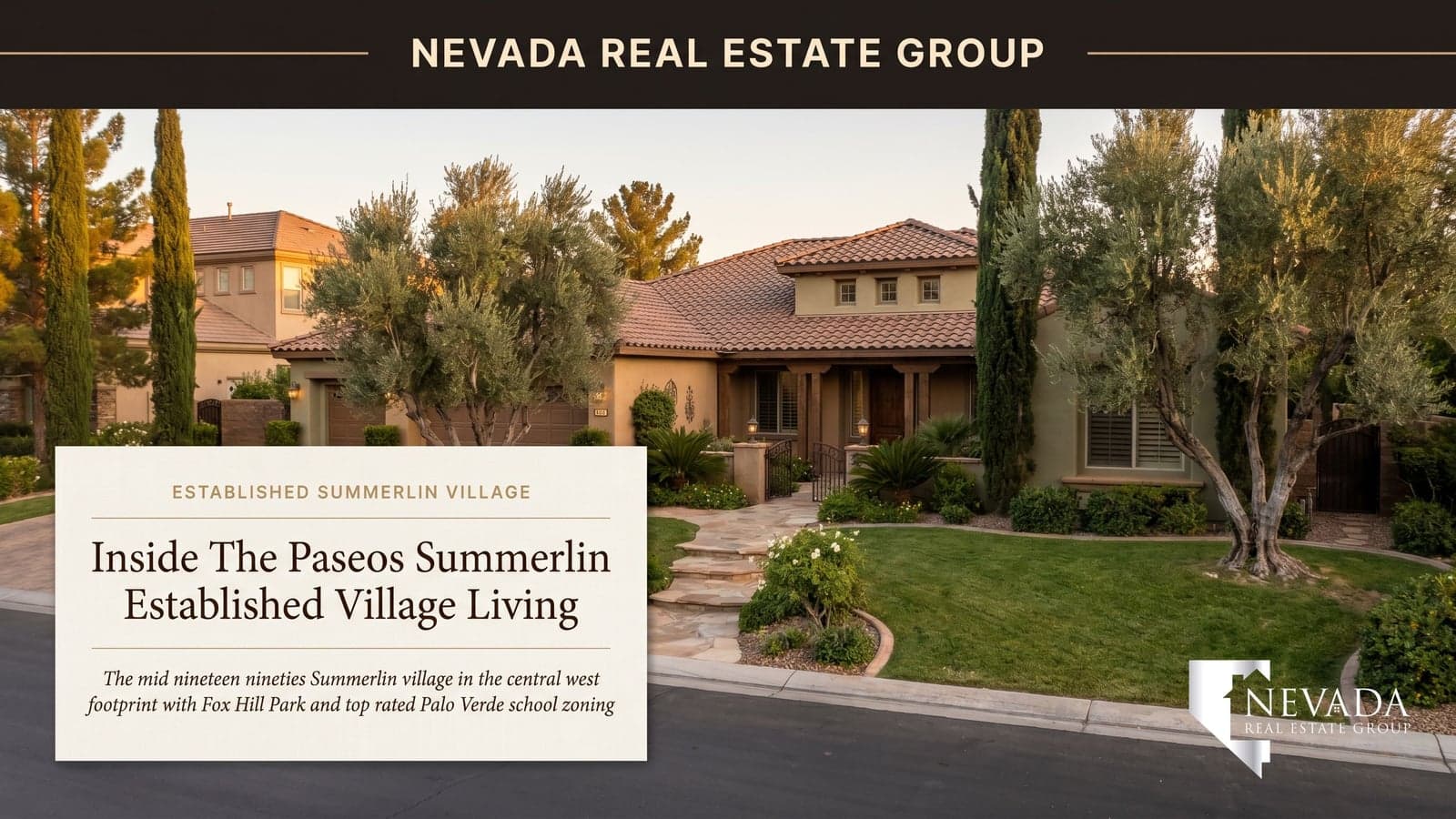

Spanish Trail is the original Las Vegas guard-gated luxury master-planned community — 640 acres in the central-west valley anchored by the Spanish Trail Country Club's 27-hole Robert Trent Jones Sr. golf course, established in 1979 by Howard Hughes Properties (the original Hughes Las Vegas holdings, separate from the later Howard Hughes Corporation Summerlin development). Spanish Trail predates every other major guard-gated luxury master plan in the metro area — Peccole Ranch's Queensridge (1995), Seven Hills's gated enclaves (1995-2007), and Summerlin's gated villages (1990s-2010s) all came later. The community is fully built-out with approximately 750 single-family estate homes across 16 named villages developed between 1979 and 1995, with no remaining master-developer new construction and a steady but small inventory of teardown-rebuild custom-build activity on premium lots.
What separates Spanish Trail from the other central-west and western Las Vegas guard-gated luxury enclaves — Queensridge, Canyon Gate, the Summerlin Ridges — is the 45-year established neighborhood tenure plus the integrated private country club. Spanish Trail has the kind of mature 40-plus-year landscape canopy (Italian cypress, mature olive trees, established hedge walls) that newer luxury communities will take decades to develop. The Spanish Trail Country Club operates as a fully-private member-only club (initiation fees plus monthly dues) with 27 holes of original Robert Trent Jones Sr. championship golf, full clubhouse facilities, tennis, swimming, and the kind of traditional country-club social culture that distinguishes Spanish Trail from the more contemporary mixed-use developments that came after. Home prices in 2026 run from approximately $700,000 to over $5 million, with the median 2026 closing landing around $1,050,000.
This guide is the buyer-side map for Spanish Trail in 2026: how the community is organized into 16 named villages and price tiers, what the Spanish Trail Country Club offers as the de facto resident amenity, what the architectural character looks like, what the school cluster is, what HOA dues run, what the resale market is doing in 2026, and how Spanish Trail compares head-to-head against the other central-west and western Las Vegas guard-gated luxury options. Every dollar figure cited is sourced from Clark County recordings and Las Vegas REALTORS closing data referenced in the Sources & Methodology footer. The phone number throughout — (702) 637-1759 — connects to our Spanish Trail specialist team at Nevada Real Estate Group.
Spanish Trail is the original Las Vegas guard-gated luxury master-planned community — 640 acres in the central-west valley anchored by the Spanish Trail Country Club's 27-hole Robert Trent Jones Sr. golf course, established in 1979 by Howard Hughes Properties. The community contains approximately 750 single-family estate homes across 16 named villages built between 1979 and 1995. Home prices in 2026 run from approximately $700,000 for established resale up to over $5 million for the largest custom estates, with the median 2026 closing around $1,050,000. The Spanish Trail Country Club is a fully-private member-only club with initiation fees and monthly dues; club membership is optional, not required. School cluster includes Bryan Elementary (7 out of 10 GreatSchools), Becker Middle School (7 out of 10), and Bonanza High School (6 out of 10). HOA dues run approximately $275 to $425 per month combined depending on village. The drive to the Las Vegas Strip is approximately 12 to 17 minutes via Tropicana Avenue or Flamingo Road.
- Spanish Trail covers 640 acres in central-west Las Vegas with approximately 750 single-family estate homes across 16 named villages — the original 1979 guard-gated luxury master plan.
- The Spanish Trail Country Club is a private member-only club with a 27-hole Robert Trent Jones Sr. championship golf course, full clubhouse, tennis, and swimming.
- Architectural character is Mediterranean and Spanish revival custom-build — consistent with the 1979-to-1995 build-out window and the master plan's original architectural review framework.
- Home prices in 2026 run from approximately $700,000 for established resale up to over $5 million for largest custom estates; median closing approximately $1,050,000.
- Club membership is optional, not required for homeownership — initiation fees run approximately $75,000 to $125,000 with monthly dues approximately $1,200 to $1,800 for full golf membership.
- HOA dues run approximately $275 to $425 per month combined depending on village — the master Spanish Trail Community Association fee plus village-specific sub-association fees.
- The drive to the Las Vegas Strip is approximately 12 to 17 minutes via Tropicana Avenue or Flamingo Road — among the closest gated luxury enclaves to the Strip.
What exactly is Spanish Trail in 2026?
Spanish Trail is a master-planned, fully guard-gated luxury single-family residential community in central-west Las Vegas, anchored by the Spanish Trail Country Club's 27-hole golf course at the community's geographic and amenity center. The total footprint covers approximately 640 acres with approximately 750 single-family estate homes at full build-out across 16 named villages developed sequentially between 1979 and 1995. The community is fully built-out with no remaining master-developer new construction — all 2026 activity is resale, plus occasional teardown-rebuild on premium lots and slow steady custom build activity on a handful of remaining undeveloped lots inside the original entitlement.
According to the Nevada Secretary of State and historical Las Vegas planning records, Spanish Trail was entitled by Howard Hughes Properties (the original Hughes Las Vegas land holdings, predating the later Howard Hughes Corporation that developed Summerlin) in 1978 with the first model homes opening in 1979. The community's master-developer history is intertwined with the Hughes Las Vegas property portfolio of the late 1970s. Spanish Trail sits inside Las Vegas city limits, served by Las Vegas Metropolitan Police Department, City of Las Vegas Fire & Rescue, and the Clark County School District.
Where is Spanish Trail and why does the central-west valley positioning matter?
Spanish Trail sits in the central-west Las Vegas valley along Tropicana Avenue between Buffalo Drive and Rainbow Boulevard, with the broader Spring Valley residential corridor extending east and the Peccole Ranch master plan extending north. The community is reached via Tropicana Avenue from I-15 (approximately 6 minutes east) or via Rainbow Boulevard from the Beltway (I-215, approximately 4 minutes south). The main guard-gated entry sits at Hidden Trail Drive off Tropicana Avenue, with secondary entries off Buffalo Drive and Rainbow Boulevard.
The drive to the Las Vegas Strip from Spanish Trail runs approximately 12 to 17 minutes during off-peak hours via Tropicana Avenue or Flamingo Road east to I-15. Harry Reid International Airport is approximately 15 to 19 minutes via the same corridors plus I-15. This positions Spanish Trail among the closer guard-gated luxury communities to the Strip and airport — meaningfully closer than the Summerlin Ridges (22 to 28 minutes) and slightly farther than Queensridge (10 to 15 minutes). According to recent Las Vegas traffic studies, the Tropicana Avenue corridor between Spanish Trail and I-15 handles approximately 72,000 daily vehicle trips. The central-west position also places Spanish Trail equidistant from the Strip corridor (east), Summerlin commercial nodes (north), and Henderson (southeast) — a meaningful practical lifestyle advantage for residents who travel across multiple Las Vegas valley submarkets regularly.
What sub-villages make up Spanish Trail?
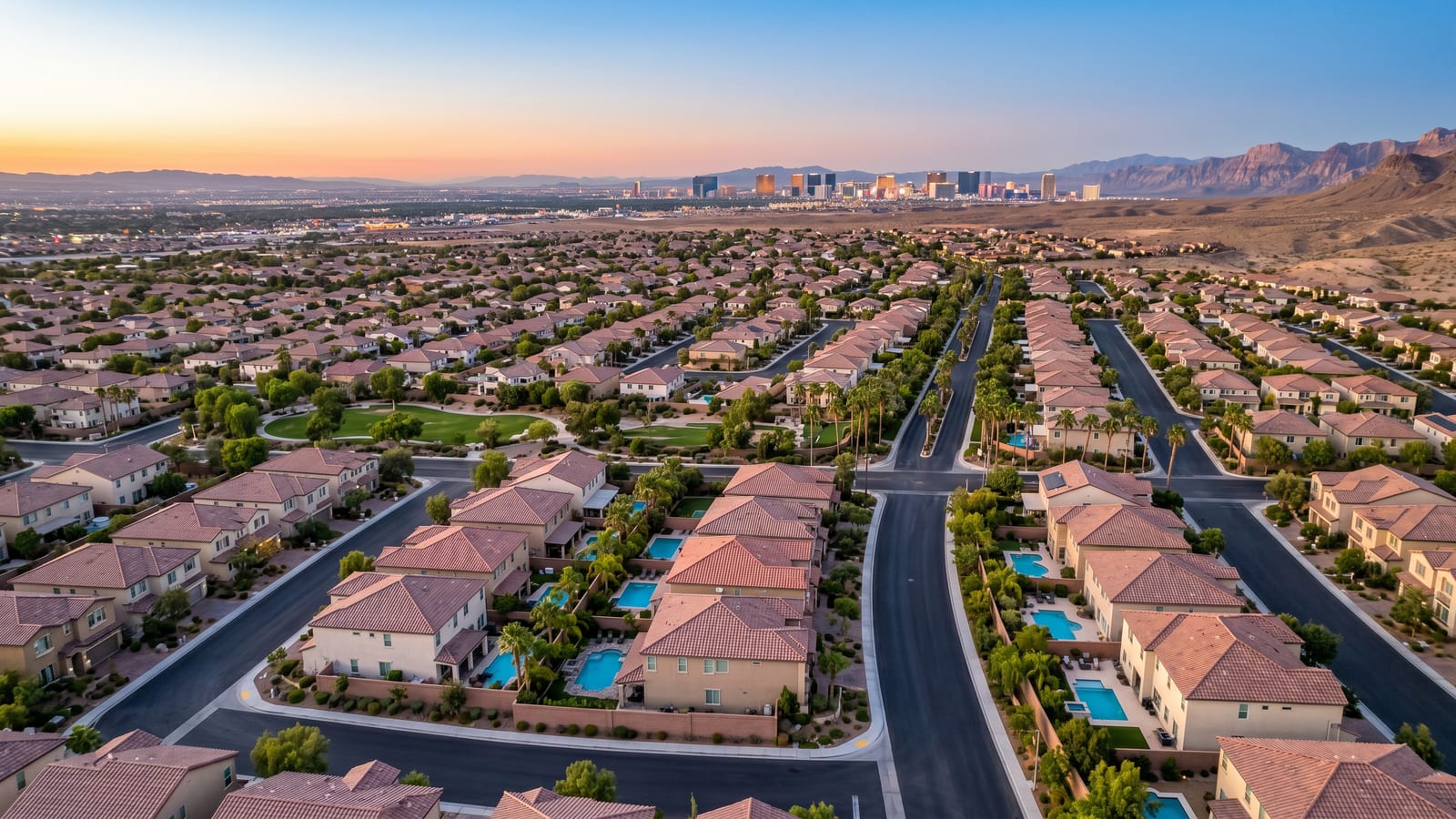
Spanish Trail is organized internally into approximately 16 named villages, each developed in a specific Howard Hughes Properties builder-program phase between 1979 and 1995. Unlike newer luxury master plans where single production builders typically built entire sub-sections, Spanish Trail's villages were primarily custom-build pocket developments served by multiple custom builders working from a Hughes Properties-approved architectural review framework. The largest by lot count are Estancia (the central-section primary estate area), Pueblo (the early-phase 1979-1985 village with the most mature landscape canopy), Vineyards (the mid-phase 1986-1990 village with larger lots), San Lorenzo (the elevated north-edge premium village), La Manda (the established mid-tier village near the country club), Las Brisas (an entry-tier 1990s-vintage village), San Rafael (a smaller gated-within-gated cul-de-sac of approximately 28 custom estates), and several smaller named pocket developments.
The table below summarizes the broad village tiers, their approximate 2026 price ranges, and characteristic notes. Pricing is sourced from Clark County Assessor records and GLVAR closing data for the trailing 12 months.
| Village | Price range (2026) | Style | Notes |
|---|---|---|---|
| San Rafael (gated cul-de-sac) | $2.15M to $5M+ | Mediterranean / Spanish custom | Premium 28-lot gated-within-gated village |
| San Lorenzo | $1.45M to $3.25M | Mediterranean custom | Elevated north-edge premium lots |
| Estancia | $1.05M to $2.35M | Mediterranean / Spanish revival | Central-section primary estate area |
| Vineyards | $985K to $1.85M | Mediterranean / Tuscan | Larger 1986-1990 vintage lots |
| Pueblo | $895K to $1.65M | Spanish revival / Pueblo | Original 1979-1985 phase, mature canopy |
| La Manda | $825K to $1.45M | Mediterranean | Established mid-tier near country club |
| Las Brisas | $745K to $1.15M | Mediterranean | Entry-tier 1990s-vintage village |
| Various smaller villages | $700K to $1.95M | Mixed custom | Pocket developments throughout |
Across all villages, the median 2026 closed sale at Spanish Trail runs approximately $1,050,000 per LVR data — comparable to other central-west guard-gated luxury communities and meaningfully above the broader central-west Las Vegas median of approximately $475,000. The luxury tier (closings above $1.5 million) represents approximately 26 percent of transaction count but approximately 49 percent of total dollar volume across the community.
What is the Spanish Trail Country Club?
The Spanish Trail Country Club is a fully-private member-only club with 27 holes of championship golf designed by Robert Trent Jones Sr. — one of the most decorated American golf course architects of the twentieth century. The course opened in 1980 as one of the original anchor amenities of the Spanish Trail master plan, and the three nine-hole loops (Sunrise, Lakes, Canyon) provide 27 holes of championship play that can be configured into three different 18-hole combinations depending on the day.
According to published club materials, the Spanish Trail Country Club operates with approximately 425 active member households across multiple membership categories. Full golf membership initiation runs approximately $75,000 to $125,000 with monthly dues approximately $1,200 to $1,800; social/tennis runs approximately $650 to $950 monthly. The club operates a 35,000-square-foot clubhouse with dining, a fitness facility, 10 tennis courts, four pickleball courts (added 2020), a swimming complex with junior swim team, and approximately 180 organized member events annually.
Club membership is optional, not required for Spanish Trail homeownership. Many residents are not members — they purchased for the gated security and central-west location rather than the club. The club has historically maintained a waitlist for full golf membership, though the wait has shortened in recent years as competing newer Las Vegas private clubs (TPC Las Vegas, DragonRidge, SouthShore at Lake Las Vegas, Anthem Country Club, Red Rock Country Club) have expanded inventory.
What is the architectural character of Spanish Trail?
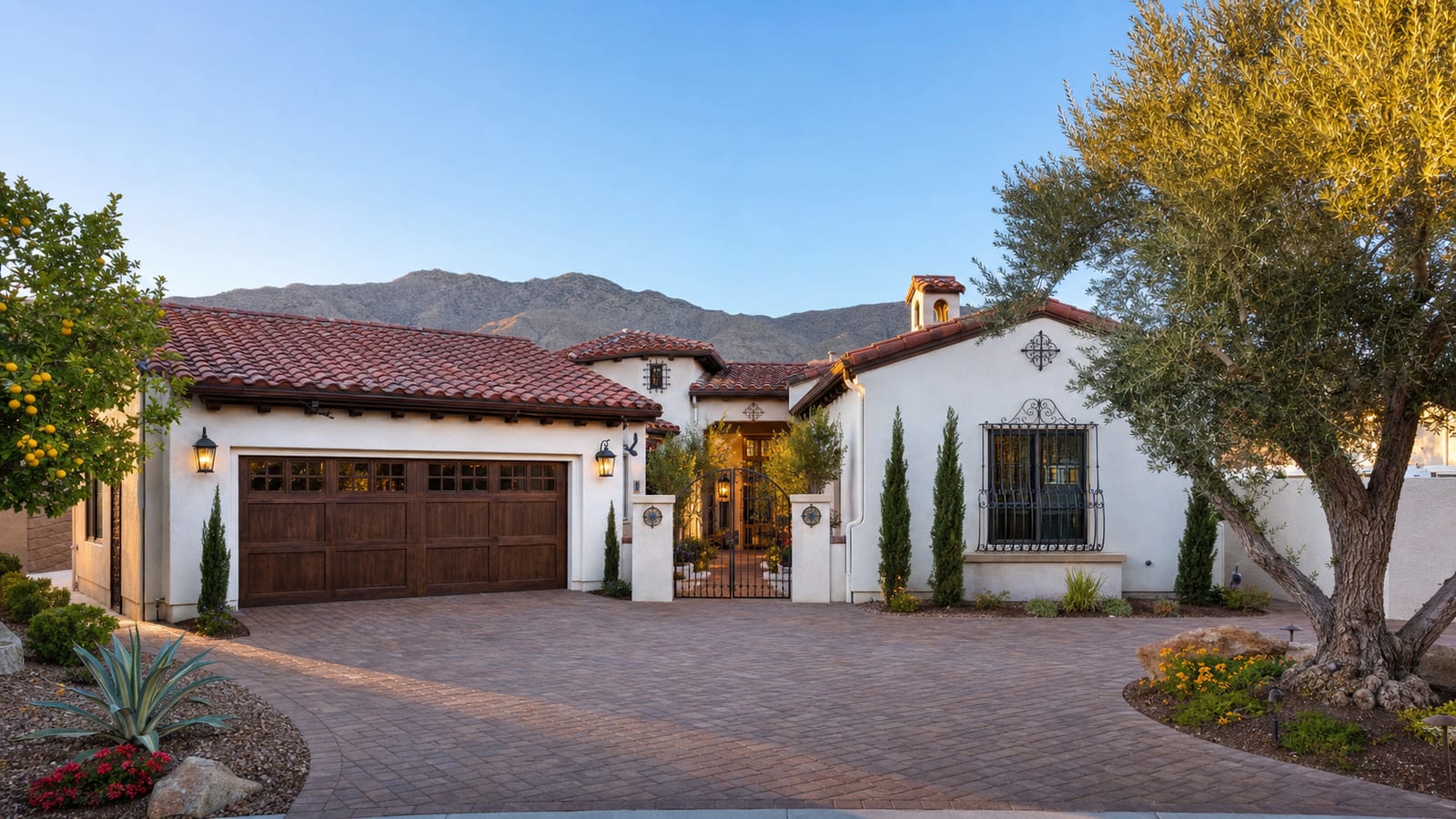
Spanish Trail is solidly in the Mediterranean and Spanish revival vocabulary that defined late-1970s and 1980s Las Vegas luxury custom-build practice. Warm-stucco façades with sandstone, taupe, and terracotta exterior colors; tile (clay barrel) roofs; arched windows and entryways; iron grillwork and tile-detail accents; and a desert-Mediterranean landscape palette emphasizing mature olive trees, Italian cypress, Mediterranean hedge walls, and limited grass primarily in back yards. The architectural review committee enforces this palette uniformly across the community.
What distinguishes Spanish Trail visually from newer central-west luxury communities is the established landscape canopy and the architectural variety across its 45-year build-out window. Pueblo (1979-1985 original phase) has the most mature canopy — Italian cypress and olive trees planted at original construction are now 35-to-45 years old. Vineyards (1986-1990) shows larger floor plans typical of late-1980s Vegas luxury. Estancia (central master section, 1985-1992) shows the broadest architectural range. San Rafael (1991-1995) is the latest vintage with larger lots and more modern interior finishes at original build.
Which schools serve Spanish Trail?
Spanish Trail is zoned to the Clark County School District (CCSD) with a primary feeder pattern to the Bonanza High School cluster: Bryan Elementary School, Becker Middle School, and Bonanza High School. According to GreatSchools.org as of 2026, Bryan Elementary holds a 7 out of 10 rating, Becker Middle School holds a 7 out of 10, and Bonanza High School holds a 6 out of 10. The Bonanza rating is meaningfully below the Palo Verde cluster that serves Summerlin and Queensridge (Palo Verde holds an 8 out of 10) — the school-cluster math is generally the weakest comparison point for Spanish Trail versus peer guard-gated luxury communities.
Many Spanish Trail families enroll their school-age children at private schools to address the public-school-cluster gap. The leading private options include The Meadows School (PreK through 12, A-plus rated, approximately 12 minutes east via Tropicana Avenue), Bishop Gorman High School (the elite Catholic high school, approximately 8 minutes east via Tropicana Avenue and I-15), and Alexander Dawson School (PreK through 8, A-plus rated, approximately 18 minutes north via Town Center Drive). According to recent Nevada Department of Education enrollment data, approximately 32 percent of Spanish Trail school-age children attend private school — notably above the broader central-west Las Vegas average of approximately 14 percent and consistent with the community's traditional luxury-buyer preference for elite private education to compensate for the weaker public cluster.
What HOA dues should buyers expect at Spanish Trail?
HOA dues at Spanish Trail run approximately $275 to $425 per month combined depending on village. The base Spanish Trail Master Community Association fee is approximately $185 to $235 per month — funding the master guard gate, the master security patrol, the master-community landscaping, the architectural review committee, and reserve-fund contributions for major capital infrastructure. Sub-villages add their own internal HOA fees on top, particularly San Rafael (the gated cul-de-sac with its own internal gate) and the cul-de-sac sub-villages with additional internal amenity maintenance.
The table below summarizes approximate combined monthly HOA cost by village. Verify current fees with the Spanish Trail Master Community Association before purchase, as these are subject to change.
| Village | Approximate combined monthly HOA (2026) |
|---|---|
| San Rafael (gated cul-de-sac) | $375 to $425 |
| San Lorenzo | $315 to $375 |
| Estancia | $285 to $335 |
| Vineyards | $275 to $325 |
| Pueblo | $275 to $315 |
| La Manda | $275 to $315 |
| Las Brisas | $275 to $305 |
| Various smaller villages | $285 to $385 |
Country club dues are not included in HOA — full golf membership initiation runs approximately $75,000 to $125,000 with monthly dues approximately $1,200 to $1,800. Spanish Trail's HOA carrying cost is comparable to peer central-west and western Las Vegas guard-gated luxury communities (Queensridge $315 to $585 combined, Canyon Gate $295 to $445 combined). The Spanish Trail HOA structure is slightly simpler than Queensridge's three-layer master + sub-association + cul-de-sac structure because Spanish Trail has fewer internal cul-de-sac sub-associations.
What is the resale market like at Spanish Trail in 2026?
According to LVR (Las Vegas REALTORS) closing data for the trailing 12 months, Spanish Trail recorded approximately 62 closed single-family transactions with a median closed price of approximately $1,050,000 and a median days-on-market of 42 days. The luxury tier — closings above $1.5 million — represented approximately 26 percent of transaction count but approximately 49 percent of total dollar volume. Median price per square foot across the community ran approximately $275 to $355 depending on village, with the premium San Rafael and San Lorenzo villages trading meaningfully higher at approximately $385 to $475 per square foot.
Resale demand at Spanish Trail has been steady through 2026 despite the weaker school-cluster comparison versus peer luxury communities. The community's draws are the established neighborhood tenure (45-plus years of mature landscape and neighborhood character that newer master plans cannot match), the central-west Strip proximity (12 to 17 minutes versus 22 to 28 minutes for Summerlin equivalents), and the private country club (which is a meaningful draw for traditional country-club households even though it operates outside the community's HOA structure). According to recent Clark County Assessor data, approximately 26 percent of Spanish Trail 2026 closings involved out-of-state buyers — comparable to the broader luxury market and consistent with the community's reputation among traditional country-club-oriented relocators.

How does Spanish Trail compare to Queensridge, Canyon Gate, and the Ridges?
Spanish Trail competes most directly with the other central-west and western Las Vegas guard-gated luxury communities. All four communities offer guard-gated entry, custom and semi-custom estate homes, and meaningful resale liquidity at the $1 million-plus tier. The differences are vintage, country-club integration, architectural character, and the specific schools/amenity profile.
| Factor | Spanish Trail | Queensridge | Canyon Gate | The Ridges (Summerlin) |
|---|---|---|---|---|
| Build-out years | 1979-1995 | 1995-2003 | 1989-1998 | 2005-ongoing |
| Total homes | 750 | 987 | ~575 | ~700 |
| Private country club inside | Spanish Trail CC (Robert Trent Jones Sr.) | None | Canyon Gate CC | None |
| Architectural character | Mediterranean / Spanish revival | Mediterranean / Tuscan / European | Mediterranean / Spanish revival | Desert-modern strict |
| Public school cluster | Bonanza HS (6/10) | Palo Verde HS (8/10) | Bonanza HS (6/10) | Palo Verde HS (8/10) |
| Median home price (2026) | $1.05M | $1.275M | $925K | $3.85M |
| Top closing in 24 months | $5.6M | $8.4M | $3.8M | $22M+ |
| Drive to Strip | 12 to 17 minutes | 10 to 15 minutes | 14 to 18 minutes | 22 to 28 minutes |
| Best for | Traditional country-club luxury | Strip-proximity, architectural variety | Country-club at lower entry | Desert-modern ultra-luxury |
In rough generalization: Spanish Trail wins on established neighborhood tenure (oldest at 45-plus years) and the integrated Robert Trent Jones Sr. country club — the choice for traditional country-club households and buyers who specifically value established neighborhood maturity. Queensridge wins on Strip proximity and architectural variety. Canyon Gate wins on country-club access at the lowest entry pricing. The Ridges wins on ultra-luxury desert-modern with the highest ceiling. See Las Vegas guard-gated luxury tier ranking for the broader comparison and the Peccole Ranch master plan guide for context on the neighboring central-west luxury inventory.
What is the 1979-1995 history and why does it matter?
Spanish Trail's place as the original Las Vegas guard-gated luxury master plan has both historical and practical significance. Founded in 1979 by Howard Hughes Properties as the first major guard-gated luxury residential development in the metro area, Spanish Trail predates Summerlin (1990 master-developer commercial launch by the later Howard Hughes Corporation), Peccole Ranch (1989 entitlements, mid-1990s build-out), Anthem and Sun City Anthem (1998), and every other major luxury master plan in the valley.
According to historical Las Vegas planning records, Spanish Trail introduced several concepts that became standard in subsequent Las Vegas luxury development: layered guard-gated security with both master and sub-section entries, integrated private country club as an anchor amenity, and the master-association-plus-sub-association HOA structure now standard across Las Vegas luxury master plans. The community served as the destination of choice for late-1970s and 1980s casino executives, entertainment-industry residents, and the original generation of California-relocator luxury buyers — giving Spanish Trail a long-tenured neighborhood character no newer community can replicate.
What lifestyle amenities does the central-west location offer Spanish Trail residents?
Beyond the Spanish Trail Country Club and the community's internal gated security, Spanish Trail residents have access to the full central-west Las Vegas commercial and entertainment infrastructure. The community sits within 5 to 10 minutes of multiple major commercial corridors: the Tropicana Avenue retail and dining corridor immediately south, the Flamingo Road retail corridor approximately 3 minutes north, and the broader West Sahara commercial corridor approximately 5 minutes north. The Boulevard Mall, Downtown Summerlin (approximately 14 minutes north via Pavilion Center Drive), and the Las Vegas Strip corridor (12 to 17 minutes east) all provide major retail, dining, and entertainment options within a reasonable drive.
The Suncoast Hotel and Casino (approximately 6 minutes north on Rampart Boulevard) provides walkable-distance entertainment access. Summerlin Hospital Medical Center (approximately 12 minutes north via Pavilion Center Drive) is the closest full-service hospital. The Las Vegas Beltway (I-215) runs approximately 4 minutes south of the community, providing direct freeway access to the Strip corridor, Henderson, and Harry Reid International Airport. The combination of Strip proximity (12 to 17 minutes), country-club access, mature 45-plus-year neighborhood tenure, and full central-west commercial infrastructure defines the practical lifestyle profile that Spanish Trail offers versus more remote or newer luxury alternatives.
What about country club membership for Spanish Trail residents?
The Spanish Trail Country Club operates as a fully-private, member-only club separate from the community's HOA. Membership is optional, not required for homeownership — many residents are not members. The membership tiers:
- Full Golf Membership — Initiation approximately $75,000 to $125,000, monthly dues approximately $1,200 to $1,800. Unlimited 27-hole golf plus all clubhouse amenities.
- Social/Tennis Membership — Initiation approximately $25,000 to $45,000, monthly dues approximately $650 to $950. Clubhouse, tennis, swimming, events — no golf access.
- Junior Executive Membership — Reduced-rate program for members under 40 with initiation approximately $35,000 to $55,000 transitioning to full-rate at age 40.
The membership profile skews traditional in 2026. The club has historically maintained a waitlist for full golf membership, though the wait has shortened as competing newer Las Vegas private clubs have expanded inventory. Verify current category availability with the club before submitting an offer if club access is part of the purchase calculus.
Frequently Asked Questions
What is the full price range across Spanish Trail in 2026?
Approximately $700,000 for the smallest established resale homes in entry-tier villages (Las Brisas and the smaller pocket developments) up to over $5 million for the largest custom estates in San Rafael. The median 2026 closing sits at approximately $1,050,000 per LVR data, with the luxury tier above $1.5 million representing approximately 26 percent of transaction count and 49 percent of total dollar volume.
Is country club membership required to buy in Spanish Trail?
No. Country club membership is optional, not required for Spanish Trail homeownership. Many Spanish Trail residents are not country club members — they purchased the home for the gated security and central-west location rather than the country club access. For buyers who do want club access, the membership categories range from social/tennis ($25,000 to $45,000 initiation) to full golf ($75,000 to $125,000 initiation).
How do Spanish Trail's schools compare to peer luxury communities?
The standard CCSD zoning is Bryan Elementary (7 out of 10 GreatSchools rating), Becker Middle School (7 out of 10), and Bonanza High School (6 out of 10). The Bonanza rating is meaningfully below the Palo Verde HS cluster (8 out of 10) that serves Summerlin and Queensridge. Approximately 32 percent of Spanish Trail school-age children attend private school — notably above the central-west average and consistent with the community's traditional luxury-buyer preference for elite private education.
How does Spanish Trail HOA compare to other gated-luxury communities?
Spanish Trail combined HOA runs approximately $275 to $425 monthly across the major villages. This is comparable to Canyon Gate ($295 to $445), slightly below Queensridge ($315 to $585), and notably below The Ridges in Summerlin ($395 to $625). The Spanish Trail HOA structure is slightly simpler than peer communities because there are fewer internal cul-de-sac sub-associations layered on top of the master HOA.
Are there famous or celebrity residents at Spanish Trail?
Spanish Trail has long been a residence of choice for entertainment-industry, professional-athlete, and casino-executive buyers since the early 1980s. Resident identities are not disclosed by the Master Community Association, and most high-profile residents purchase through LLC or trust entities. The community has a long-standing reputation as one of the original celebrity and entertainment-industry residential corridors in the broader Las Vegas market.
How does Spanish Trail compare to Queensridge for buyers?
Both are central-west guard-gated luxury communities at roughly comparable price tiers. Spanish Trail offers older established tenure (45-plus years vs Queensridge's 25-to-30 years), an integrated private country club, and Bonanza HS cluster zoning. Queensridge offers Palo Verde HS cluster (8/10 vs Bonanza's 6/10), slightly closer Strip access (10-15 min vs Spanish Trail's 12-17), broader architectural variety, and no integrated club. Buyers who specifically want a country-club community choose Spanish Trail; buyers who prioritize school cluster ratings choose Queensridge.
How long is the commute from Spanish Trail to the Strip and the airport?
The drive to the Las Vegas Strip runs approximately 12 to 17 minutes via Tropicana Avenue or Flamingo Road east to I-15. Harry Reid International Airport is approximately 15 to 19 minutes via the same corridors plus I-15. Spanish Trail is meaningfully closer to both the Strip and the airport than Summerlin's western villages (which run 22 to 28 minutes) and slightly farther than Queensridge (10 to 15 minutes).
Which Sources Inform This Spanish Trail Guide?
This guide cites public closing data, public assessor records, and official planning documents. The full inline-citation set:
- Las Vegas REALTORS (LVR) — MLS closing data, monthly market reports, and trailing-12-month median price data for Spanish Trail and the central-west Las Vegas luxury market.
- Clark County Assessor — public parcel and sale records for Spanish Trail villages.
- City of Las Vegas — historical planning records and traffic studies for the central-west valley corridor.
- Nevada Secretary of State — business entity filings used to verify the Howard Hughes Properties (1979 master-developer) ownership history.
- U.S. Census Bureau — population estimates for the City of Las Vegas underlying the demographic context.
- GreatSchools — current ratings for Bryan Elementary, Becker Middle, and Bonanza High School.
- Nevada Department of Education — public versus private enrollment data underlying the school-choice context.
- Federal Housing Finance Agency (FHFA) — Las Vegas-Henderson-Paradise MSA House Price Index, referenced for the central-west luxury appreciation history.
- Nevada Department of Taxation — property tax assessment methodology applied to Spanish Trail residences.
- Nevada Revised Statutes — NRS 361.4722 (the 3 percent annual primary-residence property-tax cap that applies across the community).
- Bureau of Labor Statistics (BLS) — Las Vegas metro area employment data underlying the broader buyer-demand context.
- Spanish Trail Country Club historical materials — published membership category data and Robert Trent Jones Sr. course-design context.
For Spanish Trail resale questions, village-specific recommendations, country club membership context, or a private tour of any village, call Nevada Real Estate Group at (702) 637-1759 or visit the Spanish Trail community page for the full village directory and current active listings. Related reading: the Queensridge gated estates buyer's guide, the Peccole Ranch master plan guide, and the Las Vegas guard-gated luxury tier ranking.