
Published May 11, 2026 · Updated May 11, 2026 · By Chris Nevada, Nevada Real Estate Group · NV License S.181401
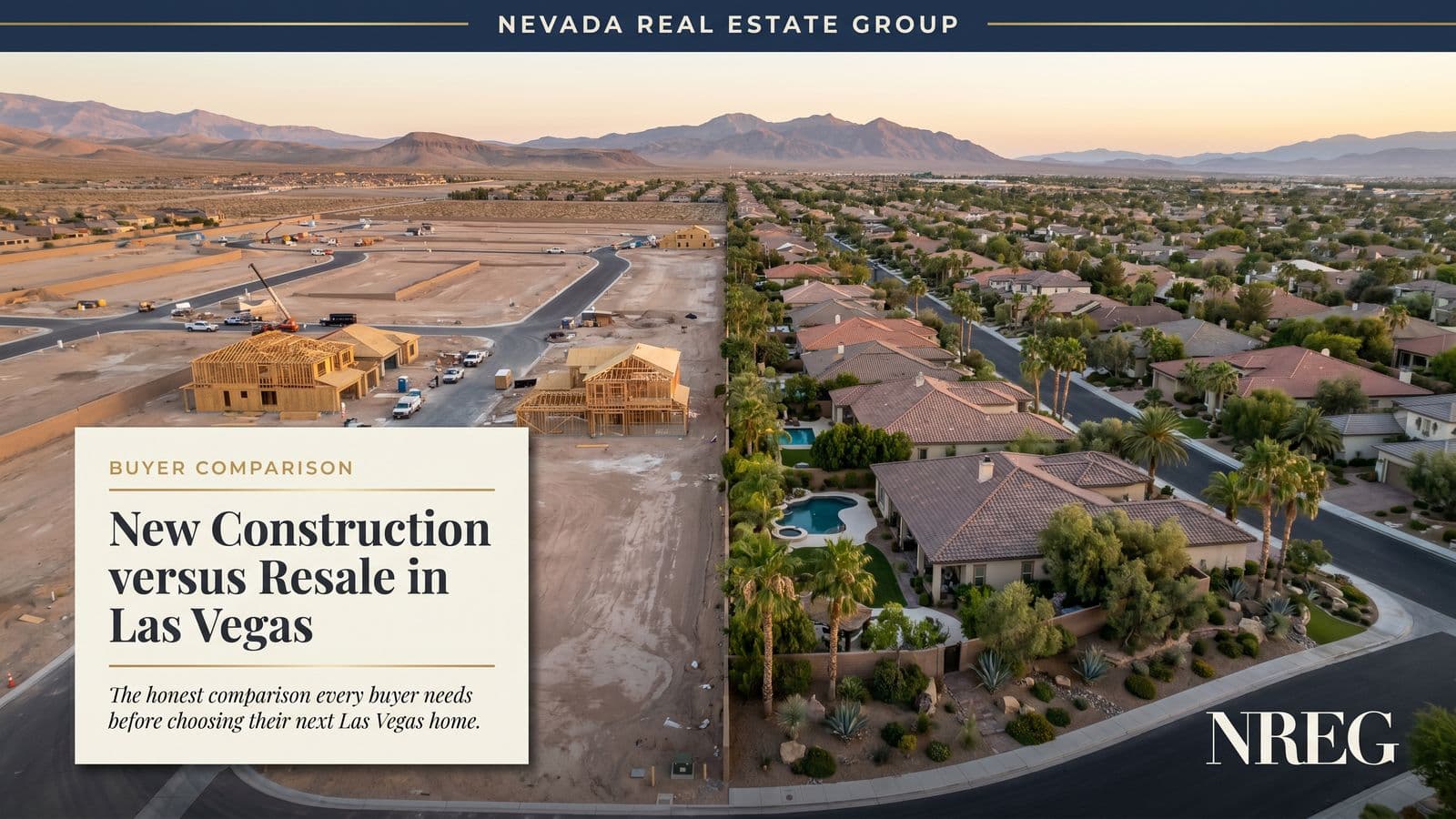
Direct Answer: New construction homes in Las Vegas typically command a 10-15% pricing premium over comparable resale homes in similar neighborhoods. The premium delivers genuine value — full 1/2/10 builder warranty, modern construction with energy efficiency, ability to customize through the design center, builder incentive packages worth $15,000-$35,000, and zero deferred maintenance. But the premium isn't right for every buyer. First-time buyers prioritizing immediate occupancy with established mature neighborhoods typically benefit from resale. Move-up families wanting customization, fresh systems, and warranty coverage typically benefit from new construction. Investors split based on rental property economics. Retirees split based on aging-in-place priorities and timeline flexibility. The decision matrix is not "new construction is always better" or "resale is always cheaper" — it depends on specific buyer priorities, hold horizon, and willingness to wait for the 9-11 month new construction timeline. This guide covers the complete decision framework with specific scenarios.
Key Takeaways
- New construction in Las Vegas typically commands 10-15% pricing premium over comparable resale
- Premium delivers: full warranty, modern systems, customization, incentives, zero deferred maintenance
- First-time buyers needing immediate occupancy: typically favor resale
- Move-up families wanting customization: typically favor new construction
- Investors: split based on rental economics (resale often wins on cash-flow yield)
- Retirees: split based on aging-in-place priorities (new construction often wins)
- New construction premium typically recovers at resale on 5-7 year holds
- Resale advantages: established neighborhood, mature landscaping, faster close
- New construction advantages: warranty, customization, incentives, modern energy efficiency
- Buyer representation pays for itself regardless of new vs resale choice
What Is the Typical New Construction Premium in Las Vegas?
The premium isn't a single number — it varies by community, price tier, and specific home characteristics. Understanding the typical range helps calibrate expectations.
Pricing premium analysis. A 2,400 sq ft 4-bedroom new construction home in mid-tier Henderson production typically prices $625,000. A comparable 2,400 sq ft 4-bedroom resale home in the same neighborhood built 7-12 years ago typically sells $545,000-$575,000. The premium: $50,000-$80,000, or approximately 9-14% above comparable resale.
Premium variation by market tier.
| Market Tier | New Construction Premium | Reasons |
|---|---|---|
| Entry production ($395K-$575K) | 8-12% above comparable resale | Lower builder margins, sharper resale comp |
| Mid production ($575K-$900K) | 10-15% above comparable resale | Standard production premium |
| Production luxury ($900K-$1.5M) | 12-18% above comparable resale | Higher customization value |
| Semi-custom luxury ($1.5M-$3M) | 15-25% above comparable resale | Significant design participation |
| Custom luxury ($3M+) | 20-40%+ above comparable resale | Full design customization |
Why the premium exists. The premium represents the genuine value differential delivered by new construction:
-
Full warranty. 1-year comprehensive, 2-year systems, 10-year structural. Resale homes typically have no warranty unless the seller purchased a transferable home warranty.
-
Modern construction efficiency. New construction meets current Nevada energy codes and often exceeds them. Operating costs typically 15-30% lower than 10-15 year old resale homes.
-
Zero deferred maintenance. New homes have no aging HVAC requiring replacement, no aged roof, no plumbing fixtures showing wear, no outdated electrical, no flooring showing wear. Resale homes carry varying levels of deferred maintenance.
-
Customization potential. New construction buyers select cabinets, countertops, flooring, fixtures, layout configurations, structural options. Resale buyers inherit the previous owner's choices.
-
Builder incentive packages. Las Vegas builders offer $15,000-$35,000+ in closing credits, design center allowances, rate buydowns, and free upgrade packages. Resale homes don't carry equivalent incentive packages.
-
Modern aesthetics. Current design trends, current finishes, fresh paint, contemporary fixtures.
The premium reflects real value. The question for each buyer: does the value match their specific priorities?
When Does New Construction Win for First-Time Buyers?
First-time buyers face several specific factors that affect the new construction vs resale decision.
When new construction wins for first-time buyers.
Scenario 1: Builder incentive package exceeds new construction premium. When standing inventory builder incentives reach $20,000-$30,000+ on a $475,000 home, the effective premium over comparable resale drops to near zero. First-time buyers can capture new construction quality at near-resale pricing.
Scenario 2: Builder offers full FHA/conventional financing flexibility. First-time buyers using 3.5% FHA or 5% conventional financing benefit from builders who don't require unusually high credit scores or down payments. Most major Las Vegas builders accept standard first-time buyer financing.
Scenario 3: Builder offers attractive rate buydown. 2-1 rate buydowns delivering $400-$600/month in year-1 payment relief can bridge first-time buyers' early-year cash flow constraints. The resale market doesn't typically offer equivalent rate concessions.
Scenario 4: Buyer plans 5+ year hold. New construction premium recovers at resale on 5-7 year holds in most cases. First-time buyers planning long-term residence benefit from new construction even at premium pricing because they capture the appreciation tailwind from continued community build-out.
When resale wins for first-time buyers.
Scenario 1: Immediate occupancy required. Resale homes typically close in 30-45 days vs 9-11 months for build-to-order new construction. First-time buyers with constrained timelines (lease ending, school enrollment, job start) favor resale.
Scenario 2: Budget-tight buyers. Resale homes price 10-15% below comparable new construction. Budget-constrained first-time buyers may prefer the lower entry pricing of resale even with the trade-offs (older systems, deferred maintenance, less customization).
Scenario 3: Mature neighborhood priority. First-time buyers prioritizing established neighborhood character with mature landscaping, established neighbors, and stable community dynamics favor resale.
Scenario 4: Want specific older floor plan characteristic. Some older Las Vegas floor plans (specific 1990s-2000s designs) have characteristics buyers prefer over contemporary new construction floor plans. Open kitchen connections, specific room sizes, particular outdoor living configurations.
Practical decision framework for first-time buyers. Most first-time buyers benefit from comparing 2-3 specific new construction options against 2-3 specific resale options at similar price points in similar neighborhoods. The decision typically becomes clear after seeing actual properties rather than evaluating abstractly. Nevada Real Estate Group helps first-time buyers structure this comparison.
When Does New Construction Win for Move-Up Families?
Move-up families (upgrading from starter homes to larger family-oriented homes) face different dynamics than first-time buyers.
When new construction wins for move-up families.
Scenario 1: Customization desire is strong. Move-up families upgrading often have specific requirements based on family growth — additional bedrooms, larger garages, specific outdoor configurations, dedicated office spaces. New construction's customization through the design center addresses these specific requirements better than resale.
Scenario 2: Warranty protection valued. Families investing $500K-$1M in family home want protection against systems failures. The 1/2/10 warranty (detailed in our Nevada warranty guide) provides genuine protection during the early years of family home ownership.
Scenario 3: Selling current home and timing works. Move-up families selling current homes can coordinate timing with new construction build cycles. Sell current home month 6-7 of the new construction build, close on Las Vegas new construction at month 9-11. The 9-11 month timeline can work if planned correctly.
Scenario 4: Children need to start in new schools at specific time. New construction's predictable close timing (when properly planned with broker representation) helps families align with school year starts. Resale homes can have less predictable close timing depending on seller circumstances.
Scenario 5: Family wants specific community character. New master plans like Cadence, Inspirada, Skye Canyon, and Meriden offer master amenity infrastructure, modern community design, and family-oriented programming. Move-up families often prioritize these community characteristics.
When resale wins for move-up families.
Scenario 1: Family needs immediate move-in for school enrollment. If the school enrollment deadline is within 6 months and the family hasn't started the new construction process, resale is often the only realistic option.
Scenario 2: Specific established neighborhood priority. Move-up families who want to remain in specific established Las Vegas neighborhoods (older Summerlin villages, Anthem, Seven Hills) typically need resale since new construction inventory is limited in these built-out areas.
Scenario 3: Larger lot priority. Resale homes often offer larger lots than current new construction inventory because original construction occurred when land was less expensive. Move-up families wanting yards for play areas, pools, gardens, or outdoor entertaining sometimes find better lot inventory in resale.
Scenario 4: Avoid landscape installation hassle. Resale homes come with mature landscape already installed. As discussed in our HOA landscape requirements guide, new construction buyers face $10K-$25K in landscape installation costs plus the time investment in coordinating the work. Resale homes avoid this entirely.
When Does New Construction Win for Investors?
Investors evaluating Las Vegas rental property face a distinctive cost-benefit analysis around new construction vs resale.
When new construction wins for investors.
Scenario 1: Long-term hold strategy. Investors planning 10-20+ year holds benefit from new construction's longer warranty protection and lower deferred maintenance during the critical early ownership years. The 10-year structural warranty extends into the holding period.
Scenario 2: Premium rental positioning. Investors targeting premium rental tenants who want modern construction quality and energy efficiency benefit from new construction. Premium tenants pay $200-$400/month above comparable resale rentals for new construction features.
Scenario 3: Builder incentive captures. Large builder incentive packages on standing inventory can shift new construction economics for investors. A $30,000 incentive on a $500,000 home represents 6% effective discount, sometimes making new construction more economic than comparable resale.
Scenario 4: Tax efficiency from depreciation. New construction allows depreciation calculation on the full new construction cost. Resale homes get depreciation based on the structure portion (excluding land), which can be lower depending on local land valuation. Some investors prefer the depreciation simplicity of new construction.
When resale wins for investors.
Scenario 1: Pure cash-flow yield optimization. Resale homes price 10-15% below new construction with comparable rental income potential. The 10-15% lower acquisition cost translates directly to higher cash-flow yield on equity. Investors prioritizing cash-flow yield typically prefer resale.
Scenario 2: Faster deployment of capital. Resale closes 30-60 days; new construction takes 9-11 months. Investors looking to deploy capital quickly favor resale.
Scenario 3: Established rental track record. Resale homes in established neighborhoods have known rental track records based on neighboring rental activity. New construction in new master plans has less established rental market data, requiring more market projection.
Scenario 4: Lower vacancy risk. Resale homes in established neighborhoods have known tenant pools. New construction in newer communities sometimes experiences slower initial leasing as the community's tenant market establishes.
Sample investment math comparison.
| Factor | $500K New Construction | $445K Comparable Resale |
|---|---|---|
| Purchase price | $500,000 | $445,000 |
| Down payment (25%) | $125,000 | $111,250 |
| Monthly rental income | $2,650 | $2,500 |
| Monthly P&I (75% LTV at 7.25%) | $2,562 | $2,278 |
| Monthly property tax/insurance | $480 | $445 |
| Monthly HOA | $135 | $115 |
| Net monthly cash flow | -$527 | -$338 |
| Cash-on-cash yield | -5.1% | -3.6% |
| Annual depreciation tax shield | $14,500 | $12,800 |
Both scenarios show negative cash flow at current rates and prices — typical of Las Vegas rental investments in 2026. The resale option shows less negative cash flow (-$338 vs -$527) and better cash-on-cash yield. Investors prioritizing cash flow optimization should favor resale; investors prioritizing depreciation tax efficiency and long-term appreciation may favor new construction.
When Does New Construction Win for Retirees?
Retirees and active adult buyers face their own distinctive decision factors around new construction vs resale.
When new construction wins for retirees.
Scenario 1: Aging-in-place priority. New construction allows specific aging-in-place customization — single-story configurations, primary suite-first layouts, wider doorways, walk-in showers, lower-step entries, easier garage access. Resale homes built 15-25+ years ago typically weren't designed with aging-in-place priorities.
Scenario 2: Energy efficiency for fixed-income retirees. Lower operating costs from new construction's improved energy efficiency matter more for fixed-income retirees than for working-age buyers. $50-$100 per month in lower utility costs represents meaningful protection of retirement income.
Scenario 3: 55+ community access. Most active adult 55+ communities like Heritage at Stonebridge, Regency at Summerlin, and Esplanade at Red Rock are new construction communities. Retirees seeking the active adult lifestyle infrastructure must purchase new construction in these communities.
Scenario 4: Warranty protection during early retirement years. The early years of retirement are critical to long-term retirement security. Warranty protection during these years protects against unexpected home maintenance costs that could affect retirement income planning.
Scenario 5: Move-down right-sizing. Retirees right-sizing from larger family homes often want specific smaller home configurations. New construction offers floor plans optimized for empty nesters and retirees that older resale inventory may not match.
When resale wins for retirees.
Scenario 1: Immediate move desired. Many retirees have specific timing — selling current family home, completing one phase of life and starting the next. Resale's 30-45 day close matches retirement transition timing better than new construction's 9-11 month timeline.
Scenario 2: Maintenance flexibility. Retirees with strong DIY skills and time to handle home maintenance themselves may not value the warranty protection that justifies the new construction premium. They can purchase older resale and handle maintenance themselves.
Scenario 3: Specific established community priority. Retirees who specifically want to live in established Las Vegas communities (older Anthem sections, established Sun City Anthem, mature Summerlin villages) typically need resale since new construction inventory is limited in these mature communities.
Scenario 4: Smaller budget after retirement income transition. Some retirees have meaningful budget constraints after retiring. Resale's 10-15% lower pricing matters more for budget-constrained retirees than for working-age buyers.
What Is the Decision Matrix for Different Buyer Types?
A summary decision matrix helps buyers narrow the new construction vs resale decision quickly.
| Buyer Type | New Construction Wins When | Resale Wins When |
|---|---|---|
| First-time buyer | Builder incentives cover premium; 5+ year hold | Immediate move; tight budget; established neighborhood priority |
| Move-up family | Customization important; school timing works; new community priority | School deadline tight; specific established neighborhood; larger lot needed |
| Empty nester | Aging-in-place customization; energy efficiency; 55+ community | Established neighborhood priority; smaller budget; faster move |
| Investor | Long-term hold; premium tenant target; builder incentives | Cash-flow yield optimization; faster capital deployment; known rental track record |
| Retiree | Aging-in-place features; 55+ community access; warranty during early retirement | Immediate move; smaller budget; established community |
| Luxury buyer | Customization priority; modern architecture; warranty | Specific established luxury community; faster transaction; unique character |
| California migrant | Builder incentives stack with migration savings; modern energy efficiency | Established Las Vegas community priority; faster move from California |
| Cash buyer | Builder negotiation power with cash; design center customization | Maximum negotiation leverage on motivated resale sellers |
Practical use. Most buyers fit predominantly into one buyer type but partially into others. The decision matrix helps identify primary considerations while acknowledging secondary factors. Final decision typically involves comparing 2-3 specific new construction options against 2-3 specific resale options to find the right fit.
What Are the Hidden Costs of Each Path?
Both new construction and resale carry hidden costs that buyers should factor into the decision. Understanding these costs prevents post-purchase surprises.
Hidden costs of new construction.
Landscape installation ($10,000-$25,000). As discussed in our HOA landscape requirements guide, most new construction homes deliver with dirt yards requiring buyer-funded landscape installation within HOA timelines.
SID/LID assessments. As discussed in our SID/LID fees guide, many new construction communities carry Special Improvement District assessments adding $1,400-$3,200 annually to property tax bills.
Year 2 property tax shock. As discussed in our Clark County property tax guide, Year 2 property tax often runs 60-110% higher than Year 1 due to the assessor's catch-up to full home valuation.
Design center temptation. Buyers routinely overspend $10,000-$25,000 at design centers on cosmetic upgrades that financed cost much more than aftermarket equivalents.
Builder lender premium. Using the builder's preferred lender typically costs $20,000-$45,000 in extra interest over 30 years compared to outside lenders offering better rates.
Hidden costs of resale.
Deferred maintenance. Resale homes carry deferred maintenance — HVAC requiring replacement, aging roofs, plumbing fixtures showing wear. Year 1-5 resale maintenance often runs $5,000-$25,000 above new construction's comparable period.
Renovation costs. Resale buyers wanting modern aesthetics or specific updates face renovation costs — kitchen renovation $25,000-$75,000, bath renovation $15,000-$40,000, flooring replacement $10,000-$25,000. Costs add up quickly.
Higher energy costs. Older homes typically operate 15-30% less energy efficiently. $50-$100/month higher utility costs equal $6,000-$12,000 over a 10-year hold.
Warranty gap. Resale homes typically have no warranty unless seller purchased transferable home warranty. Major system failures during ownership are buyer's full cost.
Inspection-revealed issues. Resale inspection reports often reveal $5,000-$15,000 in needed repairs that affect negotiation but ultimately become buyer's cost.
Net hidden cost comparison. Both paths carry roughly $20,000-$50,000 in hidden costs that buyers should factor into decisions. New construction hidden costs are typically front-loaded (landscape, design center, year-2 tax shock); resale hidden costs are typically distributed across the hold period (deferred maintenance, renovation, energy costs).
How Does the Decision Change Based on Hold Horizon?
The hold horizon (how long the buyer plans to own the home before selling) materially affects the new construction vs resale decision.
1-3 year hold. Resale typically wins. New construction's customization value, warranty protection, and modern systems benefit primarily during longer holds. Short-hold buyers pay the premium without capturing the full ownership benefit. Plus the 9-11 month new construction timeline can extend much of a 3-year hold.
3-5 year hold. Mixed. New construction works if specific customization is valued or if builder incentives compress the effective premium. Resale works for buyers wanting faster move-in or established neighborhood character.
5-7 year hold. Typically new construction territory. The premium recovers reasonably during this hold period and buyers capture warranty protection, modern systems, and customization value across the meaningful ownership window. This is the most common buyer hold horizon and typically favors new construction.
7-15 year hold. Either works. By year 10-15, new construction-purchased homes look much like comparable resale homes. The original premium has substantially dissipated. Buyers focused on long-term ownership economics can choose either path based on specific priorities.
15+ year hold. Slight preference for resale during initial purchase. Long-hold buyers benefit from older homes (lower entry cost) and capture full market appreciation. New construction's early-years premium isn't load-bearing on long holds.
Hold horizon framework summary.
| Hold Horizon | Typical Best Choice | Why |
|---|---|---|
| 1-3 years | Resale | Premium not recoverable, timeline pressure |
| 3-5 years | Either (mixed) | Depends on specific priorities |
| 5-7 years | New construction | Premium recovers, value captured |
| 7-15 years | Either | Comparable economic outcomes |
| 15+ years | Slight resale | Lower entry cost, full appreciation |
Practical use. Most buyers think they'll hold longer than they actually do. Job changes, family situations, lifestyle preferences all shift over time. Hold horizon should be a realistic projection rather than aspirational long-term commitment.
What About the Resale Investment of the New Construction Premium?
A common buyer question: does paying 10-15% more for new construction recover at resale, or is the premium "lost" once the home becomes resale itself?
The 5-year hold pattern. New construction homes typically retain a modest premium over comparable older resale during the first 5 years of ownership. A $625K new construction home sold 5 years later as 5-year-old resale typically commands approximately $750K-$850K (combined market appreciation + retained premium reflecting the home's relatively new condition).
The 10-year pattern. By year 10, new construction-purchased homes look much more like comparable resale homes. The original new construction premium has largely faded; the home competes on its own merits. The original $625K home is now selling for what comparable older homes sell for — but the home has appreciated meaningfully through the broader market.
The "premium recovery" analysis.
| Year | Original Purchase Price | Estimated Market Value | "Premium" Component |
|---|---|---|---|
| 0 (purchase) | $625,000 (premium new) | $625,000 | $75,000 above $550K comparable resale |
| 5 (after 5 years, 5%/yr appreciation) | — | $797,000 | Approximately $50,000 premium retained |
| 10 (after 10 years, 5%/yr appreciation) | — | $1,018,000 | Approximately $20,000 premium retained |
| 15 (after 15 years) | — | $1,300,000 | Premium fully dissipated; same as comparable resale |
What this means. The new construction premium isn't fully "recovered" — but it's also not fully "lost." Premium owners capture market appreciation during the hold, retain partial premium during early years, and gradually merge into comparable resale pricing as the home ages. The premium economics work out reasonably across 5-15 year holds.
The relevant comparison. Comparing $625K new construction vs $550K comparable resale, both sold 10 years later:
- $625K new construction → $1,018K resale = $393K appreciation
- $550K comparable resale → $895K resale = $345K appreciation
The new construction owner captures $48K more appreciation but paid $75K more initially. Net economic outcome: roughly equivalent depending on the specific resale and market conditions. The new construction premium isn't necessarily wealth-destroying — it's a trade-off between upfront cost and ownership experience.
How Should Buyers Actually Make This Decision?
Practical decision framework for buyers facing the new construction vs resale choice.
Step 1: Identify your buyer type from the decision matrix above. Most buyers fit one type predominantly. Identifying the type narrows the relevant decision factors.
Step 2: Define your hold horizon. 3-year hold? 7-year hold? Forever home? The hold horizon affects whether the new construction premium economics work for you.
Step 3: Define your timeline constraints. Need to move within 90 days? Flexible for 9-12 months? Timeline constraints often resolve the new vs resale decision automatically.
Step 4: Compare actual properties. Don't decide abstractly. Have your broker show you 2-3 new construction options at your target community and 2-3 comparable resale options. The actual properties usually make the decision clearer than abstract analysis.
Step 5: Run the math on specific options. Calculate total carrying cost (PITI + HOA) for each option. Compare against your budget and lifestyle priorities.
Step 6: Engage broker representation. Brokers experienced in both new construction and resale know which options match buyer priorities and can advocate effectively on either side of the transaction.
Step 7: Make the decision and move forward. Either option works for most buyers. Indecision is more costly than choosing imperfectly. Make a thoughtful decision and proceed.
How Does Nevada Real Estate Group Help Across Both New Construction and Resale?
Nevada Real Estate Group represents Las Vegas buyers across both new construction and resale transactions at no cost to the buyer. The representation structure differs slightly between the two but the value remains substantial across both.
New construction representation. Builder pays the commission. Broker represents the buyer throughout the design center, contract negotiation, build monitoring, inspections, and close. Standard new construction broker representation work.
Resale representation. Seller typically pays the commission (split between listing agent and buyer's broker). Broker represents the buyer through offer negotiation, inspection coordination, contract execution, and close.
Combined value. Buyers often benefit from broker representation that can advise on both new construction and resale options. We help buyers compare specific properties across both categories without bias toward either — our compensation works similarly in both cases.
Decision support. Most importantly, we help buyers identify which path matches their priorities. Sometimes buyers think they want new construction but resale actually fits better; sometimes vice versa. Independent advice that doesn't push buyers toward either path is genuinely valuable.
No buyer cost. Builder pays our commission on new construction; seller pays our commission on resale. Either way, the buyer benefits from full representation at zero out-of-pocket cost.
Q: Is new construction always more expensive than resale in Las Vegas?
Generally yes — new construction typically commands a 10-15% pricing premium over comparable resale homes in Las Vegas. The premium reflects genuine value: full warranty, modern construction, customization capability, builder incentive packages, and zero deferred maintenance. However, builder incentive packages on standing inventory ($20,000-$35,000 typical) can compress the effective premium to near zero in some cases. The premium varies by market tier — entry production carries a smaller premium than ultra-luxury custom.
Q: When should I buy resale instead of new construction?
Resale typically wins when: (1) you need immediate occupancy (resale closes 30-45 days vs 9-11 months for build-to-order new construction); (2) you prioritize established neighborhood character with mature landscape; (3) you have budget constraints making the 10-15% premium impractical; (4) you want a specific established community where new construction isn't available; (5) you have strong DIY skills and don't value the warranty protection.
Q: Does the new construction premium recover at resale?
Partially. New construction-purchased homes retain a modest premium over comparable older resale during the first 5 years of ownership. By year 10, the original premium has largely faded as the home becomes comparable to other resale inventory. Owners capture market appreciation during the hold but don't fully recover the original premium. Total economic outcome at 10-year holds is typically roughly comparable between new construction and resale purchases of comparable homes — the premium trades off against ownership experience rather than destroying wealth.
Q: What is the new construction premium for Las Vegas in 2026?
The new construction premium runs approximately 10-15% above comparable resale across most Las Vegas market tiers. Entry production carries an 8-12% premium; mid production 10-15%; production luxury 12-18%; custom luxury 20-40%+. A 2,400 sq ft 4-bedroom new construction home at $625,000 typically prices $75,000-$80,000 above a comparable 2,400 sq ft 7-12 year old resale home in the same neighborhood.
Q: Which is better for first-time buyers — new construction or resale?
Depends on specific priorities. First-time buyers benefit from new construction when builder incentive packages compress the premium and they're planning 5+ year holds. First-time buyers benefit from resale when they need immediate occupancy (lease ending), have tight budgets, or strongly prefer established neighborhood character. Most first-time buyers should compare 2-3 specific new construction options against 2-3 comparable resale options to make the decision concrete.
Q: Should investors buy new construction or resale in Las Vegas?
Most Las Vegas rental investors favor resale for cash-flow yield optimization. Resale homes price 10-15% below new construction with comparable rental income, translating to higher cash-on-cash yield. New construction can win for investors prioritizing long-term hold, premium tenant positioning, depreciation tax efficiency, or capture of large builder incentive packages on standing inventory. Most current Las Vegas rental investments show negative cash flow at 2026 rates and prices regardless of new vs resale choice.
Q: How does customization differ between new construction and resale?
New construction offers meaningful customization through the design center — cabinet colors, countertop selections, flooring tiers, fixture choices, structural options (covered patios, room additions, garage extensions). Customization depth varies by builder tier (production builders limited; custom luxury builders nearly unlimited). Resale homes have zero customization — buyers inherit the previous owner's choices. Resale buyers can renovate post-close but face the cost and disruption of renovation work in an occupied home.
Q: Is new construction worth the wait?
For buyers with timeline flexibility, yes. The 9-11 month new construction wait delivers genuine value: full warranty, modern systems, customization, builder incentives. Buyers with flexible timeline benefit from the wait. Buyers with constrained timeline (school enrollment deadlines, job relocations, lease end dates) often can't wait and must choose resale or standing inventory (which closes in 30-90 days).
Q: Should I use the same broker for new construction or resale?
Most experienced Las Vegas brokers represent buyers across both new construction and resale. The structures differ slightly (builder pays commission on new construction; seller pays on resale) but the value remains substantial in both cases. Nevada Real Estate Group represents buyers across both, helping buyers compare specific options across both categories without bias toward either path.
Nevada Real Estate Group represents Las Vegas buyers across new construction and resale at no cost to the buyer — builders or sellers pay our commission. All pricing, premium analysis, and decision frameworks reflect May 2026 market conditions and Nevada Real Estate Group's experience across hundreds of represented transactions. Specific decisions benefit from personalized analysis tailored to individual buyer circumstances.
About the Author: Chris Nevada leads Nevada Real Estate Group, the #1 real estate team in Nevada with 150+ licensed agents and 5,770+ verified five-star reviews. Licensed in Nevada (S.181401), Chris has closed transactions across new construction with every major Las Vegas builder including Toll Brothers, Lennar, Pulte, KB Home, D.R. Horton, Tri Pointe, Taylor Morrison, Richmond American, plus thousands of Las Vegas resale transactions across every major neighborhood. For buyer representation across new construction or resale, call (702) 637-1759 or email info@nevadagroup.com.
Nevada Real Estate Group · 8945 W Russell Rd, Suite 170 · Las Vegas, NV 89148 · (702) 637-1759
Related Reading:
- 7 First-Time Buyer New Construction Mistakes (2026)
- New Construction Timeline Las Vegas Build Reality (2026)
- 12 Builder Contract Clauses to Negotiate Las Vegas (2026)
- How Much Do Builder Closing Cost Credits Save You (2026)
- California to Las Vegas New Construction Savings (2026)
- Inspirada Final 75 Homes — Last New Construction in South Henderson (2026)
- Las Vegas New Construction Buyer Guide