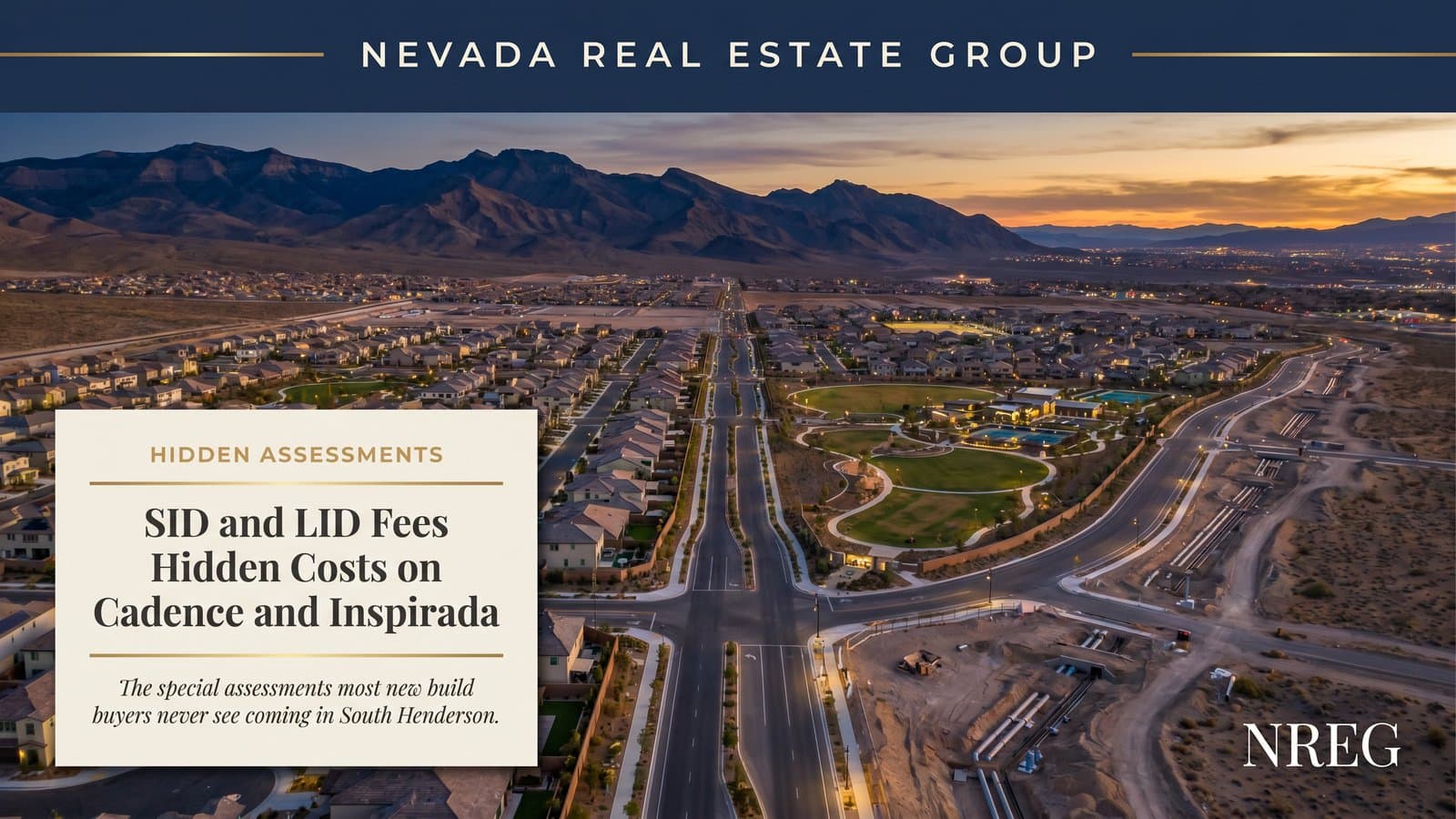

Published May 11, 2026 · Updated May 11, 2026 · By Chris Nevada, Nevada Real Estate Group · NV License S.181401
Direct Answer: Special Improvement District (SID) and Limited Improvement District (LID) assessments add $1,200 to $3,600 per year to property tax bills on new construction homes in Cadence, Inspirada, Skye Canyon, Lake Las Vegas, and other master-planned Las Vegas communities — typically lasting 10 to 20 years until the underlying infrastructure bond is paid off. Total lifetime cost ranges from $7,000 on smaller streetlight districts to $50,000+ on the largest infrastructure bonds. The fee appears as a line item on the same Clark County tax statement as regular property tax, often catching buyers off guard. Most buyers in Henderson, Las Vegas, and surrounding Cadence, Inspirada, and Skye Canyon communities have the option to pay off their SID/LID balance at closing as a lump sum or to continue annual payments. Here's how each option works and which is right for different buyer scenarios.
Key Takeaways
- SID = Special Improvement District. LID = Limited Improvement District. Both fund infrastructure bonds.
- Annual cost: $1,200-$3,600 in most master-planned new construction
- Lifetime cost: $7,000-$50,000+ depending on bond size and remaining term
- Appears on Clark County property tax statement as a separate line item
- Funds streets, sewers, water mains, streetlights, parks, drainage, and other infrastructure
- Bond terms typically run 10-20 years
- Can usually be paid off at closing as a lump sum
- Cadence, Inspirada, Skye Canyon, and Lake Las Vegas all carry SID/LID assessments
- Many buyers learn about the fee only AFTER closing
- The 3% property tax cap does NOT apply to SID/LID assessments
What Are SIDs and LIDs and Why Do They Exist on Las Vegas New Construction?
A Special Improvement District (SID) and a Limited Improvement District (LID) are legal mechanisms used by Nevada local governments — typically the City of Henderson, City of Las Vegas, City of North Las Vegas, or Clark County — to finance large-scale infrastructure projects by issuing municipal bonds backed by future property tax assessments on the benefiting properties.
The basic concept. When a master-planned community like Cadence or Inspirada is built, someone has to pay for the streets, sewers, water mains, drainage systems, streetlights, traffic signals, and other public infrastructure that serves the community. The developer could pay for it upfront and roll the cost into home prices. Or the city could issue a bond to pay for the infrastructure today, then collect annual payments from the future homeowners over 10-20 years to repay the bond.
Most large Las Vegas master-planned communities use the SID/LID structure for at least part of their infrastructure financing. The developer benefits because home prices don't have to absorb the full upfront infrastructure cost. The city benefits because property owners — the people who actually use the infrastructure — pay for it over time. The homeowner benefits in lower upfront purchase prices but pays via the annual SID/LID assessment.
SID vs LID — what's the difference?
A Special Improvement District is a Nevada-statutory district authorized under NRS Chapters 271 and 318. SIDs typically fund large-scale infrastructure: streets, drainage, sewer trunk lines, water mains, parks, and similar projects. SIDs can be established by city ordinance and bond issuance, and they can run 10-30 years.
A Limited Improvement District is a smaller-scale, often single-purpose district authorized under similar statutory authority. LIDs typically fund a single specific improvement — streetlight network, traffic signal upgrades, a specific street widening project, or a single park. LIDs typically run 5-15 years.
For the homeowner, the practical experience is identical: a line item on the Clark County property tax statement showing an additional assessment. The legal mechanism differs but the bill looks the same.
How Much Do SID and LID Fees Actually Cost in Las Vegas in 2026?
The dollar amount depends on three factors: the size of the underlying infrastructure bond, the number of properties sharing the assessment, and the remaining bond term. Here are the typical 2026 ranges across major Las Vegas communities with active SID/LID assessments.
| Community | Annual SID/LID Range | Remaining Term (2026) | Total Lifetime Cost |
|---|---|---|---|
| Cadence (Henderson) | $1,400-$3,200 | 8-18 years | $11,000-$45,000 |
| Inspirada (Henderson) | $1,200-$2,800 | 5-15 years | $7,000-$32,000 |
| Skye Canyon (NW Las Vegas) | $1,600-$3,400 | 10-19 years | $16,000-$50,000 |
| Lake Las Vegas (Henderson) | $1,800-$3,600 | 7-16 years | $14,000-$48,000 |
| Mountain's Edge (SW Las Vegas) | $1,100-$2,400 | 4-12 years | $5,000-$25,000 |
| Aliante (North Las Vegas) | $800-$1,800 | 3-10 years | $3,000-$15,000 |
| Providence (NW Las Vegas) | $900-$2,000 | 5-13 years | $5,000-$22,000 |
| Tule Springs / Villages at Tule | $1,000-$2,200 | 8-16 years | $8,000-$28,000 |
| Summerlin West | $1,300-$2,800 | 9-18 years | $12,000-$40,000 |
| Anthem (Henderson) | $700-$1,500 | 2-8 years | $1,500-$11,000 |
Important nuance. The annual assessment is not flat across all lots within a community. Larger lots and higher-value homes typically pay more — the assessment formula often includes lot size, square footage, or assessed value as a factor. The same SID/LID structure can produce $1,400 annual for a small Cadence interior lot and $3,200 annual for a luxury Cadence lakeside lot.
Important nuance 2. Multiple districts can overlap on a single property. Many Cadence and Inspirada homes have two or three concurrent SID/LID assessments — one for major streets, one for sewer trunk infrastructure, one for the local parks system. Each shows as a separate line item, and the buyer sees the combined total.
How Do I Find My Specific SID/LID Assessment in Clark County?
Three reliable ways to find your specific SID/LID exposure before closing.
Method 1: Clark County Treasurer property tax bill. The annual property tax statement on any existing parcel shows every assessment, special district, and special improvement district line by line. If the home you are considering is resale or has had at least one full tax cycle, pull the most recent tax bill from the Clark County Treasurer's website. The SID/LID line items will be clearly labeled.
Method 2: Title company's preliminary HUD-1 / closing disclosure. During the escrow period, the title company prepares a closing disclosure that estimates ongoing property tax burden. The title company should be able to identify SID/LID exposure on the specific parcel and provide a payoff quote.
Method 3: Builder sales office disclosure. Builders are required by Nevada law to disclose SID/LID assessments before contract signing. The disclosure typically appears as part of the public offering statement, the CC&Rs disclosure packet, or a separate addendum titled "Special Assessment District Disclosure" or similar. Ask specifically: "What is the total annual SID/LID assessment for this specific lot, and how many more years remains on the bond?"
Most buyers fail to ask method 3 directly. They sign disclosure packages without reviewing the SID/LID sections. They learn the actual dollar amount only after closing when the first Clark County tax bill arrives.
Pro tip for Nevada Real Estate Group buyer clients. Every contract we negotiate on a new construction home includes a specific written request for the seller (builder) to provide: (1) total current annual SID/LID assessment, (2) the underlying bond name and remaining term, (3) the current payoff quote if available, and (4) projected annual assessment changes during the bond term. This information goes into the buyer's transaction file and protects against future surprises.
What Does the 3% Property Tax Cap Do for SID/LID Assessments?
This is the question that surprises most Henderson and Las Vegas homeowners: the 3% annual property tax increase cap does NOT apply to SID/LID assessments.
Nevada's property tax abatement (NRS 361.4722) caps the year-over-year increase on the basic property tax bill at 3% for owner-occupied primary residences. The cap is a major homeowner protection — it prevents runaway tax bills as property values rise.
But SID/LID assessments are legally separate from the basic property tax. They are statutory special district assessments backed by improvement bonds. They are not "taxes" in the legal sense that triggers the 3% cap protection.
In practice, this means:
- A homeowner in Cadence sees their basic property tax bill grow only 3% per year after year 3
- The SID/LID portion of the same tax bill can change based on bond debt service requirements, refinancings, or scheduled step-ups
- Some SID/LID bonds have flat annual payments through the bond term
- Other SID/LID bonds have escalator clauses with 2-4% annual increases scheduled into the bond documents
- Bond refinancings can occasionally lower the annual assessment if interest rates have fallen since the bond was issued
The good news: SID/LID assessments do eventually end when the underlying bond is paid off. Once a 20-year bond reaches maturity in year 21, the assessment disappears entirely. The homeowner inherits the infrastructure free and clear, and the annual tax bill drops by $1,200-$3,600.
Can I Pay Off My SID/LID Assessment at Closing?
Yes, in most cases. Nevada law (NRS 271.428 and related statutes) generally allows property owners to pay off the prorated SID/LID assessment as a lump sum at any time, subject to the specific bond documents and any prepayment provisions.
The decision. Pay off the bond now in cash, or continue making annual payments through the bond term?
Pay off scenario. A new buyer at Cadence faces a $2,200/year SID/LID assessment with 14 years remaining on the bond. The payoff quote at closing is $19,800 (the present value of remaining payments at the bond's stated discount rate). The buyer has two choices:
Option A: Pay $19,800 at closing. No more SID/LID assessments for the life of ownership. Total cash to close goes up by $19,800. No monthly payment impact.
Option B: Continue annual $2,200 assessments. Pay $30,800 over 14 years total ($2,200 × 14). The annual amount can change with bond escalators. Monthly impact: roughly $183/month added to escrow if the lender escrows for property tax.
Math comparison. Option A pays $19,800 today. Option B pays $30,800 over 14 years. Net "savings" from prepayment: $11,000. But Option B uses other people's money (the city's bond financing) at the bond's interest rate, which is typically tax-advantaged municipal rate (3.5-4.5%). The cost of bond money is below most cash alternatives.
The honest math: pay off the SID/LID at closing if (1) you have the cash and were going to put it in low-yield savings anyway, or (2) you plan to refinance within 5 years and want to keep your mortgage payment low. Continue the annual assessment if (3) you have higher-yield uses for the $19,800 (paying down higher-rate debt, contributing to retirement accounts, investing).
A note on resale. Some Las Vegas buyers in 2026 are paying off SID/LID assessments at closing specifically to improve resale marketability. A home with "no SID/LID" is meaningfully more attractive to the next buyer than a home with $2,200/year ongoing assessment, especially in slower-velocity neighborhoods. The $19,800 prepayment can recoup at resale through faster days-on-market and modestly higher pricing.
How Do SID/LID Fees Compare Across Cadence, Inspirada, and Skye Canyon?
These three large master-planned communities have some of the highest SID/LID exposures in the Las Vegas valley. Each was built with significant new infrastructure financed through bond issuance.
Cadence (Henderson). The Cadence master plan involved extensive infrastructure across approximately 2,200 acres in Henderson. Major SIDs fund the main arterials (Boulder Highway frontage road, Cadence Crest), the sewer trunk system, the central park system, and the lake infrastructure. Most Cadence homes carry two to three concurrent SID assessments totaling $1,400-$3,200 annually. Remaining bond terms range from 8 to 18 years depending on which specific Cadence section was developed first vs last.
Inspirada (Henderson). Inspirada's SID structure funds significant grading and infrastructure for the foothills development on approximately 1,950 acres. Most Inspirada homes carry $1,200-$2,800 in annual SID assessments. Earlier Inspirada villages have 5-8 years remaining on the original bonds; newer Inspirada villages have 12-15 years remaining. The variation across the community is substantial — buying in Phase 1 vs Phase 6 can mean a $1,000 annual difference in SID exposure even within the same community.
Skye Canyon (Northwest Las Vegas). Skye Canyon's SID structure funds the Olympia development infrastructure including major access roads, water/sewer extension to the northwest valley, and the Skye Canyon Park system. Annual SID assessments run $1,600-$3,400 — the highest of the three communities — and bond terms generally run 10-19 years. Newer Skye Canyon villages have the longest remaining terms.
Practical buyer guidance for these three communities. Always request the specific SID/LID assessment for the EXACT lot you are buying — not the community average. Annual amounts vary by lot size and home value within the same community. A $2,200 assessment on one Inspirada lot can be $2,800 on the lot directly across the street. Get it in writing before signing.
Do SID/LID Fees Affect My Mortgage Qualification?
Yes — and this catches many buyers off guard during the qualification phase.
Lenders include SID/LID assessments in the total housing payment calculation when determining your debt-to-income ratio. A $2,400/year assessment ($200/month) adds $200 to your monthly housing cost from the lender's perspective. On a buyer at the edge of qualification, this $200 can push debt-to-income above the 43% conforming loan limit or above the lender's specific overlay limit.
Example. A buyer with a $9,500/month gross income is looking at a $625,000 Cadence home. The standard PITI math:
- Principal & Interest at 6.90% on $500,000 loan: $3,293
- Property tax (annual $6,250 / 12): $521
- Homeowner insurance: $135
- HOA: $115
Standard PITI total: $4,064/month. DTI: 4,064 / 9,500 = 42.8%. Under the 43% conforming limit. Approved.
Add the SID/LID assessment of $2,400 annual / $200 monthly. Adjusted housing payment: $4,264. DTI: 4,264 / 9,500 = 44.9%. Over the 43% limit. Loan declined or required to put down more cash.
This is real and happens regularly in Cadence, Inspirada, Skye Canyon, and Lake Las Vegas transactions. The mortgage underwriter sees the title company's tax estimate, sees the SID/LID line, and includes it in the calculation. Some buyers find out about SID/LID exposure for the first time when their lender flags a DTI issue mid-underwriting.
Defense. Before submitting the loan application, ask the title company for the full property tax estimate including SID/LID. Cross-check this number against the lender's qualifying calculation. If the SID/LID exposure is high enough to threaten DTI, consider one of three options: (1) pay off the SID/LID at closing to remove it from the monthly calculation, (2) increase down payment to lower the principal & interest portion, or (3) consider a different lot in the same community with lower SID/LID exposure.
How Do SID/LID Fees Affect Resale Value?
The honest answer: SID/LID exposure modestly reduces resale appeal compared to comparable homes without the assessment, but the impact is smaller than buyers fear.
The negative effect. Future buyers see the annual assessment and view it as ongoing cost. A $2,400 annual SID/LID is functionally equivalent to a $200/month rent on the property. Buyers price this into their willingness to pay — typically by reducing offers $5,000-$15,000 below comparable homes without SID/LID.
The positive offset. Homes in SID/LID communities generally have access to infrastructure and amenities that homes outside such communities lack. Cadence buyers benefit from the lake, central park, premium streetscape, and other infrastructure paid for by the SID. The same infrastructure that creates the assessment also creates the community appeal that supports resale value.
Net effect over typical hold periods. Most Cadence, Inspirada, and Skye Canyon homes have not shown meaningful SID/LID-related discounts at resale through 2024-2025 closings. The community quality created by the infrastructure investment supports pricing comparable to or stronger than nearby non-SID neighborhoods.
Where SID/LID exposure starts to genuinely hurt resale. When the remaining bond term is short (2-5 years remaining), the assessment is highest in the final years (some bonds back-load payments), and the next buyer can see the math saying "I'm going to pay $5,000-$10,000 for 3-5 years and then it goes away." This is the period when paying off the SID at closing has the biggest psychological resale benefit — buyers prefer "no SID" over "SID with 3 years remaining" even when the math is equivalent.
| Bond Status | Resale Impact | Recommended Action |
|---|---|---|
| 15-20 years remaining | Negligible impact on resale | Continue annual payments |
| 10-15 years remaining | $5K-$10K discount in offers | Continue annual payments |
| 5-10 years remaining | $10K-$15K discount in offers | Consider payoff at sale time |
| 2-5 years remaining | $5K-$10K discount in offers | Strong case to pay off before listing |
| Less than 2 years | Negligible (almost done anyway) | Continue annual payments |
How Are SID/LID Bonds Structured and Why Does That Matter to Buyers?
Understanding the bond mechanics helps buyers evaluate whether their SID/LID assessment is fair, predictable, and likely to behave as expected over the bond term.
Bond issuance. A SID or LID is created by city ordinance (typically the City of Henderson, City of Las Vegas, City of North Las Vegas, or Clark County). The ordinance defines the boundary of the district, the improvements to be financed, the total bond amount, and the assessment formula that will apportion bond payments across the included properties. Once the bonds are issued, the city collects the proceeds, pays the contractor for the infrastructure work, and begins collecting the annual assessment from homeowners.
Bond amortization. Like a home mortgage, SID/LID bonds amortize over a defined term — typically 10 to 25 years — with annual debt service payments covering both principal and interest. Some bonds have flat annual debt service (the assessment stays roughly constant); others have increasing debt service (the assessment goes up modestly over time, often 2-4% per year); a few have decreasing debt service.
Coverage ratios. Most SID/LID bonds carry coverage ratios that require collections to exceed scheduled debt service by 10-25% — meaning if scheduled debt service is $1,800 per home, the actual assessment might be $2,000-$2,200 to provide a buffer for delinquencies. Excess collections build up in reserve funds that can later be used to call bonds early or to refund principal to homeowners (rare but possible).
Refunding bonds. When interest rates fall significantly, cities sometimes "refund" old SID/LID bonds with new bonds at lower rates, similar to a homeowner refinancing a mortgage. This can lower the annual assessment for the remaining bond term. In 2020-2021's low-rate environment, several Henderson and Las Vegas SID bonds were refunded, lowering assessments by 10-25% for the remaining term. As of May 2026, refunding activity has slowed due to higher rates.
Default risk. Theoretically, an SID/LID district can fail to collect enough to service its bonds, potentially triggering increased assessments on remaining homeowners. In practice, this rarely happens in Las Vegas because the underlying real estate has held value through multiple cycles. Las Vegas SID/LID bonds enjoy strong investment-grade ratings.
What Should Buyers Ask Their Builder and Title Company About SID/LID Before Closing?
Before signing a purchase agreement on any Las Vegas master-planned community home, demand written answers to these eight questions.
- What is the total annual SID and LID assessment for this specific lot? Get the exact dollar amount, not a community average.
- Which specific SIDs and LIDs apply to this lot, and what does each one fund?
- What is the remaining term on each bond? This determines lifetime cost.
- Does the assessment have an escalator clause? Some bonds increase the assessment 2-4% per year. Get this in writing.
- What is the current payoff quote for each bond? This tells you the prepayment option amount.
- Has the bond been refunded recently, and is refunding anticipated in the near future?
- Are there any pending or planned new SIDs or LIDs that would add to my future assessment? Some master-planned communities have multiple phases of bond issuance.
- What happens to the assessment when the bond is paid off? Confirm the assessment ends (not converts to something else).
The combination of these eight answers gives buyers a complete picture of their SID/LID exposure for the full ownership period. Buyers who get written answers consistently make better purchase decisions and avoid first-tax-bill surprises.
What Are the Biggest SID/LID Mistakes Buyers Make in Las Vegas?
Mistake 1: Not asking about SID/LID exposure before signing. Most buyers ask "what's my property tax going to be?" The sales rep quotes the base property tax number and does not volunteer the SID/LID separately. The buyer learns the actual total at first tax bill or first escrow analysis. Always ask explicitly: "What is the total annual property tax INCLUDING all SID and LID assessments on this specific lot?"
Mistake 2: Confusing HOA dues with SID/LID assessments. These are separate. HOA dues fund private community management — landscaping, gates, amenity maintenance, master HOA reserves. SID/LID assessments fund public infrastructure — streets, sewers, water mains, public parks. A home in Cadence pays BOTH: HOA dues of $50-$150/month AND SID/LID assessments of $100-$300/month. Some buyers see the HOA dues line and think it's the whole story. It isn't.
Mistake 3: Underestimating mortgage qualification impact. A $200/month SID/LID can push borderline applicants over conforming DTI limits. Get the full tax estimate from the title company BEFORE submitting the loan application, not after.
Q: What does SID/LID stand for in Las Vegas real estate?
SID stands for Special Improvement District. LID stands for Limited Improvement District. Both are Nevada statutory mechanisms for financing public infrastructure (streets, sewers, water mains, streetlights, parks) through bonds backed by future property tax assessments on the benefiting properties. SIDs typically fund larger multi-purpose infrastructure projects; LIDs typically fund smaller single-purpose improvements like streetlights or specific street widening.
Q: How much do SID and LID fees cost in Cadence Henderson?
Cadence SID/LID fees in 2026 range from $1,400 to $3,200 per year per home, depending on the specific lot size, home value, and which Cadence section the home is in. Most Cadence homes carry two to three concurrent SID assessments totaling the full annual amount. Remaining bond terms range from 8 to 18 years depending on the specific section. The total lifetime cost of Cadence SID/LID assessments ranges from approximately $11,000 to $45,000 across the bond term.
Q: How much do SID and LID fees cost in Inspirada?
Inspirada SID/LID fees in 2026 range from $1,200 to $2,800 per year per home. Earlier Inspirada villages have 5-8 years remaining on the original bonds; newer Inspirada villages have 12-15 years remaining. The variation across the community is significant — Phase 1 lots can have meaningfully lower SID exposure than Phase 6 lots even within the same community. Always request the specific assessment for the exact lot you are buying.
Q: Can I pay off my SID or LID assessment at closing?
Yes, in most cases. Nevada law generally allows property owners to pay off prorated SID/LID assessments as lump sums at any time, subject to the specific bond documents and prepayment provisions. The payoff quote — the present value of remaining payments at the bond's discount rate — is available from the title company during escrow. Paying off at closing eliminates the monthly impact on your mortgage payment but requires bringing the cash to close.
Q: Does the 3% Nevada property tax cap apply to SID/LID assessments?
No. The Nevada property tax abatement caps the year-over-year increase on basic property tax at 3% for owner-occupied primary residences, but it does NOT apply to SID/LID assessments. SID/LID amounts can change based on bond debt service schedules, refinancings, and any escalator clauses written into the bond documents. The good news: SID/LID assessments do eventually end when the underlying bond is paid off, at which point the annual tax bill drops by the full SID/LID amount.
Q: How do I find out the SID/LID exposure on a specific Las Vegas home?
Three ways: (1) pull the most recent Clark County property tax bill from the Treasurer's website, which itemizes every assessment line; (2) ask the title company during escrow for a full property tax estimate including SID/LID assessments; (3) request the SID/LID disclosure directly from the builder sales office before signing. Builders are required by Nevada law to disclose SID/LID assessments but rarely volunteer the dollar amount unless asked specifically.
Q: Do SID/LID fees affect my mortgage qualification in Las Vegas?
Yes. Lenders include SID/LID assessments in the total housing payment calculation for debt-to-income ratio purposes. A $200/month SID/LID adds $200 to your qualifying housing payment, which can push borderline applicants over the 43% conforming DTI limit. Get the full property tax estimate from the title company BEFORE submitting the loan application to avoid surprises during underwriting.
Q: Are SID/LID fees deductible on my federal tax return?
The deductibility of SID/LID assessments depends on whether they qualify as "ad valorem property tax" or as "special assessments" under IRS rules. Generally, the portion of a SID/LID payment that funds general public infrastructure (streets, sewers, water mains) is deductible as state and local property tax, subject to the $10,000 SALT cap. The portion that funds specific local improvements that increase the value of the specific property may not be deductible. Consult a CPA or tax professional for your specific situation.
Q: Which Las Vegas master-planned communities have the highest SID/LID fees?
Among major Las Vegas master-planned communities in 2026, the highest SID/LID assessments are typically found in: Skye Canyon ($1,600-$3,400 annual), Lake Las Vegas ($1,800-$3,600 annual), Cadence ($1,400-$3,200 annual), and Summerlin West ($1,300-$2,800 annual). The lowest assessments are typically found in older established communities like Anthem ($700-$1,500 annual) and Aliante ($800-$1,800 annual), where the underlying infrastructure bonds are closer to payoff.
Nevada Real Estate Group represents buyers in Las Vegas master-planned community transactions at no cost to the buyer — the builder pays our commission. All SID/LID assessment ranges reflect May 2026 market conditions and Clark County Treasurer records. SID/LID assessments change with bond debt service schedules and refinancings. Consult a licensed Nevada real estate professional and the Clark County Treasurer for property-specific guidance.
About the Author: Chris Nevada leads Nevada Real Estate Group, the #1 real estate team in Nevada with 150+ licensed agents and 5,770+ verified five-star reviews. Licensed in Nevada (S.181401), Chris has closed 400+ new construction transactions across every major Las Vegas builder and master-planned community. For new construction buyer representation, call (702) 637-1759 or email info@nevadagroup.com.
Nevada Real Estate Group · 8945 W Russell Rd, Suite 170 · Las Vegas, NV 89148 · (702) 637-1759
Related Reading:
- How Much Do Builder Closing Cost Credits Actually Save You in Las Vegas (2026)
- The 2-1 Rate Buydown Explained (2026 Real Math)
- Why Your Property Tax Bill Doubles in Year 2 of a New Build (Clark County 2026)
- Lot Premium Negotiation in Las Vegas New Construction (2026)
- Las Vegas New Construction Buyer Guide