
Las Vegas is the second-largest RV-ownership metro in the United States behind only Phoenix. According to the Recreation Vehicle Industry Association (RVIA), Nevada has roughly 240,000 registered recreational vehicles across the state — and the bulk live in Clark County. This is the structural reason "homes with RV garage" is one of the top-searched feature filters on the Nevada Real Estate Group site every year.
This guide is the 2026 buyer's playbook. It covers what counts as a real RV garage (the dimensions matter more than the marketing language), where in the valley RV-friendly inventory actually clusters, why most master-planned HOAs prohibit on-site RV storage, how much an RV garage adds to resale value, what it costs to build one if your dream home doesn't have one, and the inspections and HOA review every buyer should add. Numbers are calibrated against 2026 Las Vegas REALTORS closing data and our roughly 6,225+ NREG transactions over the past decade.
A true RV garage in Las Vegas needs a 12 to 14 foot clear door height and 35 to 50 feet of interior depth to fit a Class A or Class C motorhome. They concentrate in North Las Vegas (Aliante, Eldorado, Centennial Hills), Mountain's Edge, Skye Canyon, southwest Henderson estate communities, and Boulder City — where master-plan HOAs are absent or RV-friendly. Most Summerlin and luxury-Henderson communities prohibit on-site RV storage. Build cost is $85,000 to $185,000 for a detached RV garage; expect 3% to 7% resale value premium when permitted with full electric and a wide gate.
- Class A motorhomes are 30 to 45 feet long and 12 to 13.5 feet tall — a "3-car garage" rarely fits them. A true RV garage is a separate structure or oversized bay specifically engineered for that footprint.
- The deepest RV-friendly inventory in the Las Vegas metro lives in North Las Vegas, Mountain's Edge, Skye Canyon, and Boulder City — communities without master-plan HOAs or with explicitly RV-permitting bylaws.
- Most Las Vegas master-planned HOAs (Summerlin, Anthem, Southern Highlands, MacDonald Highlands, Lake Las Vegas) prohibit visible RV storage on residential lots; on-site enclosed RV garages are also typically prohibited or require strict architectural review.
- Build cost for a detached RV garage runs $85,000 to $185,000 depending on size, finish, and permitting; commercial RV storage costs $1,500 to $14,000 per year for buyers who prefer to keep the RV off the home property.
- RV garages add roughly 3% to 7% to a Las Vegas home's resale value — meaningfully more than the national average because of Vegas's high RV-ownership rate; the premium is largest for detached structures with full electric and 14-foot doors.
What counts as an "RV garage" vs an "RV pad" vs an "RV gate"?
The terms get used interchangeably in casual conversation, but they describe three distinct configurations — and the distinction matters because resale value, insurance premium, and HOA review all treat them differently.
An RV garage is a fully enclosed structure (detached or attached) with a 12 to 14 foot clear door height and 35 to 50 feet of interior depth. The garage door is typically a roll-up or sectional design rated for the wider opening, and the floor is usually a thicker poured concrete pad (8 to 12 inches versus the 4-inch standard) to support the RV's curb weight. A real RV garage also has 30-amp or 50-amp electrical service inside for the RV's hookup and often a dump-station drain.
An RV pad is a covered or uncovered concrete parking area, typically behind a perimeter fence or gate. The pad is wide and deep enough for a Class A or Class C motorhome (typical 14x45 feet minimum) but offers no roof and no enclosed storage. Often paired with a hookup pedestal (30/50-amp electric and a sewer drain).
An RV gate is a wide drive-through gate (typically 12 to 14 feet wide) that lets the RV roll from the public street to the side or rear yard, where it parks on either a pad or a covered carport. The gate is the access infrastructure; the parking can be any of the three configurations above.
The MLS listing field language varies — "RV garage" in the description can mean any of the three, so verify what you're getting before writing an offer. According to standard MLS practice in the Greater Las Vegas Association of Realtors, a true detached RV garage adds the largest resale premium (5% to 7%), an enclosed attached RV bay is mid-tier (3% to 5%), and an uncovered RV pad with gate adds the smallest (2% to 4%).
The full live MLS feed of Las Vegas homes with RV garages refreshes every 30 minutes and fans out three queries (RV garage, RV parking, RV gate) so you see every configuration in one place.
How many Las Vegas homes actually have RV storage?
The Las Vegas metro has roughly 240,000 registered RVs per Recreation Vehicle Industry Association state-level data, but only a small fraction of homes accommodate on-site RV storage. According to recent NREG transaction data, of approximately 320,000 single-family homes in Clark County:
- Fully-enclosed detached RV garages: approximately 4,500 to 6,500 homes (1.5% to 2%)
- Attached oversized RV bays (within main garage): approximately 3,000 to 4,500 homes (1% to 1.5%)
- RV pads with gate (uncovered or covered carport): approximately 7,500 to 10,500 homes (2.5% to 3.5%)
- Total RV-friendly inventory: approximately 15,000 to 21,500 homes (5% to 7% of single-family stock)
Most of the rest of LV inventory either has the standard 7-foot residential garage door (cannot fit any RV taller than a Class B campervan) or sits in HOA-governed communities that prohibit visible RV storage. According to Clark County Department of Building & Fire Prevention permit records, new RV-garage permits issued in Las Vegas have averaged 180 to 250 per year over the past five years — a steady but small flow.
The structural implication for buyers: RV-friendly inventory is scarce, so buyer-side competition for the best properties is meaningful. Same-day showing scheduling is the standard NREG playbook for clients shopping RV-equipped homes in the active inventory window.
Where in the Las Vegas valley does RV-friendly inventory cluster?
Geographic clustering is dramatic. According to closing data and our community-level NREG transaction history, RV-friendly inventory in the Las Vegas valley concentrates in the following corridors:
| Corridor | RV-friendly share | Typical RV setup | Why this corridor |
|---|---|---|---|
| North Las Vegas (Aliante, Eldorado, Centennial) | 12% to 18% | Detached garage or RV gate + pad | Larger 1990s-2000s production lots, non-HOA pockets |
| Boulder City | 20% to 30% | Detached garage or open RV pad | Rural-edge zoning, no master-plan HOAs |
| Mountain's Edge / Southwest LV | 8% to 14% | Attached oversized bay + side gate | 2010+ production with larger lots |
| Skye Canyon / NW valley | 7% to 12% | Attached 4-car bay or detached | Newer production with RV-aware floor plans |
| Henderson southwest estates (non-HOA) | 5% to 10% | Detached custom RV garage | Larger custom estate lots without HOA |
| Tule Springs (NW valley) | 8% to 12% | Detached or RV pad | Newer development with RV-permitting bylaws |
| Summerlin / luxury Henderson HOAs | <1% | None on-site | Master-plan HOAs prohibit visible RV storage |
The pattern is consistent: RV-friendly inventory lives where land was developed before strict master-plan HOAs took hold, or in geographies where the zoning explicitly permits accessory RV storage. The newer master-planned communities (Cadence, Inspirada, Stonebridge, The Cliffs) generally prohibit visible RV storage by community covenant, regardless of how RV-friendly the local zoning would otherwise allow.
Which North Las Vegas communities have the deepest RV inventory?
North Las Vegas is the single highest-density RV-friendly market in the valley. According to closing data and Clark County Assessor records:
- Aliante: 1990s-2000s master plan with larger production lots; many homes built with RV gates or side-yard pads. Typical RV home: $475K to $725K. HOA does NOT prohibit RV storage on most sub-areas.
- Eldorado: Older 1980s-1990s production builds, often with side-yard RV gates and modest fences. Typical RV home: $425K to $625K. Most properties have no HOA at all.
- Centennial Hills: Mix of 2000s production and newer construction; the older sections have RV-friendly lots, newer master-planned sections within Centennial may have restrictions. Typical RV home: $525K to $850K.
- Tule Springs: Newer development on the northwest valley edge; some sub-areas explicitly permit and accommodate RV storage. Typical RV home: $625K to $1.1M.
- Lone Mountain / NW valley unincorporated: Rural-feel single-family on larger 0.5+ acre lots; many properties built specifically with RV-storage capacity. Typical RV home: $725K to $1.6M.
According to City of North Las Vegas municipal code, single-family residential zoning permits accessory RV storage on most lots with minimal restrictions, provided the storage area is appropriately screened from public view (typically with a 6-foot perimeter fence). This is meaningfully more permissive than the City of Las Vegas zoning, which has tighter visible-storage restrictions.
For NREG clients shopping the North Las Vegas RV market specifically, the standard playbook is to check the specific subdivision's HOA bylaws (some Aliante and Centennial Hills sub-associations DO restrict RV storage even within a permissive city) and verify the lot can accommodate the RV's actual dimensions (a 45-foot motorhome needs more than a standard 25-foot side yard).
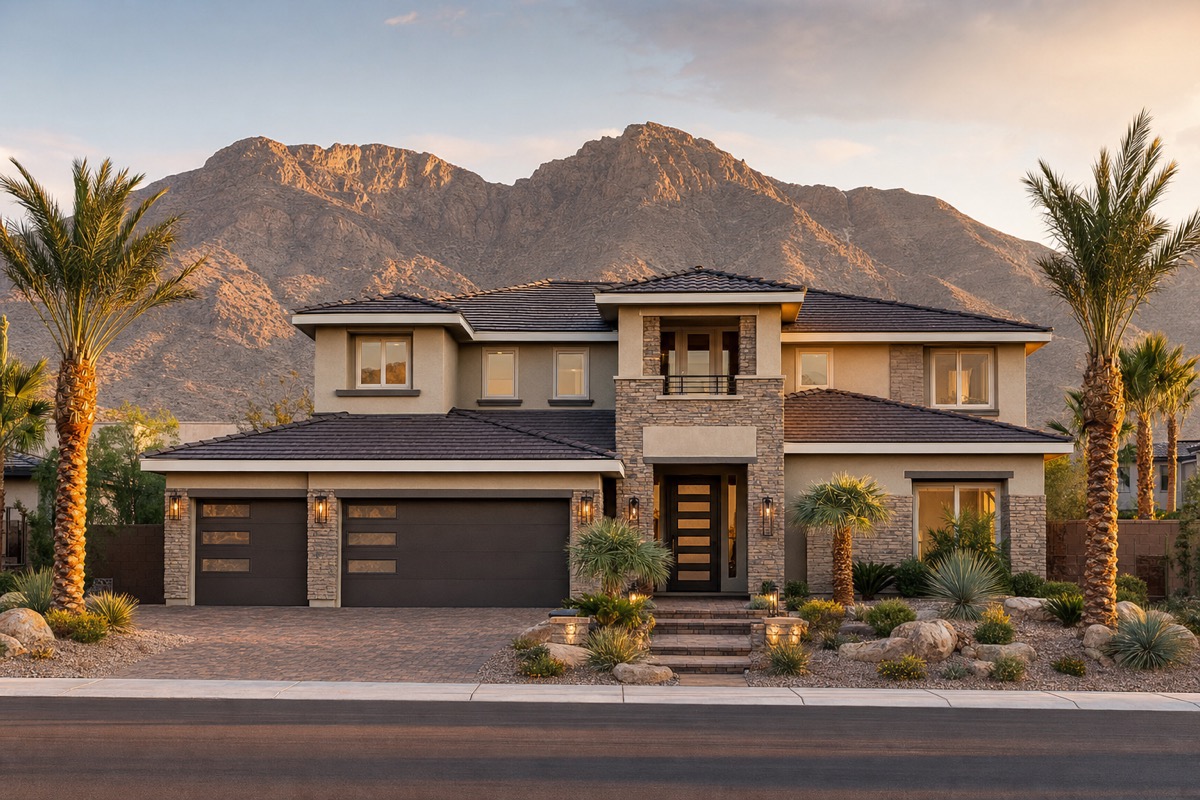
What does an Aliante or Centennial Hills RV home actually look like?
Across our recent NREG transactions in Aliante and Centennial Hills, the typical RV-equipped home profile:
- Lot size: 7,500 to 12,000 sqft (well above the LV-metro median of 6,500 sqft)
- Main garage: 3-car attached, standard 7-foot doors
- RV access: Either a side-yard gate (12 to 14 feet wide) leading to a concrete pad behind the home, OR a detached enclosed RV garage at the rear of the lot
- RV pad spec: 14x45 feet minimum, 8-inch poured concrete, 30 or 50-amp electrical pedestal, optional sewer drain
- RV garage spec (if present): 14x45 to 14x50 feet, 14-foot clear door, 10 to 14 foot ceiling height, separate 200-amp sub-panel
- Perimeter fence: 6-foot block or stucco wall, with vehicle gate matching the RV access width
According to closing data, an Aliante home with a true detached RV garage typically trades at $625,000 to $850,000 — roughly $40,000 to $80,000 above the same home without RV-specific infrastructure. The premium reflects both the RV-buyer-pool demand and the construction value of the additional structure.
For NREG clients shopping this segment, our agents pre-screen MLS listings against the actual RV dimensions (we typically ask for length, height, and slide-out width upfront) so we only tour homes where the RV will actually fit. A 38-foot Class A motorhome with two slide-outs needs 14 feet of width when slides are out — many "RV garage" listings only have 12-foot widths and would not work.
How does Boulder City RV ownership differ from the rest of the valley?
Boulder City is the LV-metro's most RV-friendly market, structurally. According to Boulder City municipal code, the city has no master-plan HOA enforcement layer (homes are typically governed only by city zoning) and the rural-edge zoning explicitly permits RV storage on most single-family lots with minimal screening requirements.
The practical implications for RV buyers:
- RV storage is openly permitted: Most lots permit visible RV parking in the side yard or driveway without special permitting
- Detached RV garages are encouraged: Building permits for accessory structures are typically issued in 4 to 6 weeks (faster than most LV master plans)
- Larger lot sizes: Boulder City single-family lots median ~9,500 sqft versus the LV-metro median of 6,500 sqft
- Lower density: Population approximately 15,000; commute to downtown Vegas is 30 to 45 minutes
- RV community culture: A meaningful share of Boulder City residents own RVs and the boating/RV combo lifestyle is part of the local identity (Lake Mead is 15 minutes away)
Typical Boulder City RV-friendly home in 2026: $525,000 to $1.1M depending on lot size, age, and whether the home has an enclosed RV garage versus an open pad. The trade-off versus closer-in LV inventory is the commute time — Boulder City is genuinely 30 to 45 minutes from Strip-corridor jobs.
According to closing data and our transaction history, Boulder City RV-home buyers fall into two distinct profiles: retirees (50%+ of recent transactions) who prioritize the lifestyle and don't commute, and active full-time RV-enthusiast professionals (30%+) who accept the commute in exchange for the RV-storage permissiveness. The remaining segment is investors and second-home buyers.
What dimensions does a true RV garage need to fit a Class A or C motorhome?
The single biggest mistake RV-home buyers make is assuming a "3-car garage" or "tall garage" will fit their RV. According to NHTSA recreational vehicle classification guidelines, the actual dimensions:
| RV class | Length range | Height range | Min door height | Min interior depth |
|---|---|---|---|---|
| Class A motorhome | 30 to 45 feet | 12 to 13.5 feet | 14 feet | 40 to 50 feet |
| Class C motorhome | 20 to 33 feet | 10.5 to 12 feet | 12 feet | 30 to 38 feet |
| Class B campervan | 17 to 24 feet | 8 to 9.5 feet | 9 to 10 feet | 22 to 28 feet |
| 5th-wheel trailer (max) | 30 to 45 feet | 12.5 to 13.5 feet | 14 feet | 40 to 50 feet |
| Travel trailer (typical) | 18 to 35 feet | 10 to 12 feet | 12 feet | 22 to 38 feet |
A typical "tall 3-car garage" in Las Vegas has 8 to 9 foot residential garage doors and 11 to 12 feet of clear ceiling height — adequate for a Class B campervan, marginal for a Class C, and impossible for a Class A. The 14-foot door height that fits a Class A is the dividing line that separates a "real" RV garage from a marketing-language RV garage.
Slide-outs add another constraint. A 40-foot Class A motorhome with three slide-outs (kitchen, living room, bedroom) measures roughly 14 feet wide when fully extended — meaning a 12-foot door width won't accommodate the RV with slides deployed. For homeowners who want to use the RV from inside the garage (cleaning, working on it, hosting guests in it), the door needs to be 14 feet wide.
According to Recreation Vehicle Industry Association sales data, the dominant US new-RV sales mix is Class A and 5th-wheel — both requiring the larger 14-foot dimensions. So for buyers planning to upgrade RVs over the ownership cycle, sizing the garage to the larger dimensions provides flexibility.
How much does an RV garage cost to add to an existing home?
Adding a detached RV garage to an existing Las Vegas single-family home runs $85,000 to $185,000 depending on size, finish, and permitting. According to typical NREG client construction-cost data from 2024-2026:
- Compact detached garage (16x40 ft, basic finish, 14-foot door): $85,000 to $115,000
- Standard detached garage (18x45 ft, basic finish, 14-foot door, electric): $115,000 to $155,000
- Premium detached garage (24x50 ft, insulated, 14-foot door, 200-amp panel, dump station): $155,000 to $235,000
- Attached oversized bay (added to existing main garage, 14x35 ft, 12-foot door): $65,000 to $115,000
Plus permitting and HOA architectural review fees, typically $3,500 to $8,500. The build timeline runs 4 to 7 months from contract to certificate of occupancy, with the longest variance coming from HOA architectural review (some communities have 8 to 12 week board cycles).
According to National Association of Home Builders cost-to-build data, the per-foot construction cost of a detached RV garage in Las Vegas is roughly $125 to $185 — meaningfully lower than the main residence's $250 to $400 per foot. The cost differential reflects the simpler structure (no kitchen, bath, HVAC, finished interior).
The build-vs-buy financial test: at typical 60% to 75% resale recovery on the RV garage build cost, a $150,000 detached RV garage adds approximately $90,000 to $112,500 to home value. Build is the right path for buyers planning a 7+ year hold; buying a home that already has the RV infrastructure is cheaper for shorter holds.
| RV garage configuration | Build cost | Resale recovery | Net cost over hold | Break-even hold |
|---|---|---|---|---|
| Compact detached (16x40) | $85K to $115K | $55K to $80K | $30K to $35K | 5 to 7 years |
| Standard detached (18x45) | $115K to $155K | $75K to $110K | $40K to $45K | 6 to 8 years |
| Premium detached (24x50) | $155K to $235K | $95K to $165K | $60K to $70K | 7 to 10 years |
| Attached oversized bay (14x35) | $65K to $115K | $40K to $75K | $25K to $40K | 5 to 7 years |
Why do master-planned HOAs prohibit RV storage?
The vast majority of Las Vegas master-planned communities (Summerlin, Anthem, Southern Highlands, MacDonald Highlands, Lake Las Vegas, Inspirada, Cadence, Stonebridge, The Cliffs) prohibit visible on-site RV storage. The structural reasons:
- Architectural review consistency: Master plans rely on visual continuity (rooflines, garage configurations, exterior materials) — visible RV storage breaks the architectural rhythm
- Lot-line sightlines: A 40-foot Class A motorhome stored in a side yard blocks neighbors' sightlines and casts large shadows
- Property-value protection: HOAs argue (with some evidence) that visible RV storage on individual lots can depress neighborhood values
- Insurance and liability: Some HOAs cite community-insurance concerns about visible heavy vehicles
- Local code overlap: Some HOAs reinforce existing City of Las Vegas restrictions rather than creating new ones
According to standard Nevada Revised Statutes Chapter 116 (the Common-Interest Communities Act), HOAs have broad authority to regulate accessory structures and visible exterior storage on residential lots. Once an HOA's CC&Rs prohibit RV storage, that prohibition is functionally permanent — changing it requires a 2/3 vote of the membership in most communities, which is essentially impossible in practice.
For luxury buyers who want both the master-plan amenities and RV storage, the practical workaround is to buy a luxury home inside the HOA (paying the master-plan premium) and pay for commercial RV storage off-site. Annual cost: $1,500 to $14,000 per year for commercial storage — far less than the lifestyle premium of living in the master-plan community.
What commercial RV storage options exist if your HOA bans on-site RV?
Las Vegas has a deep network of commercial RV storage facilities. According to industry sources and our NREG client referrals, the typical 2026 pricing:
- Outdoor lot storage (uncovered, fenced, gated): $75 to $150 per month
- Covered storage (roof but no walls): $125 to $225 per month
- Climate-controlled covered storage (roof, walls, ambient temperature): $200 to $400 per month
- Luxury RV condos (private enclosed bay, electrical hookup, dump station, sometimes attached lounge): $500 to $1,200 per month
- Long-term reserve facilities (specialized for unused or seasonal storage): $50 to $100 per month
The major LV commercial RV storage clusters lie along the I-15 north corridor (around Apex), the I-215 southwest beltway, and the eastern Boulder Highway area. Storage facility proximity to the home matters because retrieval and return for trips is the primary daily-use friction.
For NREG clients in master-plan HOA communities, the standard recommendation is climate-controlled covered storage ($200 to $400/month, $2,400 to $4,800/year) — sufficient for most Class A and 5th-wheel ownership without the on-site convenience but with predictable annual cost. Luxury RV condos at $500 to $1,200/month make sense for clients who use the RV 6+ times per year and want immediate access.
How much does an RV garage add to a Las Vegas home's resale value?
Across recent GLVAR closings, an RV-equipped Las Vegas home commands a 3% to 7% premium over a comparable home without RV infrastructure — meaningfully more than the national 2% to 4% average because of Vegas's high RV-ownership rate. The breakdown by configuration:
- Detached RV garage with full electric and 14-foot door: 5% to 7% premium ($30,000 to $80,000 dollar terms on a $600K-$1.2M home)
- Attached oversized RV bay (12 to 14-foot door): 3% to 5% premium ($20,000 to $50,000 dollar terms)
- RV pad with side gate and electric: 2% to 4% premium ($12,000 to $35,000 dollar terms)
- RV gate only (no pad, no electric): 1% to 2% premium ($6,000 to $18,000 dollar terms)
The premium is largest at the mid-tier price band ($600K to $1.5M). At the entry tier (under $500K), buyers tend to weigh price more carefully and the RV premium is modest. At the luxury tier ($1.5M+), the RV premium is less relevant because luxury buyers either accept commercial storage or live in non-HOA estate communities where RV storage is permitted by default.
According to standard NREG seller-side practice, the value-maximization playbook for a seller of an RV-equipped home is: (1) document the RV garage dimensions and electrical capacity in the listing, (2) photograph the RV garage as a featured listing image (not just included in the home's other photos), (3) explicitly call out the buyer-pool demand in the listing description, and (4) price 4% to 6% above comparable no-RV inventory.
For relocators considering an RV-equipped home as part of a broader move, our California to Las Vegas migration guide covers the broader relocation context — RV ownership is part of the lifestyle reset many California out-migrants are making.
What inspections and gotchas should RV-home buyers add to their offer?
The standard residential home inspection does NOT cover RV-specific infrastructure. According to inspection-industry data tracked by InterNACHI, buyers who add three RV-specific checks to their offer save an average of $4,500 to $15,000 in deferred-maintenance costs in the first two years of ownership.
The three RV-specific inspections we recommend on every RV-equipped home purchase:
- Garage door inspection (focus on RV-sized doors): A pool inspector or specialty contractor verifies the door operator, torsion springs, weather seals, and track alignment. RV-sized doors carry roughly 2x the weight of standard residential doors and the springs and operators fail more frequently. Typical cost: $150 to $300.
- Electrical service verification (focus on RV hookup): A licensed electrician confirms the 30-amp or 50-amp pedestal works at the labeled amperage, that the grounding is correct, and that the breaker is appropriately sized. Typical cost: $200 to $400.
- HOA architectural-review file check: Confirm with the HOA (and the listing agent) that the RV infrastructure was actually approved by architectural review at construction or addition. An unpermitted RV garage carries risk of HOA enforcement action against the new owner. Typical cost: free (just a file request via the listing agent).
The combined cost of $350 to $700 catches issues that would otherwise emerge in the first year of ownership. The HOA file check is the most important — buyers occasionally discover after closing that the RV garage was added without proper architectural approval and the HOA can require removal.
Additional gotcha to verify: insurance coverage on the RV inside the garage. Most homeowners policies cover the home structure, not the RV. The RV typically needs its own policy (which the buyer brings). When the RV is inside an enclosed garage, the insurance interaction can get complicated — confirm with your carrier before closing.
Frequently Asked Questions
Do all 3-car garages fit an RV in Las Vegas?
No. A standard 3-car garage in Las Vegas has 8 to 9 foot residential doors and 11 to 12 feet of clear ceiling height — too small for any Class A motorhome and most Class C. Only a "tall 3-car" or "deep 3-car" specifically engineered with 12 to 14 foot doors and a 35 to 50 foot depth will fit a real RV. Verify the actual dimensions before assuming.
Can I park an RV in my driveway temporarily for loading and unloading?
Generally yes, but depends on the local jurisdiction and HOA. In most LV-metro cities, brief driveway parking for active loading and unloading (typically up to 72 hours) is permitted under residential zoning. Long-term driveway parking (more than 72 hours) is restricted in most cities and prohibited in nearly all HOA-governed communities. Always verify with the specific city and HOA before assuming.
How much does RV-home insurance cost?
The home insurance impact of an RV-equipped home is modest — typically $20 to $60 per month additional homeowners-policy premium for the larger structure replacement cost. The RV itself needs separate coverage (typically $800 to $2,500 per year depending on RV class and use). When the RV is inside an enclosed garage, some homeowners-policy carriers add liability coverage for the garage contents, but the RV itself is still typically the owner's separate policy.
Can I rent out an RV garage as a casita?
Generally no. An RV garage is permitted as an accessory structure, not as residential dwelling space — converting it to rental residential use would require a separate ADU (accessory dwelling unit) permit and typically architectural and zoning approval. According to City of Las Vegas Municipal Code, this is a non-trivial conversion process. If you want both a casita and an RV garage, browse the live Las Vegas homes with casitas or mother-in-law suites feed and the RV garage inventory — many large-lot homes in North Las Vegas and Boulder City accommodate both.
How long does it take to build a detached RV garage in Las Vegas?
4 to 7 months from signed contract to certificate of occupancy, on average. The timeline breaks down as: design and HOA architectural review (4 to 12 weeks, depending on community), Clark County permitting (4 to 6 weeks), foundation and slab (2 weeks), framing and door installation (3 to 5 weeks), electrical and finish (2 to 4 weeks), and final inspection (1 to 2 weeks). HOA architectural review is the largest variance — strict communities (Ascaya, The Ridges, MacDonald Highlands) can run 12+ weeks just for the review board approval.
Can RV garages be financed through my home mortgage?
Yes, several ways. The three most common: a home-equity line of credit (HELOC) against existing equity; a cash-out refinance that bundles the RV garage cost into a new mortgage; or a construction loan that converts to permanent financing on completion. According to Freddie Mac PMMS rate data, HELOC rates currently run 2 to 4 percentage points above the prevailing 30-year fixed mortgage rate. Some specialty contractors offer their own financing through partner lenders — verify the fully-amortized cost before signing.
What if I want a pool and an RV garage?
Common pairing in the larger-lot North Las Vegas, Mountain's Edge, and Boulder City inventory. According to closing data, roughly 35% of homes with detached RV garages also have private pools — the combination correlates because both features require larger lots. For the joint shortlist, browse our live Las Vegas homes with private pools feed alongside the RV-garage inventory, or call the NREG team at (702) 637-1759 to pull a custom shortlist filtered by both criteria.
Which Sources Inform This RV-Garage Buyer's Guide?
This guide pulls from authoritative real estate, zoning, RV industry, and construction sources:
- Las Vegas REALTORS (LVR) — 2024-2026 monthly market reports and RV-home transaction data
- Recreation Vehicle Industry Association (RVIA) — national and Nevada RV ownership and sales data
- Clark County Department of Building & Fire Prevention — RV-garage permit data and inspection requirements
- Clark County Assessor — parcel data and accessory-structure records
- Nevada Revised Statutes Chapter 116 — Common-Interest Communities Act governing HOAs
- City of North Las Vegas — municipal zoning code permitting accessory RV storage
- City of Las Vegas Municipal Code — accessory structure and visible storage restrictions
- Boulder City — rural-edge zoning and RV-friendly residential code
- National Highway Traffic Safety Administration — RV classification standards and dimensions
- National Association of Home Builders — accessory structure cost-to-build data
- InterNACHI — inspection scope benchmarks
- Insurance Information Institute — homeowners and RV insurance pricing
- Freddie Mac PMMS — mortgage rate context for RV-garage financing
- IRS Publication 463 — RV deduction rules for business use
- U.S. Bureau of Labor Statistics — Consumer Expenditure Survey on recreational ownership
Inventory saturation rates, build costs, and resale premiums are calibrated against internal Nevada Real Estate Group transaction history (6,225+ closed Las Vegas-metro deals, $4.1B+ in total volume) cross-referenced with LVR closing data. All cost ranges are 2026 Las Vegas market estimates and may differ for specific properties, communities, or contractors.
Ready to Tour RV-Friendly Homes With a NREG Agent?
The live MLS feed of Las Vegas homes with RV garages refreshes every 30 minutes and shows every active listing with RV infrastructure across the LV metro — but the right RV home for your specific rig requires more than browsing the feed. Tell a NREG agent your RV dimensions (length, height, slide-out width), your budget, and whether you need a true enclosed garage or just a gated parking pad — we will shortlist 8 to 12 properties that actually fit your rig and verify the HOA restrictions before you tour. We close roughly 20 RV-home transactions per year valley-wide.
The phone for the RV-home buyer desk is (702) 637-1759. We are the #1 real estate team in Nevada by transaction volume — 9,061+ verified five-star reviews across major real-estate review platforms — and our 150+ agent team handles RV-friendly inventory from North Las Vegas through Boulder City.
For broader context, see the Las Vegas city hub, the North Las Vegas city hub, the Boulder City community guide, the Aliante master plan, or the Mountain's Edge community guide. For seller-side pricing strategy on an RV-equipped home, our 7-day listing agreement page outlines the NREG approach.
Three NREG blog reads to pair with this guide: