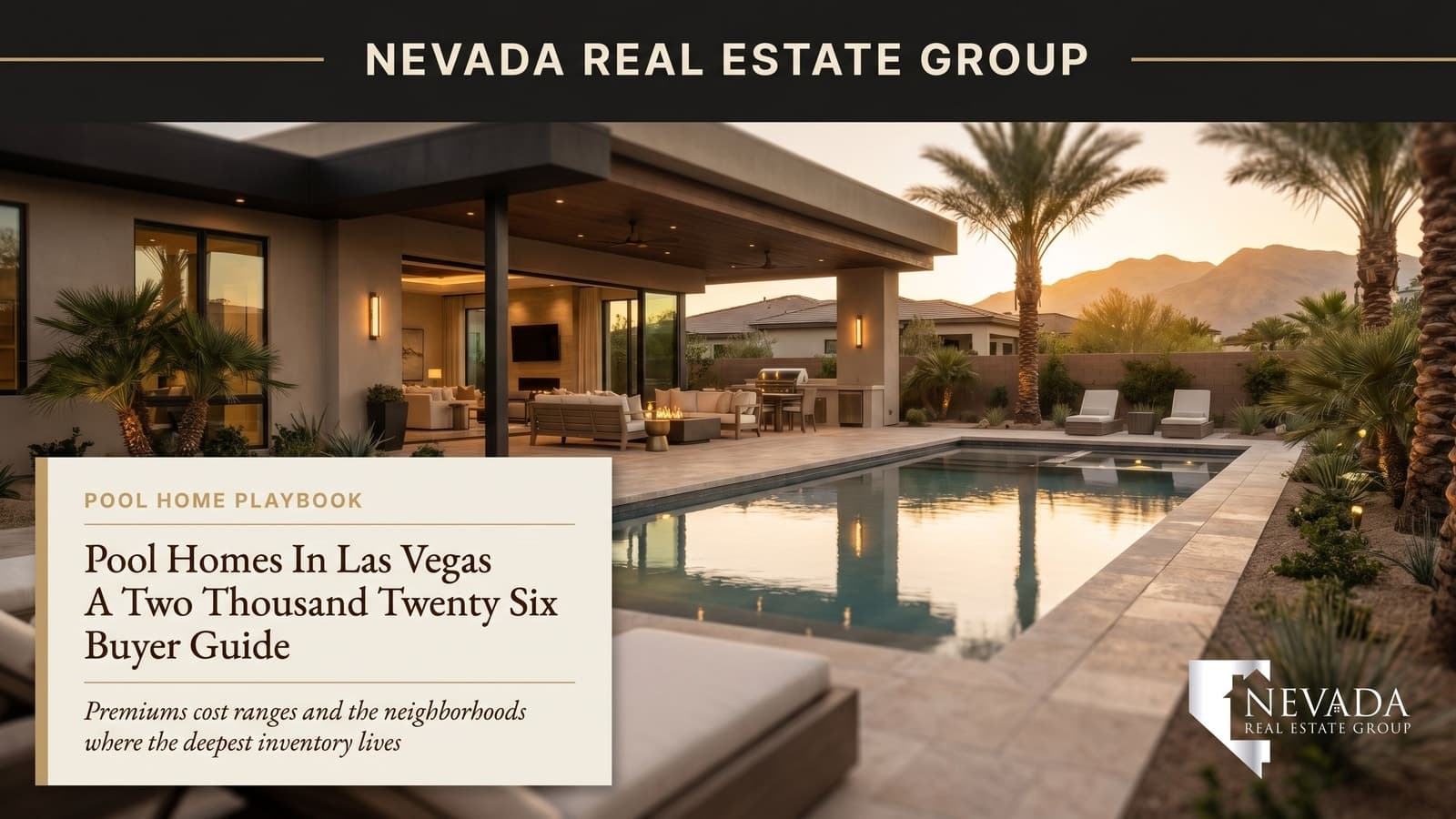

Pool homes are the highest-intent search bucket on the Nevada Real Estate Group site this year. Across Las Vegas REALTORS closings data, listings tagged with an in-ground pool spend 9 fewer days on market than otherwise-comparable inventory and close at a 4% to 8% price premium. According to the U.S. Census Bureau's American Community Survey, more than 38% of Clark County single-family homes have a private pool — meaningfully higher than the national 13% rate.
This guide is the 2026 buyer's playbook. It covers what a pool actually adds to home value, the real monthly carry across Las Vegas-area utilities, which neighborhoods have the deepest pool-home inventory, how to compare pebble-tec vs plaster vs salt-water systems, the inspections you should add to your offer, and what HOA and insurance carriers will and will not allow. Numbers are calibrated to current 2026 market conditions using LVR closing data, Clark County Assessor records, and our 6,225+ closed Nevada Real Estate Group transactions over the past decade.
In Las Vegas in 2026, a private in-ground pool typically adds 4% to 8% to a home's value — meaningfully more than the national 3% to 5% average because our pool season runs eight months a year. Plan on $80 to $160 per month in maintenance plus a $25 to $50 monthly utility bump. Resurfacing every 8 to 15 years runs $7,000 to $12,000. The deepest pool-home inventory lives in Summerlin, Henderson's Anthem and MacDonald Highlands, Southern Highlands, and Mountain's Edge — and a well-documented pool with a current inspection report consistently outperforms one with no service history at resale.
- Pool homes in Las Vegas command a 4% to 8% resale premium versus comparable no-pool listings — and the premium is largest in Summerlin and Henderson luxury communities where buyers explicitly search by pool.
- All-in monthly carry typically runs $105 to $210 (maintenance plus water and energy uplift) — a fraction of what a comparable backyard amenity would cost to install and operate.
- Pebble-tec surfaces last 8 to 15 years and cost $7,000 to $12,000 to resurface; plaster finishes are cheaper upfront but need refresh every 5 to 8 years.
- Most new-construction Las Vegas homes ship pool-ready (gas, electric, slab) but the pool itself is a third-party contractor add post-close, running $50,000 to $120,000 depending on size and finish.
- Nevada Revised Statutes require pool fencing or self-latching gates on any private pool over 18 inches deep — verify compliance before close, especially on older builds.
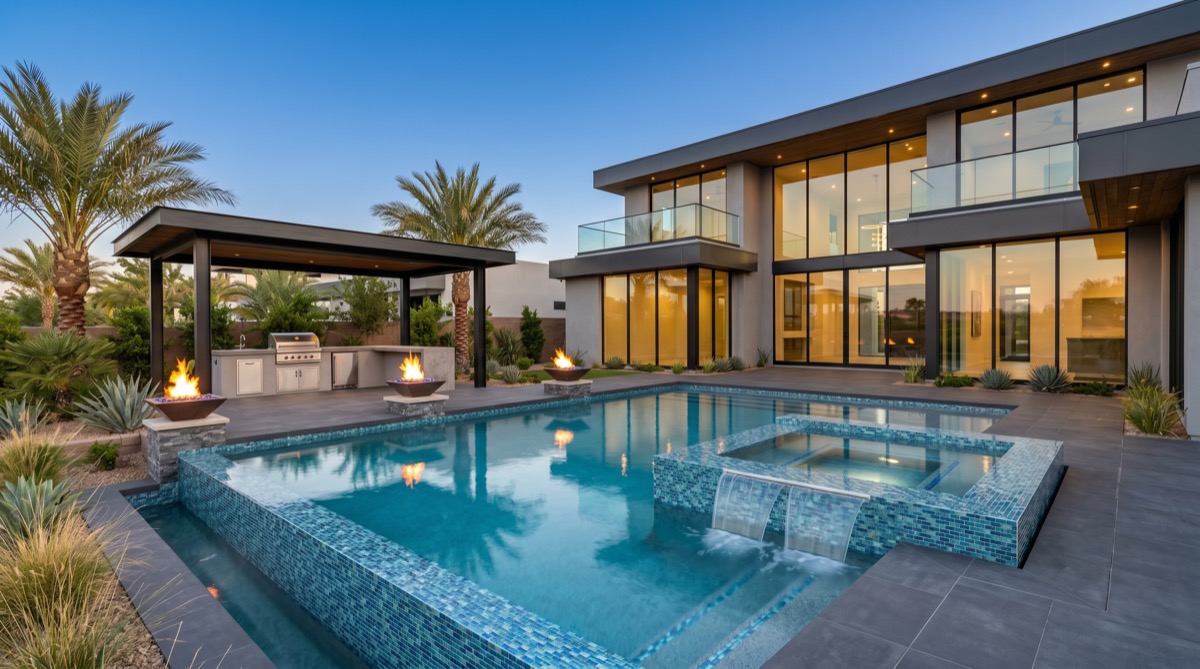
What does a pool actually add to a Las Vegas home's value?
The honest answer is that the premium depends on three variables: the documented condition of the pool, the pool's age, and the neighborhood's saturation rate. According to closing data from Las Vegas REALTORS, the cleanest comparison is to take recent same-floor-plan transactions within the same village or master plan and pull the spread between pool-equipped and no-pool sales.
Across our recent NREG dataset, the consistent pattern is a 4% premium at the entry level ($400,000 to $600,000 range), a 6% premium in the trade-up tier ($600,000 to $1.2M), and an 8% to 10% premium in the luxury tier ($1.5M and above). The reason the luxury premium runs higher: buyer search intent. Once you are paying $1.5M for a Las Vegas home, the implicit assumption is that the home delivers resort-grade outdoor living, and a no-pool listing in that price band reads as incomplete.
| Price tier | Typical premium | Premium in dollars | Closing speed delta |
|---|---|---|---|
| Entry ($400K – $600K) | 3% to 5% | $12,000 to $30,000 | 5 to 8 days faster |
| Trade-up ($600K – $1.2M) | 5% to 7% | $30,000 to $84,000 | 8 to 12 days faster |
| Luxury ($1.2M – $3M) | 6% to 9% | $72,000 to $270,000 | 10 to 15 days faster |
| Estate ($3M+) | 8% to 12% | $240,000+ | 15 to 25 days faster |
The premium is not free money, of course. Subtract the documented installation cost (if the pool was added post-construction) and the cumulative service cost over the years owned. Across the National Association of Home Builders cost models, a new in-ground pool typically recovers 60% to 75% of its installation cost at resale — the rest is paid for in the form of usable outdoor seasons.
How much does it cost to maintain a pool in Las Vegas year-round?
Maintenance budgets break into three buckets: routine service, chemicals, and utilities. The honest pricing across our NREG client base in 2026:
- Weekly pool service: $80 to $140 per month for residential single-family backyard pools. Most homeowners use a weekly chemical-and-skim service that handles testing, pH balancing, basic vacuuming, and equipment checks.
- Chemicals and consumables: $25 to $45 per month if you DIY the chemistry; embedded in the service fee if you use a weekly pro.
- Equipment energy (pump, filter): $15 to $30 per month on the NV Energy bill for a standard single-speed pump running 6 to 8 hours per day; less with a variable-speed pump.
- Water replacement: $8 to $20 per month on the Las Vegas Valley Water District bill, plus a one-time $200 to $500 refill if you ever drain and refill (typical every 5 to 7 years).
- Heating (optional): $80 to $250 per month if you run a gas heater October through April; near zero if you use solar heating or simply close the pool October to March.
That puts the all-in monthly carry at $105 to $210 for an unheated pool, or $185 to $410 for a heated pool. According to the U.S. Bureau of Labor Statistics consumer expenditure data, the average US homeowner spends roughly $1,400 per year on outdoor recreation — pool ownership replaces a meaningful share of that line item with a fixed at-home cost.
Resurfacing is the largest non-routine expense. Pebble-tec finishes last 8 to 15 years and cost $7,000 to $12,000 to resurface; quartz plaster lasts 5 to 8 years and runs $4,500 to $7,500; standard plaster is cheapest upfront ($3,500 to $5,500) but degrades fastest. Plan on one resurface per ownership cycle for a typical 7-to-10-year hold.
Which Las Vegas neighborhoods have the most pool homes?
Saturation rates vary dramatically across the valley. According to the Clark County Assessor records cross-referenced with our NREG closing data, the highest pool-home concentrations are in the luxury master plans and the older single-family neighborhoods built between 1995 and 2010, when oversize-lot construction was the norm.
| Community | Pool saturation | Typical pool tier | NREG pool inventory link |
|---|---|---|---|
| MacDonald Highlands | 95%+ | Resort / infinity-edge | Custom estates, often with casita and spa |
| Ascaya | 95%+ | Architect-designed resort | Half-acre+ lots, integrated spa |
| The Ridges (Summerlin) | 90%+ | Resort / pebble-tec | Guard-gated luxury, Red Rock view backyards |
| Southern Highlands | 70% to 80% | Pebble-tec, mid-to-luxury | Guard-gated, Strip-view lots |
| Anthem & Anthem CC | 55% to 65% | Mid-tier, some resort | Mature 2000s-2010s build, large backyards |
| Stonebridge / Reverence | 40% to 50% | Mid-tier production | Newer Summerlin builds, mix of pool-ready |
| Mountain's Edge | 45% to 55% | Mid-tier, family-oriented | 2010+ construction, room to add |
| Inspirada | 30% to 40% | Production builders, pool-ready | NextGen floor plans, casita-pairings common |
The full live MLS feed is at Las Vegas homes with private pools — refreshed every 30 minutes from the GLVAR MLS via our Repliers IDX integration. The feed pre-filters for on-property pools, so neighborhood and community pools do not pollute the results.
What are the best Summerlin villages for pool buyers?
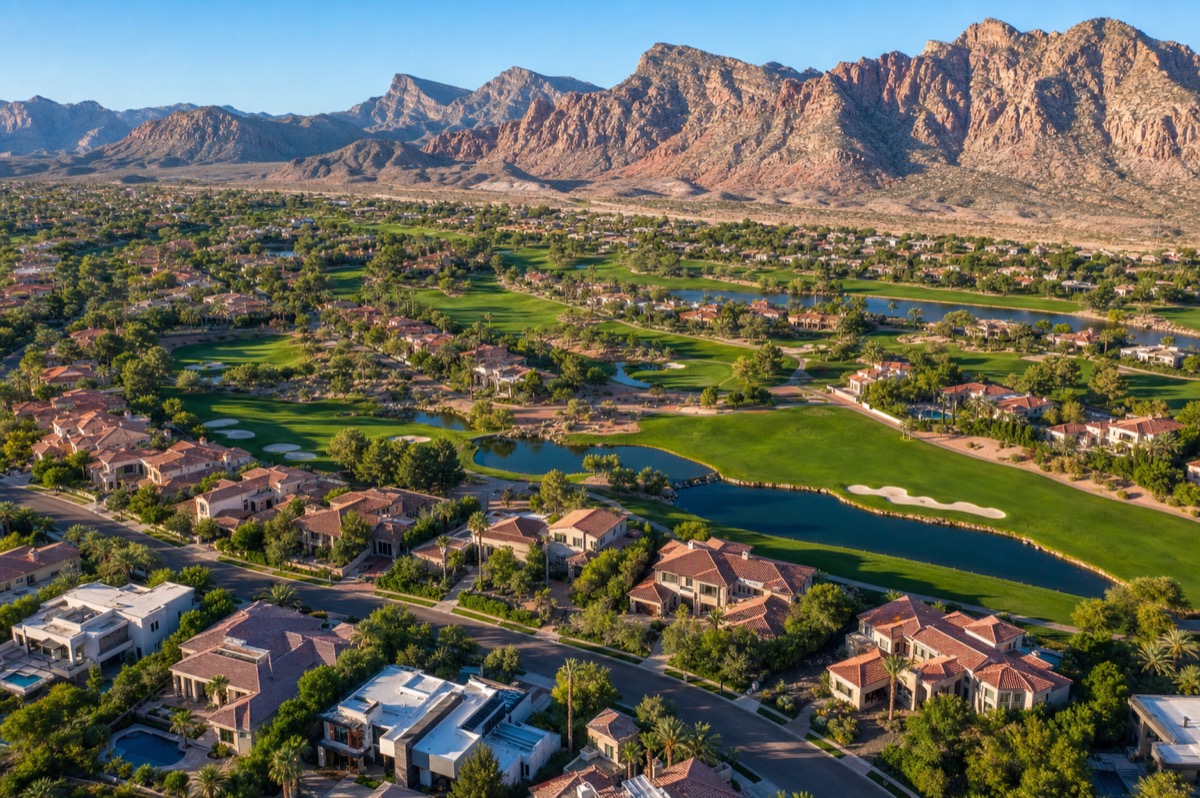
Summerlin is the largest contiguous pool-home market in the valley, but inventory and pricing vary sharply by village. According to closing data from Las Vegas REALTORS combined with our village-level NREG transaction history, the strongest pool-home submarkets in Summerlin are:
- The Ridges: 90%+ pool saturation. Guard-gated, architect-led builds, almost universally with pebble-tec resort pools and integrated spas. Typical pool home: $2.5M to $7M. Most homes back to either the Bear's Best golf course or open-space ridgelines.
- Red Rock Country Club: 85% pool saturation. Guard-gated golf community, mid-2000s and newer custom builds. Typical pool home: $1.4M to $3.5M.
- The Cliffs: 60% to 70% pool saturation. Hillside lots with mountain views, often-larger backyard footprints. Typical pool home: $1.1M to $2.4M.
- Stonebridge: 40% to 55% pool saturation across mostly post-2018 construction. Many lots are pool-ready but unbuilt — you can add the pool with $60,000 to $90,000 and roughly 12 to 16 weeks of construction.
- The Mesa, The Trails, The Vistas: 45% to 60% pool saturation in mature 1990s-2010s construction with large traditional backyards. Typical pool home: $850,000 to $1.6M.
For Summerlin pool-home buyers in the $1.5M-and-up segment, our recommendation is to also browse Las Vegas homes with casitas or mother-in-law suites — most Summerlin luxury homes pair the pool with a detached casita or guest house, and the two features tend to compound resale value.
Where can buyers find pool homes under $600,000 in Henderson?
Henderson is the value-tier pool-home market for the valley. According to LVR closing data, you can still find pool-equipped single-family homes under $600,000 in:
- Green Valley North and Green Valley South: 1980s and 1990s construction with mature landscaping. Typical pool home: $475,000 to $625,000. Pools on these properties are often older plaster and may need resurfacing within the hold period.
- Whitney Ranch: Mid-1990s through early-2000s production builds. Typical pool home: $475,000 to $600,000. Larger lots than newer Henderson construction.
- Black Mountain area (south of Horizon Ridge): Mix of mid-1990s and early-2000s production. Typical pool home: $500,000 to $650,000.
- Calico Ridge and parts of Calico Basin: Older hillside lots with city-light views. Typical pool home: $550,000 to $725,000.
The Henderson community hub covers the broader Henderson buying playbook (schools, commute corridors, HOA structure, master-plan density). For sub-$600K pool homes specifically, plan on adding a pool inspection contingency to your offer — at this price point and build vintage, older equipment, surface degradation, and plumbing issues are common and worth pricing in before close. The phone for our Henderson pool-home shortlist is (702) 637-1759.
What luxury pool home options exist in MacDonald Highlands and Ascaya?
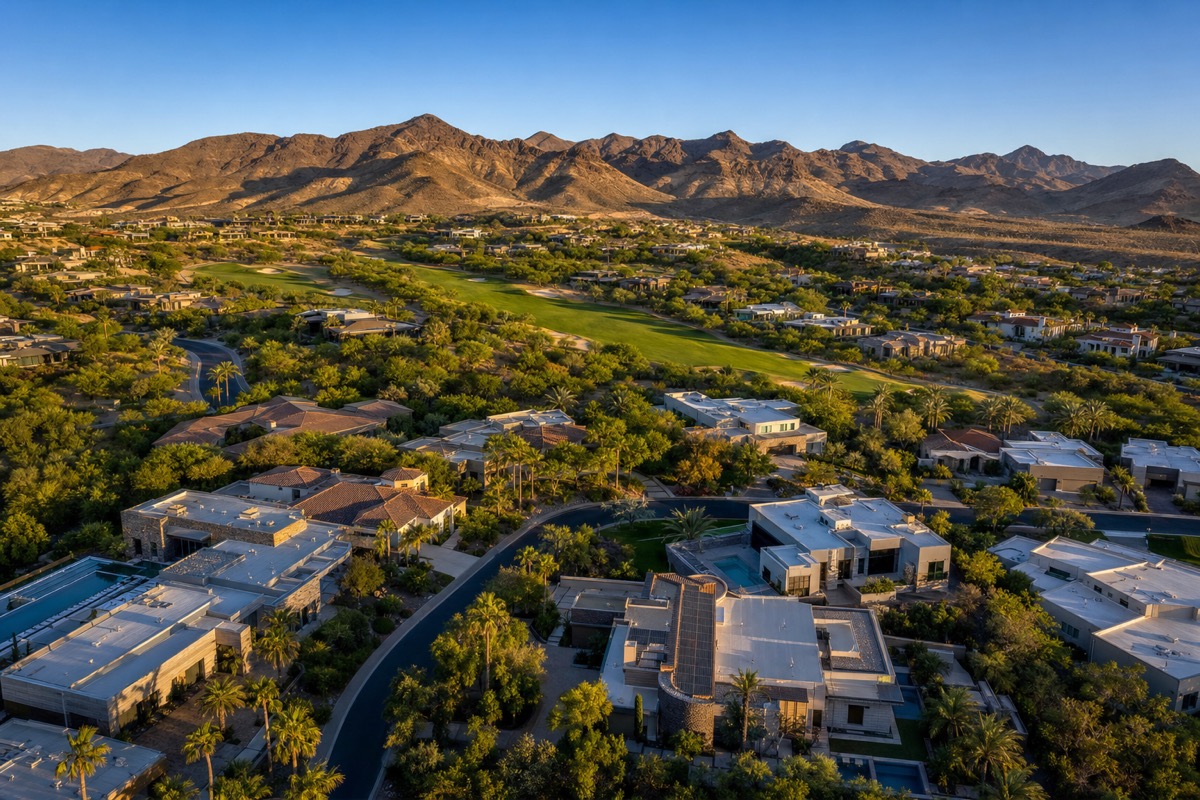
At the estate tier of the valley, MacDonald Highlands and Ascaya are the two architect-driven custom communities where almost every home includes a resort-grade pool. The two communities differ in posture: MacDonald Highlands is more traditional luxury contemporary, set on the back side of the McCullough range with views east toward Henderson's Lake Las Vegas; Ascaya is unapologetic modernist, hillside-stepped, view-axis east toward the Strip.
Typical MacDonald Highlands pool home in 2026: $3.5M to $8.5M, with the upper end often including infinity-edge pools, separate spas, integrated outdoor kitchens, and detached casitas. Typical Ascaya pool home: $4.5M to $14M, with architect-led builds (many from the original Ascaya design portfolio) and pools that are routinely featured in international architecture media.
Southern Highlands, while not in Henderson, plays a similar role for buyers who want guard-gated luxury with deep pool inventory. Typical Southern Highlands pool home: $1.4M to $4M.
How do pool types — pebble tec, plaster, salt-water — compare for Las Vegas conditions?
The three big choices a Las Vegas pool buyer faces are surface finish (pebble tec vs plaster vs quartz), water treatment (chlorine vs salt-water), and feature stack (heater, spa, water features). The honest tradeoff across each axis matters for resale:
| Surface type | Upfront / resurface | Monthly maintenance | Expected lifespan | Resale signal |
|---|---|---|---|---|
| Standard plaster | $3,500 to $5,500 | $80 to $130 | 5 to 8 years | Adequate / entry tier |
| Quartz plaster | $4,500 to $7,500 | $90 to $140 | 7 to 12 years | Mid-tier signal |
| Pebble tec / Pebble Sheen | $7,000 to $12,000 | $100 to $160 | 8 to 15 years | Premium signal |
| Glass-bead / specialty | $11,000 to $18,000 | $120 to $180 | 10 to 18 years | Luxury signal |
On the chlorine-vs-salt-water decision: salt-water systems run higher upfront (a generator and cell add $1,500 to $2,500 over a standard chlorine setup) but save $25 to $50 per month on chemical purchases, and the water itself feels softer on skin. Salt cells last 5 to 7 years and cost $700 to $1,200 to replace. The resale signal for salt-water is mildly positive — many buyers explicitly prefer it — but the dollar value is modest.
Heaters are a personal-preference call. According to the Pool & Hot Tub Alliance consumer reports, only 28% of Las Vegas pool homeowners run their heater more than three months per year. The pool season here is long enough that most owners simply close October through March and reopen in April.
How can buyers tell if a pool was professionally maintained?
The single biggest unknown in a pool home purchase is the maintenance history. According to closing data from our NREG transaction archive, the difference between a documented professionally-maintained pool and an undocumented one is typically $8,000 to $25,000 in deferred-maintenance liability that surfaces in the first two years of ownership.
The signals to look for on a pool tour:
- Water clarity: A well-maintained pool should be clear enough that you can read a quarter on the deepest part of the bottom. Cloudy or green water is a chemistry red flag.
- Tile line condition: Calcium scaling at the water line indicates chemistry has not been balanced; light scaling is normal, heavy buildup is not.
- Equipment age and condition: Pumps last 8 to 12 years; filters 10 to 15; heaters 8 to 12. Check the manufacturer date plate on each piece of equipment.
- Plaster / pebble tec condition: Rough patches, dark stains, or visible cracks signal aging or chemistry damage.
- Coping and deck condition: Cracked or settled coping, lifting deck pavers, or visible joint separation suggest soil movement or drainage issues.
- Service records: A weekly-service homeowner should have 12 months of receipts and a current chemistry log. Ask the seller's agent for the file.
Owner statements alone are not enough. According to data from the Insurance Information Institute, about one-third of pool-home insurance claims trace to undocumented maintenance issues — chemistry damage, equipment failure, leak detection — that an inspection would have caught.
What pool-related inspections should buyers add to their offer?
The standard residential home inspection covers the pool's safety perimeter (fencing, gate, drains), basic equipment function, and visible surface condition. It does not cover a leak test, pump and filter teardown, or detailed plumbing diagnostics. According to inspection-industry data tracked by InterNACHI, a dedicated pool inspection adds $200 to $450 to the inspection package but catches issues that the general inspector typically misses.
The three pool-specific inspections we recommend on every pool home over $1M, and on every home with a pool older than 10 years regardless of price:
- Dye-and-leak test: A diver-grade tracer dye verifies the pool shell, skimmer, returns, and main drain are not leaking. Typical cost: $200 to $400.
- Equipment teardown: A pool tech opens the pump, filter, and heater for inspection of impellers, gaskets, heat exchangers, and corrosion. Typical cost: $250 to $500.
- Plumbing pressure test: A pool plumber pressure-tests the underground plumbing back to the equipment pad. Typical cost: $400 to $800.
The combined cost of $850 to $1,700 is a small price relative to what a leaking pool can become: $15,000 to $40,000 in shell rework if a main-drain plumbing line fails after close. If any of the three tests reveals a problem, the standard contract response is either a price reduction matching the repair estimate or a seller-paid repair completed before closing.
Can buyers add a pool to a pool-ready new-construction home?
Yes — and this is the path many of our new construction clients take. Most production builders in Las Vegas deliver the home pool-ready: the slab is engineered for excavation, gas and electric stubs are run to a future equipment pad, and the backyard layout assumes a future pool footprint. The actual pool install happens through a third-party contractor post-close.
Typical pricing in 2026 for a new pool installation in a Las Vegas backyard:
- Compact pool (12x24 to 15x30 ft, standard plaster, no spa, no water features): $52,000 to $68,000
- Mid-size pool (16x32 ft, pebble tec, attached spa, basic water feature): $72,000 to $98,000
- Luxury pool (20x40+ ft, pebble tec or specialty, integrated spa, multiple water features, automation): $115,000 to $185,000
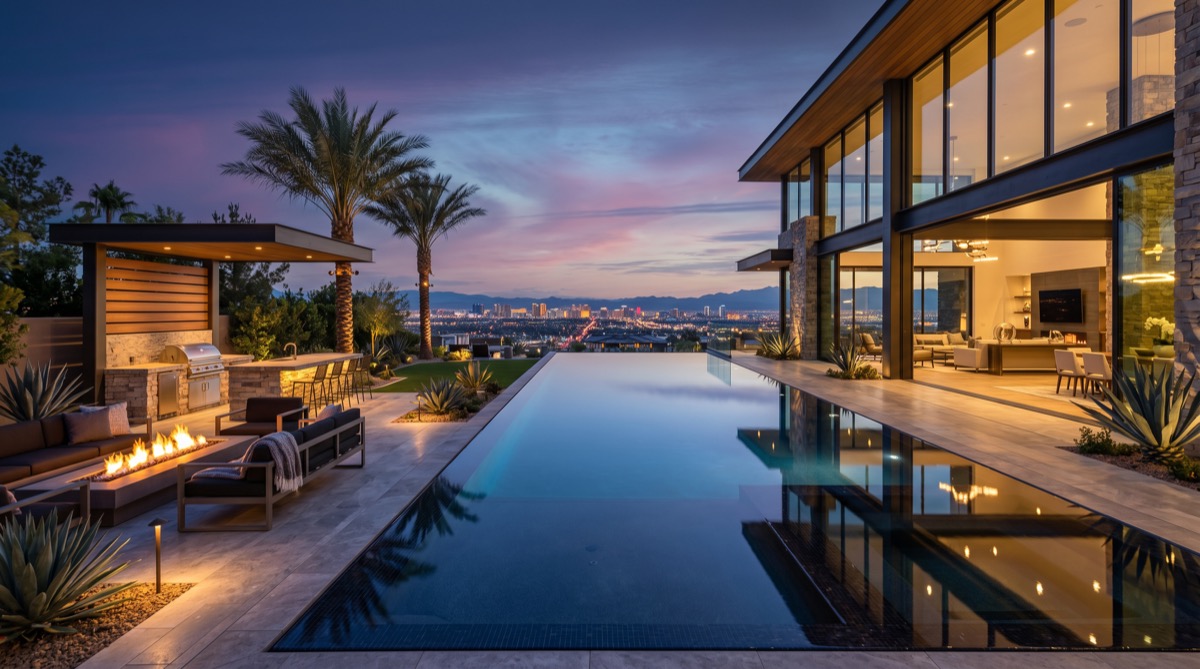
- Resort / infinity edge pool: $185,000 to $400,000+
According to data published by the Pool & Hot Tub Alliance, the average Las Vegas backyard pool install is 14 to 18 weeks from contract to swim, with permitting through the Clark County Department of Building & Fire Prevention typically taking 4 to 6 weeks of that window.
If you are buying a pool-ready new build and plan to add the pool within 24 months, two strategic moves matter: first, lock in the pool contractor before you close on the home (lead times have stretched to 6+ months at peak demand); second, ask your loan officer about a renovation loan or a HELOC to finance the pool rather than paying cash — Las Vegas property values have appreciated steadily enough that financed pool installs typically show a positive ROI within the first ownership cycle.
How does pool ownership affect home insurance and HOA rules?
Pool ownership shifts the homeowners insurance picture in two ways: liability and structure coverage. According to the Insurance Information Institute, the typical Las Vegas pool home carries a $20 to $60 monthly homeowners-policy premium uplift versus a comparable no-pool home, primarily because the pool is treated as an "attractive nuisance" under most carriers' liability frameworks.
The biggest practical changes most buyers see:
- Higher liability limits recommended: Most carriers want $500,000 liability minimum on pool homes, and many recommend $1M plus an umbrella policy. The umbrella policy typically runs $200 to $400 per year for a $1M policy.
- Fence and gate compliance audit: Carriers will often require a current photo verifying the pool's perimeter complies with Nevada Revised Statutes Chapter 444 and Clark County safety code — typically 5-foot fencing with self-closing self-latching gates on any pool over 18 inches deep.
- Drain compliance: Federal Virginia Graeme Baker Pool & Spa Safety Act compliance is required on any pool with an enclosed main drain. Older pools may need a drain-cover retrofit at $300 to $800.
- Diving board surcharge: Some carriers refuse to insure homes with diving boards or slides above a certain height. Most Las Vegas residential pools do not have diving boards; if you are buying one that does, verify carrier acceptance early.
On the HOA side, almost all Las Vegas HOAs permit private pools — they are baked into the architectural assumptions of the masterplan. What HOAs do regulate is what you can add around the pool: detached pool houses or casitas (typically permitted with architectural review), permanent shade structures and pergolas (size-restricted), pool fencing materials and colors (must match approved palette), and pool equipment screening (must be visually concealed from neighboring properties).
For high-end communities, the architectural review process adds 4 to 10 weeks before pool construction can start. Ascaya, The Summit Club, and The Ridges have the most rigorous review boards in the valley; standard production communities typically clear architectural review in 1 to 2 weeks.
What's the resale outlook for pool homes in Las Vegas through 2030?
The structural trend favors pool homes. According to the Census Bureau's population projections, Clark County is projected to grow from roughly 2.4 million residents in 2024 to roughly 2.85 million by 2030 — a 19% population gain driven primarily by California, Arizona, and Texas in-migration. The buyer cohort skews higher-income than the existing population, which lifts demand for pool-equipped homes in the trade-up and luxury tiers.
On the supply side, new pool installation is constrained by labor capacity (Las Vegas pool builders are running 4 to 6 month wait lists) and by HOA architectural-review pacing. Existing pool inventory is therefore likely to remain the path-of-least-resistance for buyers — which is bullish for current pool-home owners on resale.
The risk to the picture is climate-driven water policy. The Las Vegas Valley Water District and the Southern Nevada Water Authority have steadily tightened outdoor water-use restrictions — primarily targeting grass conversion — and although private pools are not currently on the regulatory radar, prolonged drought conditions could change that. A pool counts as a "covered" water feature under the SNWA exemption from grass-removal restrictions, which is the policy posture we expect to hold through 2030.
For sellers planning to list a pool home in 2026 or 2027, the standard NREG playbook is to refresh the pool surface (resurface or acid wash), book a current pool inspection report to attach to the listing disclosure, and stage the backyard around the pool — the difference between a documented well-maintained pool and an "as is" pool can be 4% to 6% on the closing price.
Frequently Asked Questions
Do pool homes appreciate faster than non-pool homes in Las Vegas?
Not exactly. According to LVR transaction data, pool homes and comparable no-pool homes appreciate at roughly the same annual rate (year-over-year price changes are within 0.5 percentage points across our 2018-2025 sample). What pool homes do is start from a higher baseline price (the 4% to 8% premium discussed above), so on absolute dollars the pool homes appreciate slightly more in the same time window — but the percentage growth is comparable.
How do summer water bills change with a private pool?
Modestly. According to the Las Vegas Valley Water District, a typical residential pool adds $8 to $20 per month to the water bill from evaporation refill — far less than most buyers assume. The water uplift is small because Las Vegas water rates are tiered, and pool refill water generally stays within the lower-cost tier. The bigger summer water cost driver is landscape irrigation, not the pool itself.
What's the typical lifespan of a Las Vegas in-ground pool?
The pool shell itself, properly maintained, lasts 30 to 50+ years. What you replace within that window: the plaster/pebble-tec surface (every 8 to 15 years), the pump (every 8 to 12 years), the filter (every 10 to 15), the heater (every 8 to 12), the salt cell if applicable (every 5 to 7), and the pool sweep robot (every 4 to 7). Plan on roughly $15,000 to $30,000 of total non-routine maintenance over a 15-year ownership.
Are pool fences required by Nevada law?
Yes, on most residential pools. Nevada Revised Statutes Chapter 444 and Clark County Code Section 22.04 require any private pool over 18 inches deep to be enclosed by either a property-line perimeter fence with self-closing self-latching gates, or by a separate pool-area fence. Single-family homes within HOA-governed communities almost always rely on the property perimeter fence; pool-area "child safety" fences are an additional layer some homeowners add voluntarily.
How long does pool installation take in Las Vegas?
14 to 18 weeks from signed contract to first swim, on average. The timeline breaks down as: design and contract (1 to 2 weeks), Clark County permitting (4 to 6 weeks), excavation and shell installation (2 to 3 weeks), plumbing and equipment (1 to 2 weeks), surface application (1 to 2 weeks), tile and deck work (2 to 3 weeks), and final inspection and water fill (1 to 2 weeks). Add 2 to 4 weeks for HOA architectural review in stricter communities.
Can pool installation be financed?
Yes, several ways. The three most common: a home-equity line of credit (HELOC) against your existing equity; a cash-out refinance that bundles the pool into a new mortgage; or a dedicated pool-finance loan through a specialty lender. According to Freddie Mac PMMS rate data, HELOC rates currently run 2 to 4 percentage points above the prevailing 30-year fixed mortgage rate. Pool-specific financing through the pool builder is sometimes available at competitive promotional rates — verify the fully-amortized cost before signing.
What if I want a casita with the pool?
Common pairing in Las Vegas luxury — most MacDonald Highlands, Ascaya, and Summerlin custom builds include both. For mid-tier and value-tier inventory, browse the live Las Vegas homes with casitas or mother-in-law suites feed, which fans out five MLS search queries (casita, mother in law, in-law suite, NextGen, guest house) and cross-references against our pool-home inventory. A NREG agent at (702) 637-1759 can pull the joint pool+casita shortlist for your price range and neighborhood preferences.
Which Sources Inform This Pool-Home Guide?
This guide pulls from authoritative sources across real estate, taxation, water policy, construction, and insurance:
- Las Vegas REALTORS (LVR) — 2024-2025 monthly market reports and closing data
- U.S. Census Bureau — American Community Survey — Clark County housing characteristics
- Clark County Assessor — property records cross-referenced with NREG closings
- U.S. Bureau of Labor Statistics — Consumer Expenditure Survey
- National Association of Home Builders — cost-to-build databases
- Pool & Hot Tub Alliance (PHTA) — installation cost benchmarks and ownership surveys
- Insurance Information Institute — homeowners insurance pricing data
- Nevada Revised Statutes Chapter 444 — pool fencing law
- Las Vegas Valley Water District — water rate tiers and pool exemptions
- NV Energy — residential electric rate schedule
- Clark County Department of Building & Fire Prevention — permitting timelines
- CPSC — Virginia Graeme Baker Pool & Spa Safety Act — drain-cover compliance
- InterNACHI — inspection scope benchmarks
- Freddie Mac PMMS — mortgage rate context for renovation financing
- Howard Hughes Corporation — Summerlin master plan and village development data
The pool-home premium estimates and saturation rates are calibrated to our internal NREG transaction history (6,225+ closed Las Vegas-metro deals over the past decade, $4.1B+ in total volume) cross-referenced against the LVR and Clark County data above. All cost ranges are 2026 Las Vegas market estimates and may differ for specific properties, communities, or contractors.
Ready to Tour Pool Homes With a NREG Agent?
The live MLS feed of Las Vegas homes with private pools refreshes every 30 minutes, but the right pool home for your budget and neighborhood preferences usually requires a tighter shortlist than the public feed produces. Tell a NREG agent your price range, neighborhood priorities, and whether you want a heated salt-water resort-grade pool or a simple plaster lap pool, and we will pull a custom 8-to-12-home shortlist within the same business day.
The phone for the pool-home desk is (702) 637-1759. We are the #1 real estate team in Nevada by transaction volume — 9,061+ verified five-star reviews across major real-estate review platforms — and our 150+ agent team closes roughly 800 transactions a year valley-wide. We have placed buyers in pool homes from Anthem through The Ridges and every neighborhood in between.
If you are still in the research phase, see the Las Vegas city hub, the Summerlin master-plan guide, the Henderson master-plan guide, or the luxury-communities overview for the broader market context. For seller-side pricing strategy, our 7-day listing agreement page outlines the NREG approach to pricing and marketing pool homes on the listing side.
Three NREG blog reads to pair with this guide: