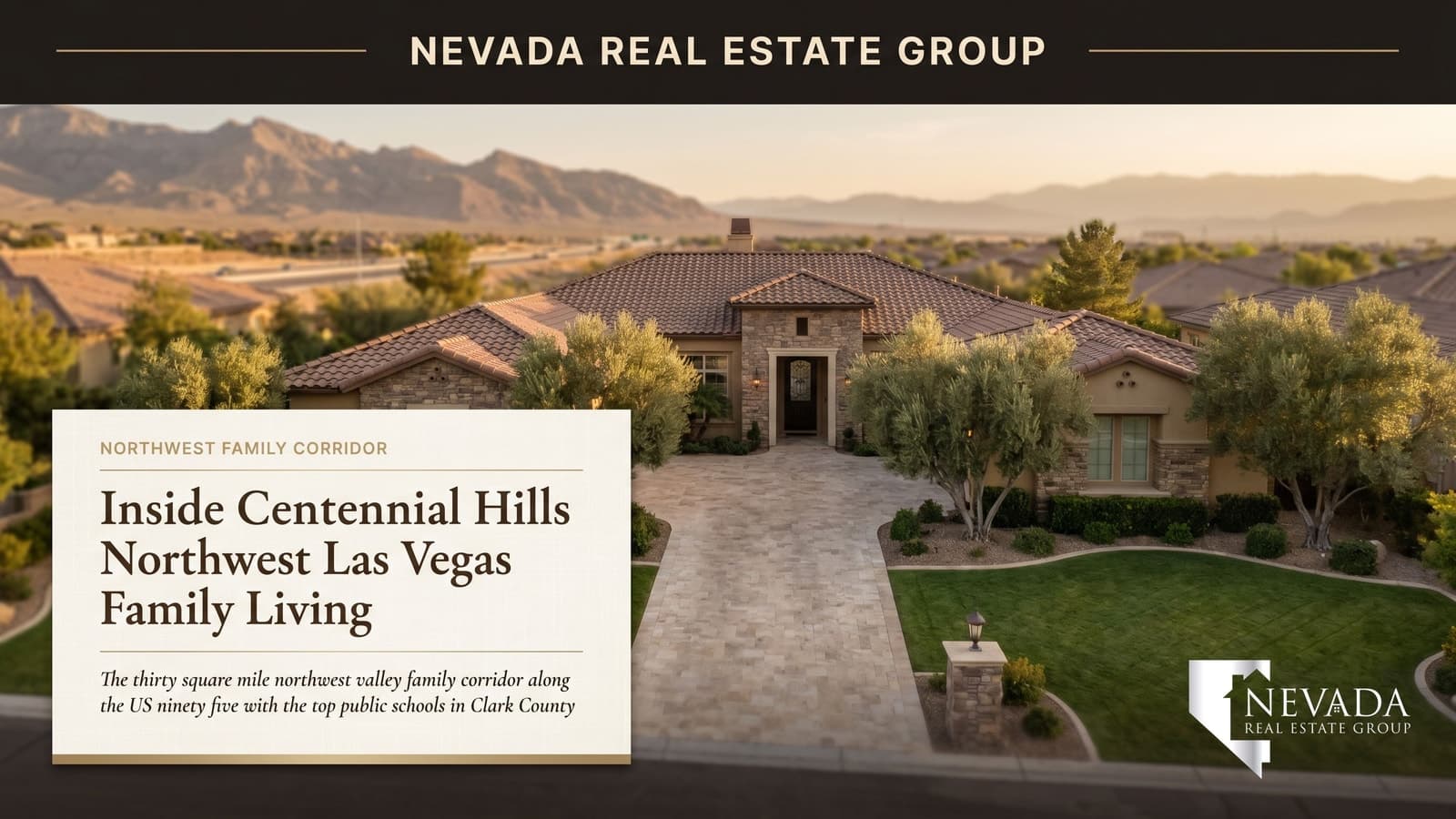

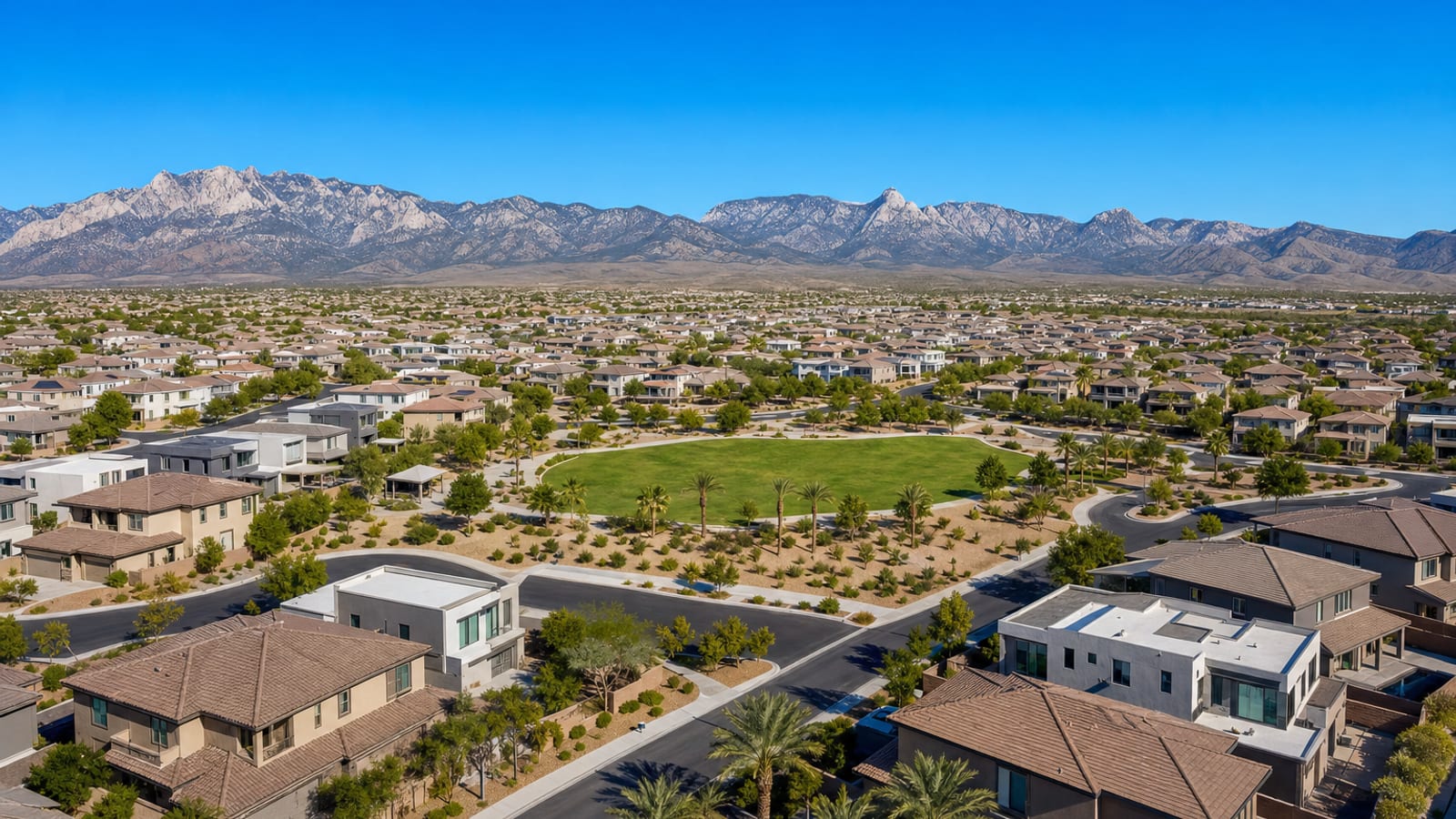
Centennial Hills is the established northwest Las Vegas family corridor — a roughly 30-square-mile area straddling the US-95 freeway between the Beltway (I-215) and the desert edge of the Spring Mountains foothills. The area is anchored by two master-planned communities (Providence and Iron Mountain Ranch), several large established neighborhoods (Eldorado, Tournament Hills North, Lone Mountain), and the broader Centennial Hills Park system that gives the corridor its name. Home prices in 2026 run from approximately $375,000 for established resale starter homes up to over $1.5 million for newer custom builds, with the median 2026 closing landing around $575,000 per LVR data — meaningfully below Summerlin to the south but with comparable school quality at the entry tier.
What separates Centennial Hills from other northwest Las Vegas options is the CCSD school-cluster math. The area is served by some of the highest-rated public schools in the entire Clark County School District: Sig Rogich Middle School holds a 10 out of 10 GreatSchools rating, Palo Verde High School holds an 8 out of 10, and Bonner Elementary School holds a 9 out of 10. For relocating families who specifically want to anchor on top public schools without paying Summerlin's price premium ($650,000-plus entry), Centennial Hills is the structural value pick in the northwest valley. The trade-off is a slightly longer Strip commute (20 to 25 minutes versus Summerlin's 15 to 22 minutes) and a less commercially-dense walking-distance retail profile than Downtown Summerlin offers.
This guide is the buyer-side map for Centennial Hills in 2026: which sub-neighborhoods anchor the corridor and how each is priced, what Providence and Iron Mountain Ranch offer as established master plans, what the school cluster actually looks like in current GreatSchools data, what HOA dues run across the area, what Centennial Hills Park and the broader park system mean for outdoor-active families, what the resale market looks like in 2026, and how the area compares to neighboring Summerlin and Skye Canyon for relocating families. Every dollar figure cited is sourced from Clark County recordings and public Las Vegas REALTORS closing data referenced in the Sources & Methodology footer. The phone number throughout — (702) 637-1759 — connects to our Centennial Hills specialist team at Nevada Real Estate Group.
Centennial Hills is the established northwest Las Vegas family corridor straddling the US-95 freeway between the Beltway and the Spring Mountains foothills. The area covers approximately 30 square miles across multiple ZIP codes (89149, 89131, 89143, 89166) and includes the Providence and Iron Mountain Ranch master plans, the Eldorado and Lone Mountain established neighborhoods, and the 120-acre Centennial Hills Park system. Home prices in 2026 run from approximately $375,000 for established resale starter homes up to over $1.5 million for newer custom builds, with the median closing around $575,000. The CCSD school cluster includes Sig Rogich Middle School (10 out of 10 GreatSchools rating), Bonner Elementary (9 out of 10), and Palo Verde High School (8 out of 10) — among the highest-rated public schools in Clark County. HOA dues run from $0 (non-HOA established sections) to approximately $250 per month depending on neighborhood. The drive to the Las Vegas Strip is approximately 20 to 25 minutes via US-95 south.
- Centennial Hills spans approximately 30 square miles in northwest Las Vegas across ZIP codes 89149, 89131, 89143, and 89166, with home prices ranging $375,000 to $1.5 million-plus in 2026.
- The Providence master plan is the largest anchor sub-area — roughly 2,400 acres with mature family neighborhoods and the Providence Promenade retail center.
- Iron Mountain Ranch is the second major master plan — a smaller 850-acre Mediterranean-styled community with established mid-tier family homes.
- CCSD school cluster includes Sig Rogich Middle School (10/10 GreatSchools), Bonner Elementary (9/10), and Palo Verde High School (8/10) — top CCSD ratings.
- Centennial Hills Park is a 120-acre regional park — one of the largest in the valley — with full athletic facilities, an amphitheater, and trail connectivity.
- HOA dues range from $0 in non-HOA established sections to approximately $250 per month in master-planned sub-communities.
- The drive to the Las Vegas Strip is approximately 20 to 25 minutes via US-95 south — longer than Summerlin by approximately 5 to 8 minutes.
What exactly is Centennial Hills in 2026?
Centennial Hills is a geographically-defined northwest Las Vegas area rather than a single legally-bounded master plan — the City of Las Vegas uses Centennial Hills as the umbrella term for the roughly 30 square miles of residential development between the Beltway (I-215) to the south, US-95 to the east, the Spring Mountains foothills to the west, and the unincorporated desert edge to the north. The area includes multiple master plans, dozens of individual residential subdivisions, the Centennial Hills Park and Library, the Centennial Hills Hospital medical center, and the Centennial Center commercial corridor along Centennial Parkway.
According to U.S. Census Bureau estimates, the broader Centennial Hills area carries a population of approximately 165,000 residents as of 2026, making it one of the largest residential corridors in the City of Las Vegas (incorporated city) by population. According to City of Las Vegas planning documents, the area was first developed in significant volume in the mid-1990s as the city expanded northwest along US-95 — the original entitlements for the largest master plans (Providence, Iron Mountain Ranch) closed approximately 1994 through 1998, with primary build-out completing between 2002 and 2010. The corridor sits inside Las Vegas city limits (not unincorporated Clark County), served by Las Vegas Metropolitan Police Department, City of Las Vegas Fire & Rescue, and the Clark County School District for public education.
Where is Centennial Hills and why does the northwest positioning matter?
Centennial Hills sits in the northwest quadrant of the Las Vegas valley, bounded by US-95 (the Veterans Memorial Highway) on the east, the I-215 Beltway on the south, the rising desert and Spring Mountains foothills on the west, and the largely-undeveloped desert toward Tule Springs and Floyd Lamb Park on the north. The primary east-west arterials are Centennial Parkway (the namesake), Lone Mountain Road, and Ann Road. The primary north-south arterials are Buffalo Drive, Decatur Boulevard, and Tenaya Way. US-95 access is the dominant freeway connection, with multiple full interchanges across the corridor.
The drive to the Las Vegas Strip from Centennial Hills runs approximately 20 to 25 minutes during off-peak hours via US-95 south, with Harry Reid International Airport approximately 25 to 30 minutes via US-95 and I-15. This positions Centennial Hills meaningfully closer to the Strip than Aliante (28 to 33 minutes) and roughly 5 to 8 minutes farther than Summerlin (15 to 22 minutes) at comparable village positions. According to recent Las Vegas traffic studies, the US-95 corridor between Centennial Parkway and the Strip handles approximately 175,000 daily vehicle trips, with peak-hour southbound congestion the most significant commute risk. Most Centennial Hills residents who work on the Strip or downtown leave home before 7:00 a.m. or after 8:30 a.m. to avoid the peak.
What sub-neighborhoods make up Centennial Hills?
Centennial Hills is organized into approximately 10 named sub-neighborhoods plus the two anchor master plans (Providence and Iron Mountain Ranch). The largest by acreage are Providence (the dominant master plan in the central corridor), Iron Mountain Ranch (mid-corridor Mediterranean master plan), Eldorado (established 1990s-era family neighborhood east of US-95 in north Las Vegas's incorporated edge), Lone Mountain (older established west-corridor neighborhoods near the trailhead), Tournament Hills North (the Centennial Hills extension of the original Tournament Hills concept), Aliante West (the bordering Aliante section that physically sits in Centennial Hills geography), Lone Mountain Ranch, and several individual gated luxury enclaves along the Spring Mountains foothills.
The table below maps the major sub-neighborhoods, approximate 2026 active-listing price ranges, and notes. Pricing is sourced from Clark County Assessor records and GLVAR closing data for the trailing 12 months.
| Sub-neighborhood | Price range (2026) | Character | Notes |
|---|---|---|---|
| Providence | $425K to $1.2M | Established master plan | 2,400 acres, Mediterranean and Spanish revival |
| Iron Mountain Ranch | $475K to $1.05M | Master plan, Mediterranean | 850 acres, mid-tier family |
| Tournament Hills North | $485K to $1.4M | Established mid-tier | Larger lots, mature trees |
| Eldorado | $375K to $750K | 1990s established family | Non-HOA in many sections |
| Lone Mountain | $425K to $1.05M | Established 1990s-2000s | Western foothills, trail access |
| Tule Springs adjacent | $450K to $850K | Mixed established + newer | Edge of new construction |
| Aliante West (geographic) | $425K to $725K | Master plan adjacent | Crosses Aliante master HOA line |
| Centennial Center luxury | $725K to $1.5M+ | Newer custom | Foothill view orientation |
| Painted Desert | $425K to $785K | Established 1990s | Golf-course adjacent |
| Foothill estates | $700K to $1.5M+ | Custom hillside | Newer build, Spring Mountains views |
Across the area, the median 2026 closed sale at Centennial Hills runs approximately $575,000 per LVR data — meaningfully below Summerlin's median of approximately $725,000 and above the Las Vegas-wide median of approximately $450,000. The luxury tier (closings above $900,000) represents approximately 17 percent of transaction count but approximately 31 percent of total dollar volume across the corridor.
What is Providence and how does it anchor the established family tier?
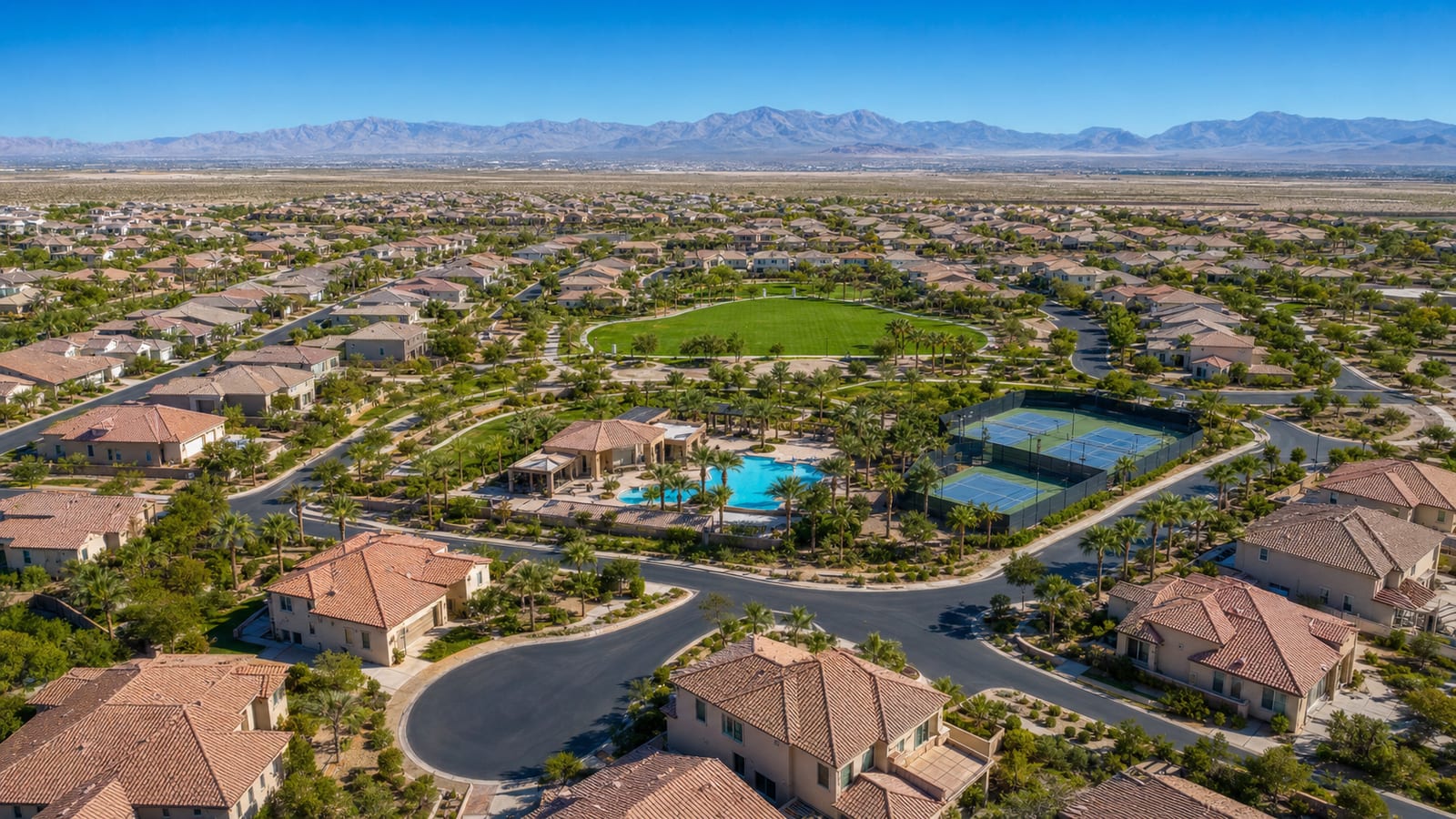
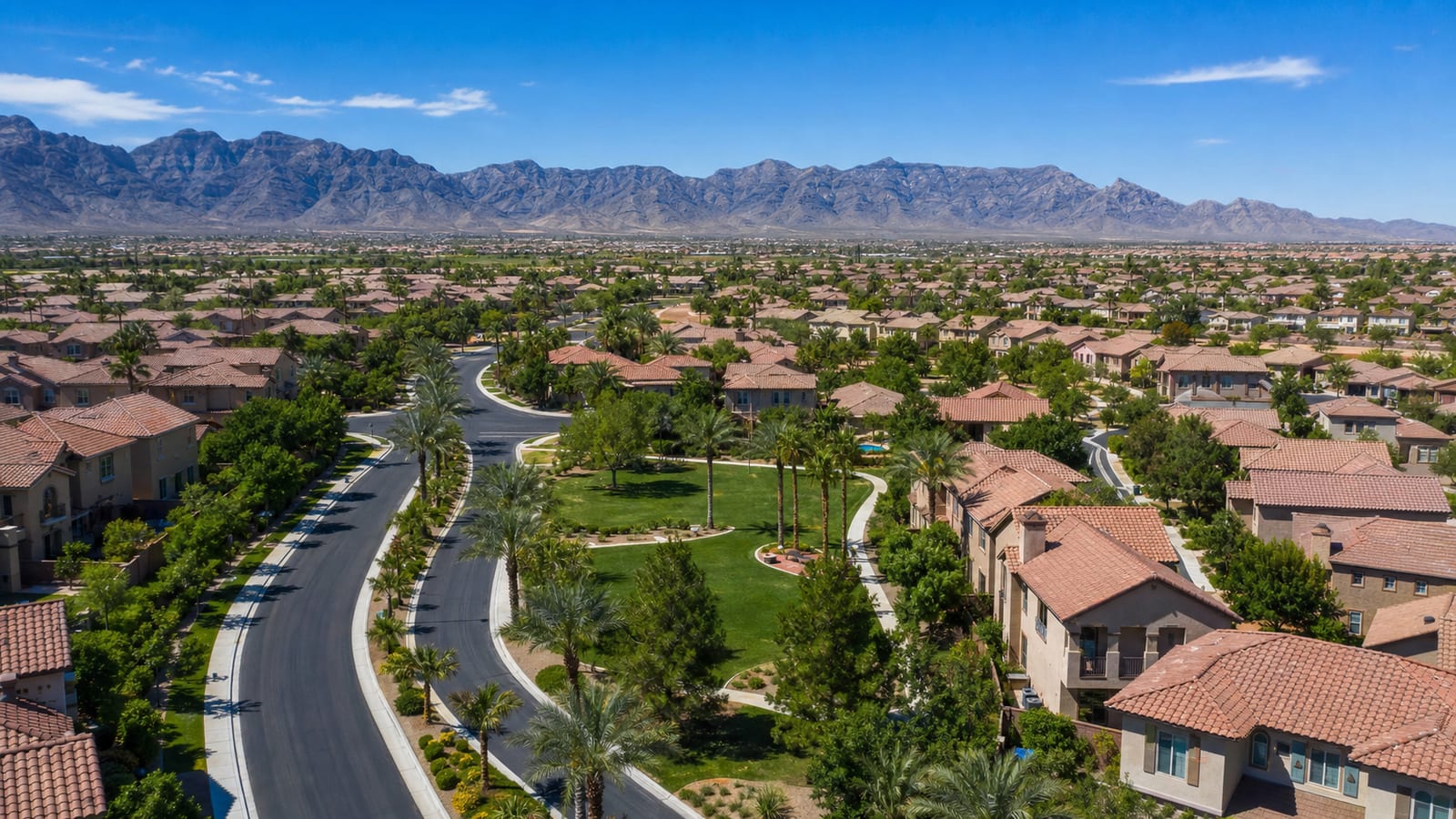
Providence is the largest master plan inside Centennial Hills — a 2,400-acre community developed by the Focus Property Group beginning in 1998 with primary build-out from 2002 through approximately 2010. The community contains approximately 6,500 homes at full build-out across multiple sub-villages with Mediterranean and Spanish revival architectural styling. Providence sits in the central Centennial Hills corridor between Lone Mountain Road and Centennial Parkway, with the Providence Promenade retail center anchoring the commercial component (grocery, dining, services).
Pricing at Providence in 2026 runs approximately $425,000 to $1.2 million, with the typical closing in the $525,000 to $700,000 range for 2,400-to-3,800-square-foot family homes. The community is fully built-out with no remaining master-developer new construction — all 2026 activity is resale. According to recent Clark County Assessor records, the highest-priced Providence closing in the past 24 months was approximately $1.34 million for a 4,800-square-foot custom home on a premium-corner lot. The bottom of the Providence market sits around $425,000 for entry-tier resale on smaller interior lots. Providence's commercial center (Providence Promenade) houses approximately 32 retail and dining tenants and serves as the primary daily-retail destination for the central corridor.
What about Iron Mountain Ranch and Eldorado as established sub-areas?
Iron Mountain Ranch is the second master plan inside Centennial Hills — a smaller 850-acre community north of Providence developed primarily between 2001 and 2008 with Mediterranean and Tuscan architectural styling. Iron Mountain Ranch contains approximately 2,100 homes at build-out, with the community organized around a smaller commercial center on Iron Mountain Road. Pricing in 2026 runs approximately $475,000 to $1.05 million, with most activity in the $550,000 to $725,000 range for 2,200-to-3,400-square-foot family homes.
Eldorado is the original 1990s-era family neighborhood east of US-95 — technically partly inside Las Vegas city limits and partly inside North Las Vegas city limits — that predates the larger 2000s master plans. Eldorado runs less expensive than Providence or Iron Mountain Ranch at the same square-footage tier (approximately 12 to 18 percent lower per square foot) because of older construction vintage and a substantial share of non-HOA sections. Pricing in 2026 runs approximately $375,000 to $750,000, with the bulk of activity in the $425,000 to $525,000 range. Eldorado is the structural value play for buyers who prioritize lower entry pricing and lower HOA carrying cost and who are comfortable with older 1990s housing stock that may need cosmetic updates.
Which schools serve the Centennial Hills address?
Centennial Hills is zoned to the Clark County School District (CCSD) with a mix of school assignments depending on specific sub-neighborhood — the area is large enough to span multiple feeder patterns. The top-rated public school cluster in the central corridor (covering Providence, Iron Mountain Ranch, and Tournament Hills North) feeds Bonner Elementary School, Sig Rogich Middle School, and Palo Verde High School. According to GreatSchools.org as of 2026, Sig Rogich Middle School holds a 10 out of 10 rating (the highest possible), Bonner Elementary holds a 9 out of 10, and Palo Verde High School holds an 8 out of 10. The Palo Verde / Rogich / Bonner combination is among the highest-rated public school clusters anywhere in the Clark County School District.
According to recent CCSD published zoning maps, school assignments are address-specific and the area's eastern boundary (closer to US-95) may feed into different schools than the central or western sub-neighborhoods. Eldorado in particular feeds into a different elementary cluster (Tomiyasu Elementary or Heard Elementary depending on the section) with slightly lower ratings (6 to 7 out of 10) than the Providence cluster. Buyers who specifically want the Rogich / Bonner / Palo Verde cluster should verify the address against the current CCSD school locator before submitting an offer. Private school options in the area include Doral Academy of Nevada (a top-rated K-12 charter, 9 out of 10) and The Meadows School (PreK-12 private, A-plus rating, approximately 20 minutes south in central-west Las Vegas).
What is Centennial Hills Park and the broader park system?
Centennial Hills Park is the largest park in the northwest Las Vegas corridor — a 120-acre regional park at the intersection of Buffalo Drive and Centennial Parkway that opened in 2002 and has since grown into one of the most-used park facilities in the City of Las Vegas. The park includes a large multi-purpose grass area, full softball and soccer fields, a community center, an amphitheater (the Centennial Hills Amphitheater hosts free summer concerts and movie nights), tennis courts, pickleball courts, a playground complex, walking and jogging trails, a lake feature, and a connecting trail to the broader Centennial Hills trail network.
Beyond Centennial Hills Park itself, the corridor includes approximately 35 smaller neighborhood and pocket parks distributed across the residential areas, plus connecting trail access to the broader Las Vegas valley trail system. The Floyd Lamb State Park (approximately 8 minutes north of the central corridor) provides 680 acres of native desert and historic ranch land with hiking, picnicking, and limited camping. The Spring Mountains National Recreation Area (Mount Charleston, approximately 35 minutes northwest) provides full alpine hiking, summer camping, and winter skiing within a reasonable day-trip radius — a meaningful lifestyle differentiator for outdoor-active families relocating to the northwest valley.
What HOA dues should buyers expect across Centennial Hills?
HOA dues across Centennial Hills vary widely depending on sub-neighborhood. The corridor was developed across multiple developer entitlements between 1990 and 2010, and the resulting HOA structures range from completely non-HOA established sections (mostly in Eldorado and some 1990s Lone Mountain neighborhoods) up to approximately $250 per month in the newer master-planned sub-communities (Providence, Iron Mountain Ranch). There is no single master HOA covering the entire Centennial Hills area — each sub-neighborhood and master plan operates its own association.
The table below summarizes approximate HOA monthly cost by sub-neighborhood. Verify current fees with the management company before purchase, as these are subject to change.
| Sub-neighborhood | Approximate monthly HOA (2026) |
|---|---|
| Providence (master HOA) | $125 to $235 |
| Iron Mountain Ranch | $95 to $185 |
| Tournament Hills North | $110 to $215 |
| Eldorado (many sections non-HOA) | $0 to $85 |
| Lone Mountain (mixed) | $0 to $150 |
| Centennial Center luxury enclaves | $175 to $315 |
| Aliante West (master HOA) | $105 to $175 |
| Painted Desert (golf-adjacent) | $135 to $245 |
According to recent published Providence and Iron Mountain Ranch budgets, the typical HOA dollar splits approximately 40 percent to common-area landscaping and roadway maintenance, 25 percent to neighborhood-park and pool maintenance, 20 percent to reserves, and 15 percent to administration and architectural review. Centennial Hills's HOA carrying cost is meaningfully lower than the Henderson guard-gated luxury master plans (which run $200 to $700 monthly combined) and notably lower than Summerlin's typical $80 to $300 sub-village range when the special-assessment cost basis is included.
What is the resale market like at Centennial Hills in 2026?
According to LVR (Las Vegas REALTORS) closing data for the trailing 12 months, Centennial Hills (across all sub-neighborhoods) recorded approximately 1,485 closed single-family transactions with a median closed price of approximately $575,000 and a median days-on-market of 38 days. The luxury tier — closings above $900,000 — represented approximately 17 percent of transaction count but approximately 31 percent of total dollar volume. Median price per square foot across the corridor ran approximately $235 to $295 depending on sub-neighborhood, with the foothill custom builds trading meaningfully higher at $315 to $385 per square foot.
Resale demand has stayed steady through 2026 despite broader Las Vegas market softening in some segments, driven primarily by family-buyer demand for the Rogich / Bonner / Palo Verde school cluster. According to recent Clark County Assessor data, the average closed price per square foot in the central Providence and Iron Mountain Ranch corridor has held above $260 per square foot for the trailing six quarters — a notable stability compared to the price softening seen in some Henderson and southwest valley submarkets. Inventory across the area stood at approximately 312 active listings at the time of writing, with approximately 52 of those concentrated in the luxury tier above $900,000.
How does Centennial Hills compare to Summerlin and Skye Canyon?
Centennial Hills competes most directly with Summerlin (specifically the northern Summerlin villages: The Vistas, The Paseos, The Trails) and with Skye Canyon (the newer northwest master plan a few miles north). All three are northwest-valley family destinations with comparable school quality, comparable lot sizes, and comparable retail proximity. The differences are vintage, price entry point, and architectural character.
| Factor | Centennial Hills | Summerlin (north villages) | Skye Canyon |
|---|---|---|---|
| Total acres (broad area) | 30 sq mi | 22,500 acres total | 1,700 acres |
| Vintage | 1990s-2010s established | 1990s-2010s established | 2015-2026 newer |
| Median home price (2026) | $575K | $725K (north villages) | $615K |
| Entry-tier price | $375K (Eldorado) | $525K (older Trails resale) | $485K (newer build) |
| Top public school cluster | Rogich 10/10, Palo Verde 8/10 | Palo Verde 8/10, Rogich 10/10 (shared) | Lummis 9/10, Centennial HS 7/10 |
| Drive to Strip | 20-25 minutes | 15-22 minutes | 25-30 minutes |
| New construction available | Limited (mostly resale) | Limited (Summerlin West villages) | Yes (active builder programs) |
| Master-plan amenities | Providence Promenade, Centennial Park | Downtown Summerlin (125+ retail), trails | Skye Park amenity center, trails |
| Best for | Value-conscious family buyers | Premium-school families, CA relocators | New construction families |
In rough generalization: Centennial Hills is the value play for families who want the Rogich / Palo Verde school cluster without paying Summerlin's price premium. Summerlin is the more polished and commercially-dense option with the same top schools at a $150,000-plus higher entry point. Skye Canyon is the newer-construction option a few miles north with active builder programs but slightly lower school ratings and a slightly longer Strip commute. See the Skye Canyon buyer's guide for the comparison detail on that adjacent master plan.
What's the new-construction picture in the Centennial corridor?
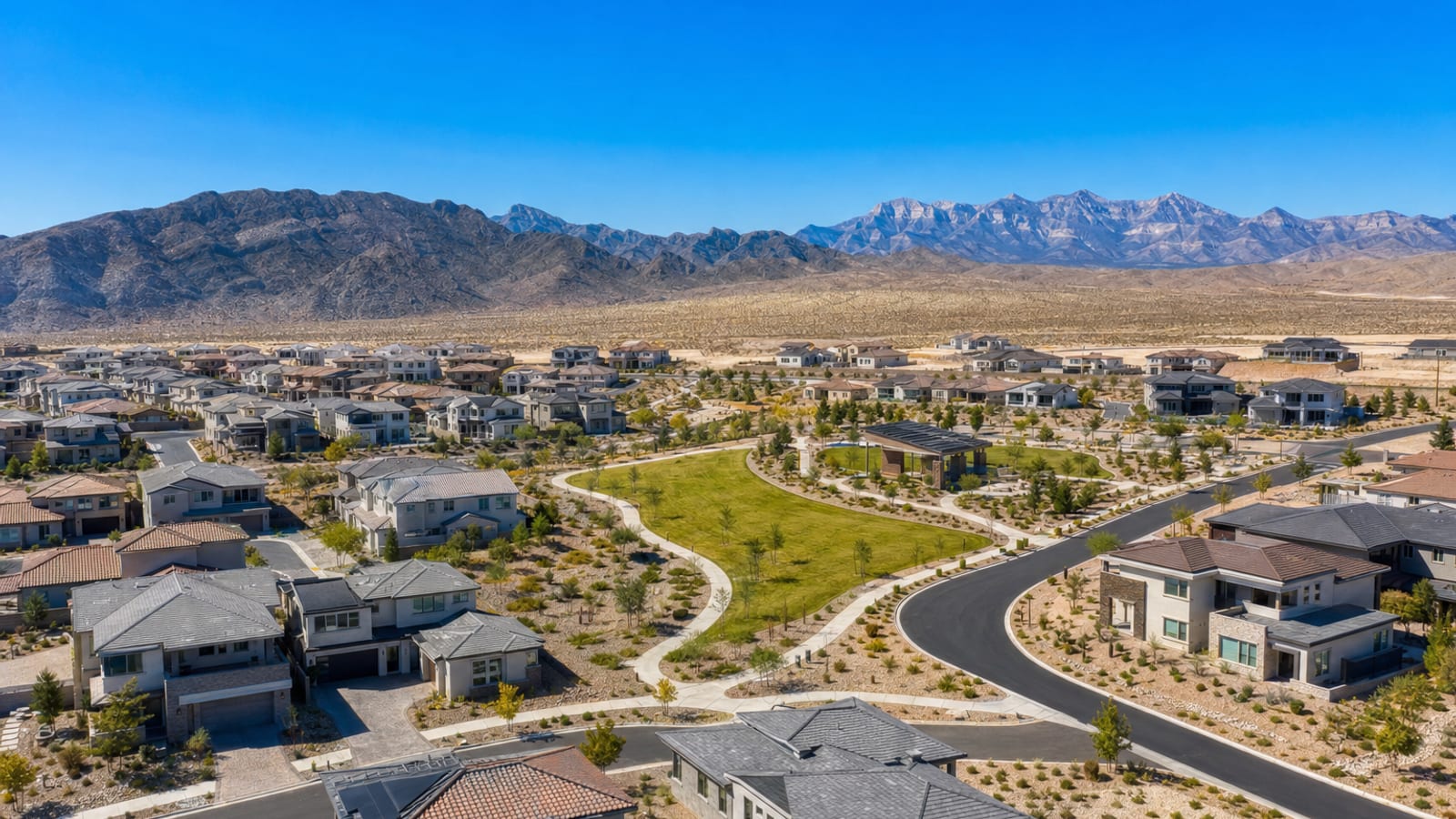
Centennial Hills proper is substantially built-out as of 2026, with most new-construction activity in the immediate northwest valley happening at adjacent master plans rather than inside the Centennial Hills boundary itself. The remaining new-build inventory inside Centennial Hills concentrates on infill custom builds along the western foothill edge (foothill estates), occasional teardown-rebuild activity in the more-established 1990s neighborhoods, and small private cul-de-sac developments inside the larger master plans.
The closest active new-construction master plans are Skye Canyon (Olympia Group, approximately 5 minutes north — full active builder programs from KB Home, Pulte/Del Webb, Taylor Morrison, and Tri Pointe Homes), Villages at Tule Springs (Lennar and D.R. Horton, approximately 8 minutes north), and the bordering Aliante master plan (limited new construction remaining). According to recent SNHBA published inventory data, the broader northwest valley accounts for approximately 28 percent of active Las Vegas new-construction inventory by unit count as of 2026, with most concentrated in Skye Canyon and Tule Springs rather than Centennial Hills itself. Buyers who specifically want new construction in the northwest valley should focus on those adjacent master plans rather than the Centennial Hills established corridor.
What lifestyle amenities and retail does the area offer?
Centennial Hills's commercial profile centers on three primary retail corridors: the Providence Promenade (anchored by Smith's grocery and approximately 32 dining and retail tenants), the Centennial Center retail corridor along Centennial Parkway between Buffalo Drive and Rampart Boulevard (mid-tier grocery, dining, services, and the Centennial Hills Hospital medical campus), and the smaller Iron Mountain Ranch retail center on Iron Mountain Road. None of these match the commercial density of Downtown Summerlin (the dominant northwest-valley retail destination at approximately 4 minutes south of Centennial Hills via the Beltway), but they cover daily-life retail needs without requiring a Strip-corridor commute.
According to recent City of Las Vegas economic-development data, the broader Centennial Hills area employs approximately 28,000 people across retail, healthcare, education, and professional services — with the Centennial Hills Hospital medical campus serving as the largest single employer. The area's healthcare profile is meaningful: Centennial Hills Hospital is a 165-bed full-service hospital (part of the Valley Health System) with emergency services, a women's health center, surgical services, and an outpatient diagnostic center. For families with school-age children, the proximity to a full-service hospital combined with the top-rated CCSD school cluster makes Centennial Hills one of the more practical relocations destinations in the broader Las Vegas valley.
Frequently Asked Questions
What is the full price range across Centennial Hills in 2026?
Approximately $375,000 for established Eldorado resale starter homes up to over $1.5 million for newer custom builds along the foothill edge. The median 2026 closing sits at approximately $575,000 per LVR data, with the luxury tier above $900,000 representing approximately 17 percent of transaction count and 31 percent of total dollar volume across the corridor.
Which Centennial Hills sub-neighborhood is best for top-rated schools?
The central corridor — primarily Providence and Iron Mountain Ranch — feeds the highest-rated public school cluster in Centennial Hills: Bonner Elementary (9 out of 10 GreatSchools), Sig Rogich Middle School (10 out of 10), and Palo Verde High School (8 out of 10). Buyers who specifically want the Rogich / Palo Verde cluster should verify the property address against the current CCSD school locator, since the eastern Centennial Hills boundary may feed into different schools.
How does Centennial Hills HOA compare to Summerlin?
Centennial Hills HOA dues run from $0 in non-HOA established sections (mostly Eldorado) up to approximately $315 per month in the newer foothill luxury enclaves. Most Providence and Iron Mountain Ranch homes carry HOA dues between $125 and $235 monthly. Summerlin sub-village HOA dues typically run $80 to $300 monthly excluding the Summerlin master-plan special assessment. The two areas are roughly comparable on HOA carrying cost at equivalent quality tiers.
Is Centennial Hills a good area for first-time buyers?
Yes — the Eldorado section in particular offers some of the most accessible price entry in any City of Las Vegas residential area while still feeding into reasonable public school cluster ratings. Eldorado prices in 2026 run approximately $375,000 to $750,000, with the bulk of activity in the $425,000 to $525,000 range. Many Eldorado sections are non-HOA, which lowers the total monthly carrying cost meaningfully versus master-planned alternatives.
What is the new-construction availability in Centennial Hills?
Limited. Centennial Hills proper is substantially built-out as of 2026, with new-construction activity concentrated in adjacent master plans (primarily Skye Canyon and Tule Springs to the north). Inside Centennial Hills itself, new construction is limited to infill custom builds along the foothill edge and occasional small cul-de-sac developments inside larger master plans.
How long is the commute from Centennial Hills to the Strip and the airport?
The drive to the Las Vegas Strip runs approximately 20 to 25 minutes via US-95 south, depending on time of day. Harry Reid International Airport is approximately 25 to 30 minutes via US-95 and I-15. This is meaningfully longer than Summerlin (15 to 22 minutes) but shorter than Aliante or northern North Las Vegas. Peak-hour southbound congestion on US-95 between Centennial Parkway and the Strip is the most significant commute risk.
How does Centennial Hills compare to Summerlin for relocating families?
Summerlin is more polished and commercially dense (Downtown Summerlin's 125-plus retail and dining tenants are the dominant northwest-valley retail destination), with the same top public school cluster at a roughly $150,000-plus higher entry point. Centennial Hills is the value play — same school cluster access, lower price entry, slightly longer Strip commute, less walkable-retail density. For relocating California families on a tight budget, Centennial Hills delivers more square footage per dollar than Summerlin at equivalent school quality.
Which Sources Inform This Centennial Hills Guide?
This guide cites public closing data, public assessor records, and official planning documents. The full inline-citation set:
- Las Vegas REALTORS (LVR) — MLS closing data, monthly market reports, and trailing-12-month median price data for Centennial Hills and surrounding northwest valley areas.
- Clark County Assessor — public parcel and sale records for Providence, Iron Mountain Ranch, Eldorado, and the broader Centennial Hills corridor.
- City of Las Vegas — planning department records, parks and recreation documentation, and traffic studies for the Centennial Hills corridor.
- U.S. Census Bureau — population estimates for Centennial Hills and the City of Las Vegas underlying the demographic context.
- Clark County School District (CCSD) — published school zoning maps, enrollment data, and academic performance reports.
- GreatSchools — current ratings for Sig Rogich Middle School, Palo Verde High School, Bonner Elementary, and the broader Centennial Hills school cluster.
- Nevada Department of Education — public school enrollment versus private school enrollment data underlying the school-choice context.
- Nevada Department of Taxation — property tax assessment methodology and the 35 percent assessed-value ratio applied to Centennial Hills residences.
- Nevada Revised Statutes — NRS 361.4722 (the 3 percent annual primary-residence property-tax cap that applies across the corridor).
- Federal Housing Finance Agency (FHFA) — Las Vegas-Henderson-Paradise MSA House Price Index, referenced for the appreciation history.
- Southern Nevada Home Builders Association (SNHBA) — new construction inventory data for the northwest valley.
- Bureau of Labor Statistics (BLS) — Las Vegas metro area employment data underlying the broader buyer-demand context.
For Centennial Hills resale questions, school-zone verification, or a private tour of any sub-neighborhood, call Nevada Real Estate Group at (702) 637-1759 or visit the Centennial Hills community page for the full sub-neighborhood directory and current active listings.