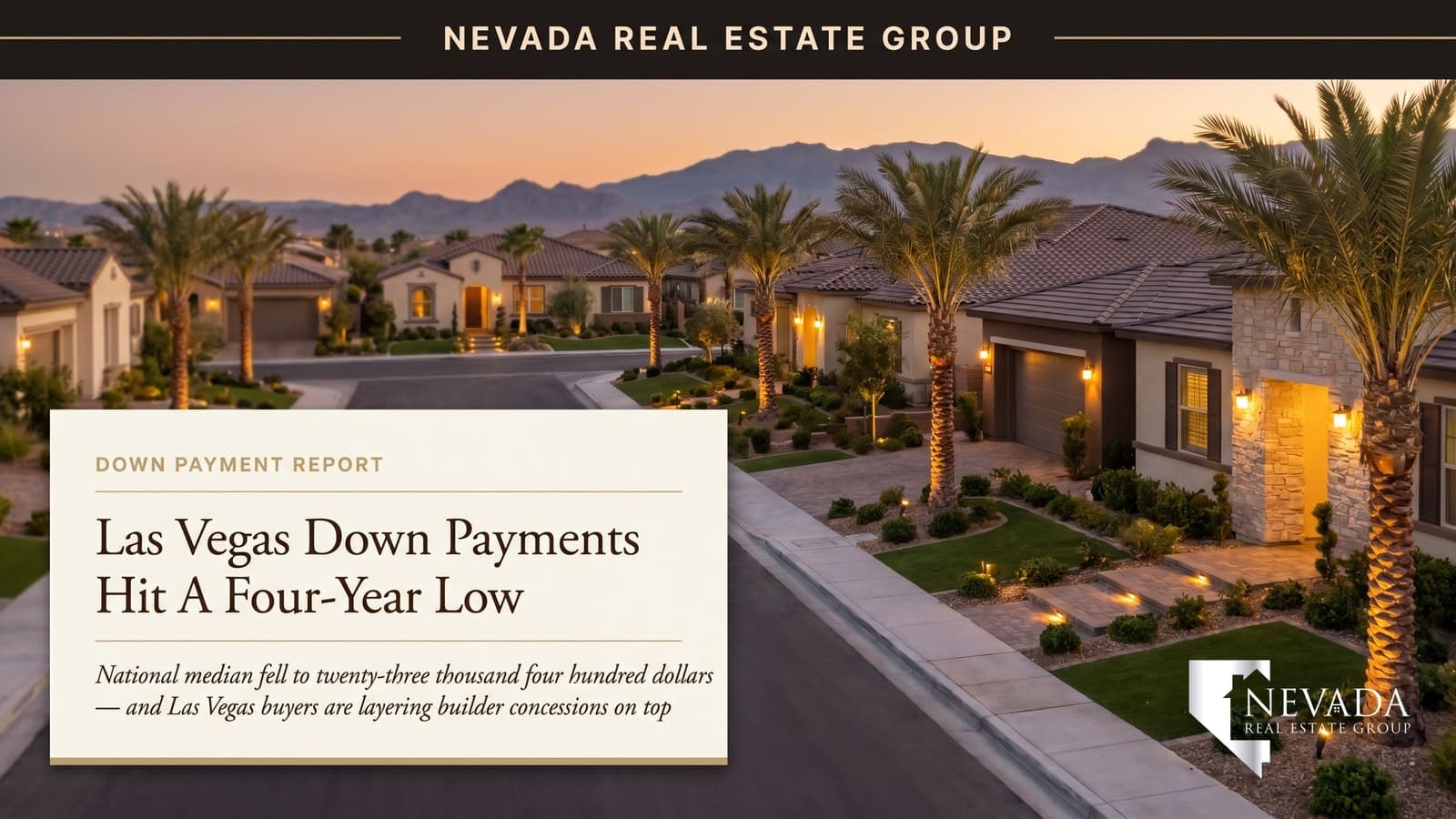

The national median home down payment just dropped to $23,400 in the first quarter of 2026 — the lowest in four years and down 19% year-over-year, according to the latest Realtor.com Down Payment Report released this month. As a percentage of purchase price, the typical buyer put down 12.8% in Q1 2026, down from 14% a year earlier. First-time buyers led the shift — their median down payment now sits at just 10%, while repeat buyers are still putting down 23%.
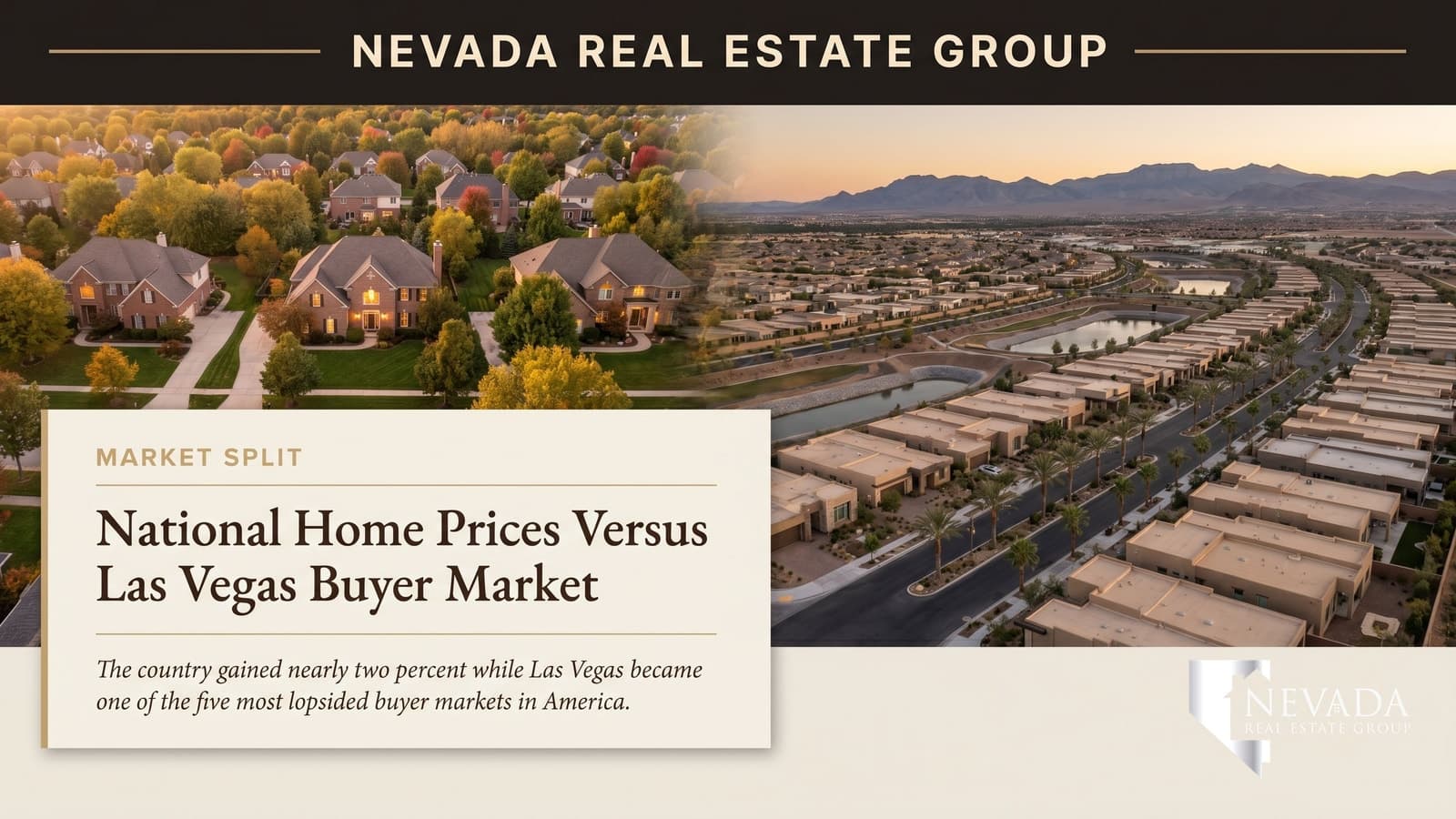
That's a national snapshot. But for Las Vegas, the picture is sharper. The Las Vegas valley sits in the middle of one of the country's most lopsided buyer's markets — sellers outnumbered serious buyers by roughly 101% according to spring 2026 market-balance data — which means buyers here are getting both the lower down payment math from the national trend AND the regional buyer's-market leverage on top. Builder concessions in Cadence, Inspirada, Skye Canyon, and Tule Springs are running $30,000 to $60,000 in present-value rate buydowns and closing-cost credits. FHA-financed Aliante and central North Las Vegas buyers are closing at 3.5% down. VA buyers PCSing to Nellis AFB are closing at zero down. The cash buyers who dominated 2021 are gone, and the math is starting to tilt back toward first-time and middle-income Las Vegas families.
This guide explains exactly what the Realtor.com Down Payment Report data shows, why down payments are falling nationally, how the trend lands in the Las Vegas valley specifically, what the buyer's-market backdrop is doing on top of it, which low-down-payment loan programs are working in 2026, how builder concessions effectively reduce the cash you need at closing, and how the math actually pencils across Summerlin, Henderson, North Las Vegas, and the Nellis-area neighborhoods. Every dollar figure is sourced from public data — Realtor.com, NAR, FHFA, Freddie Mac, Las Vegas REALTORS, and the closing files at Nevada Real Estate Group.
The U.S. median home down payment fell to $23,400 (12.8% of purchase price) in Q1 2026 — the lowest in four years, down 19% year-over-year. First-time buyers now put down a median of 10%; repeat buyers 23%. Las Vegas mirrors the national shift but with an extra layer: as a top-five buyer's market in 2026, Las Vegas buyers are also getting $30,000-$60,000 in builder concessions, $20,000-$50,000 rate buydowns, and stronger inspection-credit negotiations on resale. FHA at 3.5% down and VA at $0 down dominate the entry-level Las Vegas market in 2026, especially in Aliante, Tule Springs, Skye Canyon, and the Nellis AFB-adjacent zips.
- National median down payment: $23,400 in Q1 2026, down 19% from $28,900 a year earlier.
- As a percentage of price, the typical buyer put down 12.8% — versus 14% a year earlier.
- First-time buyer median: 10% down. Repeat buyer median: 23% down.
- Las Vegas is a buyer's market with 101% seller-to-buyer surplus — concessions stack on top of the lower down payment.
- 2026 builder concessions in active Las Vegas master plans: $30,000-$60,000 in rate buydowns + closing credits.
- FHA at 3.5% down on a $480K Las Vegas home = $16,800. VA at $0 down. Nevada Home Is Possible adds another 4-5% grant.
- Only 15-20% of U.S. renters have enough assets to cover even the new $23,400 median — Nevada down-payment assistance helps close the gap.
What did the Realtor.com Down Payment Report actually say in May 2026?
According to the Realtor.com Down Payment Report released May 19, 2026, the national median home down payment fell to $23,400 in Q1 2026 — the lowest level since 2021 and the fourth consecutive quarterly decline. As a share of purchase price, the typical buyer put down 12.8% of the home price at closing, compared to 14.0% in Q1 2025. That 1.2-percentage-point drop sounds modest on paper but represents real money — about $5,500 less cash at closing on a $460,000 home compared to a year ago.
The shift was sharpest at the entry-level. First-time buyers — defined by Realtor.com as buyers who have not owned a home in the past three years — put down a median 10% in Q1 2026. Repeat buyers (who roll equity from a prior home into the next purchase) put down a median 23%. The gap between the two groups widened in 2026 because repeat buyers benefit from accumulated appreciation while first-time buyers are working from saved cash and gifted funds. According to Realtor.com's chief economist Danielle Hale, the four-year low reflects "rising inventory, moderating prices, and longer days on market giving buyers more negotiating room — they don't need to lead with an outsized down payment to win the offer."
The report also flagged a structural affordability issue. According to Realtor.com's research, only an estimated 15-20% of U.S. renters currently have enough liquid assets to cover even the new $23,400 median conventional down payment. Government-backed programs — primarily FHA at 3.5% down and VA at $0 down — continue to do most of the work for first-time buyers nationally, and especially in markets like Las Vegas where the median household income is below the national average and the buyer base skews younger.
Why are down payments falling nationally in 2026?
Three overlapping forces are pulling the median down. According to Real Estate News' analysis of the Q1 2026 data, the dominant driver is inventory normalization. Active listings across major metros are up 30-45% year-over-year. According to the Federal Reserve Bank of St. Louis FRED housing series, the U.S. months-of-supply ratio crossed back into balanced territory in early 2026 for the first time since 2019. When inventory rebuilds, the seller's ability to demand a large down payment as a "strong offer" signal evaporates — buyers can afford to lead with 10% knowing the seller has fewer competing offers to compare against.
The second force is rate persistence. According to the Freddie Mac Primary Mortgage Market Survey, 30-year fixed mortgage rates have been range-bound between 6.4% and 7.1% for the past 14 months — the longest sustained range in over a decade. That stability has trained buyers to stop waiting for rate drops and start optimizing the down-payment math instead. According to Mortgage Bankers Association weekly survey data, purchase application volume in 2026 is heavily weighted toward FHA and VA — both of which encourage lower down payments by design.
The third force is the cash buyer pullback. According to NAR's existing-home sales reports, cash buyers represented 38% of transactions at the 2022 peak; by Q1 2026 that share had fallen to 28%. Cash buyers had been a major driver of the high 2022-2024 down-payment medians — when they exit a market, the average buyer-funded portion drops mechanically. Investor activity has cooled in parallel: cash investors were the most aggressive 2022-2024 buyers who often put 100% down with no financing. With fewer of them in 2026, the typical homebuyer's down payment profile reverts to the regular financed-buyer average.
What does the Las Vegas market look like in 2026 specifically?
The Las Vegas valley shares all three national forces — inventory recovery, range-bound rates, cash-buyer pullback — and adds one more: it is one of the five most lopsided buyer's markets in the United States in 2026. According to spring 2026 market-balance data, Las Vegas sellers outnumber serious buyers by roughly 101%, putting the valley alongside Miami, Nashville, Austin, and San Antonio at the most buyer-friendly end of the U.S. metro spectrum. We covered the broader regional split in our national home prices vs Las Vegas buyer market analysis.
In numbers: 2026 valley single-family resale median is approximately $480,000, essentially flat year-over-year, with days-on-market stretched from 18 days in spring 2024 to 38-45 days in spring 2026. Active listings have rebuilt from a March 2022 low of 2,800 to roughly 8,000-8,500 in spring 2026 — a 187% increase. According to Las Vegas REALTORS monthly statistics, the typical accepted offer in 2026 is running at 97-99% of original list price, with another 1-3% of inspection-credit concessions negotiated during escrow. Both signals mean Las Vegas buyers are getting real concessions on top of the lower national down-payment trend.
What is the typical down payment for a Las Vegas home in 2026?
Applying the national 12.8% median to the Las Vegas valley median of $480,000 gives a typical 2026 Las Vegas down payment of approximately $61,440. But that single number hides a wide spread across buyer types and submarkets. According to Nevada Real Estate Group closing-file data through April 2026, the distribution looks like this:
| Buyer Type | Typical Loan | Down % | Cash on $480K | Cash on $400K |
|---|---|---|---|---|
| First-time, no DPA | FHA | 3.5% | $16,800 | $14,000 |
| First-time, with NV DPA grant | FHA | 0%–1% effective | $0–$4,800 | $0–$4,000 |
| Active-duty military / veteran | VA | 0% | $0 | $0 |
| Conventional first-time | Conventional | 5% | $24,000 | $20,000 |
| Move-up buyer with equity | Conventional | 10–20% | $48,000–$96,000 | $40,000–$80,000 |
| Equity-relocator from CA / NY | Conventional | 30%+ | $144,000+ | $120,000+ |
| Cash buyer (luxury / investor) | Cash | 100% | $480,000 | $400,000 |
The biggest variance is at the bottom of the table — first-time buyers using FHA combined with Nevada's down-payment assistance programs can close on a $400,000 Las Vegas resale with less than $5,000 out of pocket in many cases. Buyers using VA financing pay $0 down. The middle of the table — move-up buyers with equity from prior Las Vegas homes — is the demographic most influenced by the broader 12.8% national median; they're putting down 10-20% based on personal preference and rate-sensitivity rather than program requirements.
How does the Las Vegas buyer's market amplify the down-payment drop?
The national down-payment decline is one effect. The Las Vegas buyer's market adds three more that compound the savings.
Builder concessions on new construction. According to Las Vegas REALTORS and our own negotiation log on 2026 new-construction closings, active master-plan builders in 2026 are offering rate buydowns worth $20,000-$50,000 in present-value terms, closing-cost credits of $10,000-$25,000, and bundled design-center upgrades of $15,000-$40,000. A buyer at Cadence, Inspirada, Skye Canyon, Tule Springs, or the Summerlin western villages (Stonebridge, Redpoint, Kestrel) can effectively absorb $30,000-$60,000 of total concessions. See our where to buy new construction Las Vegas 2026 tier ranking for which master plans are offering the most aggressive incentives this year.
Inspection-credit negotiations on resale. According to Nevada Real Estate Group's closed-deal data, the typical 2026 resale buyer in the Las Vegas valley negotiates $5,000-$15,000 in inspection credits during escrow — applied either toward repair costs, closing-cost reduction, or rate buydown. That's cash the buyer doesn't have to bring to closing, effectively reducing the out-of-pocket commitment beyond the headline down-payment percentage.
Seller-paid closing costs. In a 101%-buyer's-market environment, sellers are commonly contributing to buyer closing costs to keep deals alive. According to Mortgage Bankers Association data, seller-paid concessions averaged 1.8% of purchase price in early 2026, up from 0.4% at the 2022 peak. On a $480,000 Las Vegas home, that's an additional ~$8,600 the buyer doesn't have to fund. Combined, the typical 2026 Las Vegas buyer is bringing roughly $15,000-$35,000 less to closing than the same buyer would have brought in 2022, even before the lower down-payment math.

What loan programs let Las Vegas buyers go below 10% down in 2026?
Three big programs are doing the work for low-down-payment buyers in 2026. According to the Consumer Financial Protection Bureau homebuying guide, each has specific eligibility and trade-offs:
FHA loans (3.5% down). Backed by the U.S. Department of Housing and Urban Development, FHA loans require a minimum 3.5% down payment with a 580+ credit score (or 10% down with 500-579). On a $480,000 Las Vegas home, that's $16,800 minimum down. FHA loans carry mortgage insurance premiums (MIP) — 1.75% upfront and 0.55% annually — that remain for the life of the loan unless refinanced into conventional. According to our Las Vegas FHA loan buyer's playbook, roughly 28% of Las Vegas valley purchases under $500,000 use FHA financing in 2026.
VA loans ($0 down). The U.S. Department of Veterans Administration home loan program requires $0 down for eligible active-duty service members, veterans, and surviving spouses. There's a funding fee (2.15% on first use, 3.3% on subsequent) but it can be financed into the loan, leaving the buyer with effectively zero out-of-pocket down payment. Las Vegas is a major VA market because of Nellis AFB — see our Nellis AFB relocation guide for the full PCS-buyer playbook. According to VA data, the Nellis-adjacent zips (89115, 89084, 89086, 89031, 89030) see roughly 35-40% of single-family purchases use VA financing.
Conventional 97 (3% down). Conventional 97 — backed by Fannie Mae and Freddie Mac — allows first-time buyers to put down as little as 3% on a conventional loan with private mortgage insurance (PMI). On a $480,000 Las Vegas home, that's $14,400 down. PMI typically runs $80-$150/month on a $400K-$480K loan and can be removed at 80% loan-to-value (versus FHA's permanent MIP). For buyers with credit scores above 740 and modest debt, Conventional 97 often beats FHA on total monthly cost despite the higher PMI rate.
Nevada Home Is Possible (4-5% grant). According to Nevada Rural Housing Authority, Nevada's Home Is Possible program provides a 4-5% grant covering down payment and closing costs for eligible buyers earning under approximately 115% of area median income. Stacked with FHA at 3.5% down, this can produce effective near-zero out-of-pocket purchases in many Las Vegas-area zips. See our Nevada down payment assistance guide for the full eligibility detail.
How do builder concessions effectively reduce your Las Vegas down payment?
Builder concessions don't literally reduce the down payment number — they reduce the total cash you need at closing AND the monthly payment after. Walking through the math: a buyer purchasing a $500,000 KB Home in Skye Canyon at 10% down ($50,000) on a 6.75% conventional loan has a monthly P&I of approximately $2,920. If the builder offers a $30,000 rate buydown that reduces the effective rate to 5.5% for the first three years, the monthly P&I drops to $2,555 — saving the buyer roughly $13,140 over the first three years of payments. If the builder also covers $15,000 in closing costs, the buyer's actual cash outlay at closing is $50,000 down + closing costs minus the $15,000 credit = a net cash position roughly $15,000 better than the same purchase a year earlier without concessions.
According to Nevada Real Estate Group's 2026 negotiation log, the largest concession packages we've seen this year are at Cadence (Lennar, KB Home) and Skye Canyon (D.R. Horton, Lennar). Inspirada (Lennar, KB Home, Pulte, Toll Brothers) is offering aggressive packages too — see our Cadence buildout status guide for the village-by-village concession map. Summerlin western villages (Stonebridge, Redpoint, Kestrel) carry slightly smaller but still meaningful concessions; the Summerlin eastern villages (the Ridges, Reverence) carry the least because resale luxury inventory is scarce and demand is firmer.
The practical implication: a Las Vegas buyer planning to put 10% down can often negotiate the builder concession package to effectively cover the entire down payment over the first 3-5 years through a combination of rate buydown savings + closing-cost credits. In a sense, the builder's marketing budget becomes a soft second-down-payment for buyers who know how to negotiate. See our builder closing cost credits guide for the deep dive on which concessions matter and which are marketing fluff.
Should you put down less than 20% in Las Vegas in 2026?
The conventional answer was always "20% down to avoid PMI." In 2026 Las Vegas, that math is no longer obvious. Here's the trade-off across three scenarios:
| Scenario | Down | Cash at close | Mo. Payment | Trade-off |
|---|---|---|---|---|
| FHA 3.5% on $480K | $16,800 | $20-25K (with closing) | ~$3,500 (P&I + MIP) | MIP for life; can refinance later |
| Conventional 5% on $480K | $24,000 | $28-32K | ~$3,400 (P&I + PMI) | PMI drops at 80% LTV |
| Conventional 10% on $480K | $48,000 | $52-58K | ~$3,250 (P&I + PMI) | PMI drops in ~3-5 years |
| Conventional 20% on $480K | $96,000 | $100-106K | ~$3,000 (P&I only) | No PMI ever |
The 20%-down monthly payment is roughly $500/month lower than the FHA 3.5% scenario. Over a 30-year hold, that's $180,000 in interest savings. But it also requires $79,200 more cash at closing — money that could instead be invested, held as emergency reserves, or used for furniture, repairs, and moving costs. According to Bureau of Labor Statistics household financial data, the average U.S. household keeps less than 3 months of liquid emergency reserves. Putting down 20% to save $500/month often means depleting the emergency cushion below safe levels — a worse outcome than carrying a slightly higher monthly payment.
The 2026 Las Vegas-specific answer: put down what your stable savings rate supports while keeping 3-6 months of mortgage payments in reserve. Don't deplete savings to hit 20%. Don't put down less than what your debt-to-income ratio comfortably supports. The right answer is usually 5-10% conventional for buyers without VA eligibility, or FHA 3.5% with Home Is Possible stack for first-time buyers under 115% AMI. See our how much down payment do you need in Las Vegas for the full DTI-based calculation.
How does Las Vegas compare to other Western U.S. metros on 2026 down payments?
Pulling together the national data with metro-level signals from NAR Q1 2026 metro reports, Las Vegas sits in the middle of the Western metro spectrum on typical down payment. Here's how it stacks up:
| Metro | 2026 Median Price | Typical Down % | Typical $ Down | Buyer Market Tilt |
|---|---|---|---|---|
| San Francisco–Bay Area | $1,275,000 | 22% | $280,500 | Balanced |
| San Diego, CA | $945,000 | 20% | $189,000 | Balanced |
| Los Angeles, CA | $880,000 | 18% | $158,400 | Slight buyer |
| Seattle, WA | $755,000 | 19% | $143,450 | Balanced |
| Denver, CO | $625,000 | 16% | $100,000 | Balanced |
| Salt Lake City, UT | $585,000 | 15% | $87,750 | Slight buyer |
| Reno, NV | $540,000 | 14% | $75,600 | Slight buyer |
| Las Vegas, NV | $480,000 | 12.8% | $61,440 | Strong buyer (+101% surplus) |
| Phoenix, AZ | $445,000 | 13% | $57,850 | Strong buyer |
| Albuquerque, NM | $385,000 | 11% | $42,350 | Balanced |
California buyers relocating to Las Vegas — historically a major Las Vegas demographic — bring substantially higher down-payment behavior with them. A typical buyer rolling equity from a $1.1M Bay Area sale into a $480K Las Vegas purchase often puts down 40-60% (or buys cash) — but those buyers represent a minority of 2026 valley transactions because the broader California out-migration slowed in 2025. The 12.8% national median is now genuinely representative of the typical Las Vegas closing.
What's the realistic path to home ownership for a Las Vegas renter in 2026?
According to Realtor.com's research, only 15-20% of U.S. renters have enough liquid savings to cover the new $23,400 national median down payment. In Las Vegas, where the median household income runs roughly $79,000 and rents have climbed in lock-step with home prices, the share is similar. The realistic path for a Las Vegas renter looking to become a homeowner in 2026 looks like this:
Step 1 — Lock in a target submarket and price band. Las Vegas valley pricing varies $100,000+ across submarkets. A $380,000 condo in central North Las Vegas is achievable with $13,300 down (3.5% FHA); a $480,000 single-family in Aliante requires $16,800 minimum down. Be realistic about your target before saving — see the table above for the spread.
Step 2 — Build the down payment through three channels. Personal savings (the slow lane), gifted funds from family (allowed by all loan programs but must be documented), and down-payment assistance (Nevada's Home Is Possible, employer matching, military allowances). According to HUD's homebuying resources, 47% of first-time buyers nationally use at least one gift or assistance program. In Las Vegas, the share is closer to 55%.
Step 3 — Get pre-approved with a Las Vegas-licensed lender experienced in your loan type. A national call-center lender that closes a few VA loans per quarter is meaningfully slower than a Las Vegas lender closing VA loans monthly. The same is true for FHA and Nevada DPA programs — local expertise compounds. We can match you with a vetted lender within 24 hours.
Step 4 — Use the buyer's market. With 8,000+ active listings, longer days on market, and 97-99% sale-to-list ratios, Las Vegas buyers in 2026 have unusual leverage. Don't lead with your maximum down payment to "win" the offer — that strategy was rational in 2022 but actively wasteful in 2026. Lead with appropriate down payment, ask for seller-paid closing costs, ask for inspection credits, ask for rate buydowns on new construction.
Step 5 — Close, move in, and start the wealth ladder. According to Federal Housing Finance Agency Las Vegas HPI, Las Vegas home values appreciated approximately 8.5% annualized between 2010 and 2025. Future returns will be lower as the market normalizes, but the homeownership-vs-rent math still favors owning over a 5-7 year horizon for the majority of Las Vegas-area renters.
Frequently asked questions
How does the $23,400 national median compare to what Las Vegas buyers are actually putting down in 2026?
At Las Vegas's $480,000 valley median price, applying the national 12.8% rate gives $61,440 — substantially higher than the $23,400 national median. But that's because the Las Vegas median home is more expensive than the national median ($404,300). On a percentage basis, Las Vegas tracks the national trend closely. According to Nevada Real Estate Group's closing-file data, the typical Las Vegas first-time buyer is putting down 5-10% (FHA or Conventional 97) and the typical move-up buyer is putting down 15-25% (using equity from a prior Las Vegas home). The 12.8% national median sits squarely between those two groups.
Is now actually a good time to buy a Las Vegas home with a lower down payment?
For buyers with stable jobs, 3-6 months of reserves, and a 5+ year hold horizon, yes — the 2026 Las Vegas buyer's market means lower down payments combine with stronger concessions to create unusually favorable terms. According to spring 2026 market-balance data, the +101% seller-to-buyer surplus is the most buyer-tilted Las Vegas conditions in over a decade. The trade-off is that property values may be flat to slightly down over the next 12-18 months — but at a 5+ year hold, that's noise. We recommend buyers act when they find the right home and the math works, not try to time a market bottom. See our Las Vegas home price forecast for the broader market context.
What is the minimum down payment for a Las Vegas home in 2026?
$0 if you qualify for VA financing as an active-duty service member, veteran, or surviving spouse. 3.5% (about $14,000-$17,000 on a $400-$480K home) if you qualify for FHA financing with a 580+ credit score. 3% (about $12,000-$14,400) if you qualify for Conventional 97. Stacking Nevada's Home Is Possible 4-5% grant on top can bring the effective down payment to under $5,000 out of pocket in many cases. Always work with a Nevada-licensed lender experienced in these programs — the documentation is fiddly and inexperienced loan officers can blow the timeline. Call (702) 637-1759 to be matched with a vetted lender.
Are Las Vegas builders really offering $30,000+ in concessions in 2026?
Yes, on most active master plans. According to Nevada Real Estate Group's negotiation log for 2026 new-construction closings, the typical concession package at Cadence, Inspirada, Skye Canyon, Tule Springs, and the Summerlin western villages totals $30,000-$60,000 when you add rate buydowns ($20-$50K in present-value terms), closing-cost credits ($10-$25K), and bundled design-center upgrades ($15-$40K). The largest packages we've negotiated this year exceeded $75,000 on $750,000+ inventory homes that builders needed to clear before year-end. The standard package on a $500,000 base-price floor plan is closer to $30,000-$40,000. See our where to buy new construction Las Vegas 2026 tier ranking for which master plans are running the most aggressive promotions.
Will down payments keep falling in 2027 if rates drop?
Probably not. According to Realtor.com's research, the current four-year low reflects buyer's-market dynamics — when inventory is high and competition for offers is weak, buyers don't need to lead with a large down payment. If rates drop into the high 5s in 2027 and buyer competition increases, sellers regain leverage and down-payment medians typically tick back up because buyers are willing to put more cash forward to win bidding wars. The structural floor on first-time-buyer down payments is FHA's 3.5% — that won't move regardless of macro conditions. The variable is how much above the floor the typical buyer chooses to put down based on competitive pressure.
What happens to my offer competitiveness if I put down only 10% in a Las Vegas multiple-offer situation?
In the current Las Vegas buyer's market, multiple-offer situations are rare for resale homes priced above $350,000 — most properties receive 0-2 offers in their first 30 days on market. When multiple offers do occur (typically on entry-level homes under $350,000 or on standout luxury listings), down-payment percentage is one signal sellers weigh alongside earnest money, contingency-free terms, financing type (cash > conventional > FHA/VA in the sellers' view, fairly or not), and the buyer's pre-approval strength. According to our Las Vegas closing costs guide, a 10% conventional offer with strong pre-approval and waived appraisal contingency competes well even against 20%-down offers with weaker financing strength. The structure of the deal matters more than the down-payment percentage.
Which sources inform this Las Vegas down-payment analysis?
- Realtor.com Down Payment Report — May 2026 release
- Real Estate News analysis of the Q1 2026 down-payment data
- Realtor.com Research housing reports
- National Association of REALTORS Q1 2026 metro home price report
- Las Vegas REALTORS monthly statistical reports
- Federal Reserve Bank of St. Louis FRED housing inventory and rate series
- Freddie Mac Primary Mortgage Market Survey
- Mortgage Bankers Association weekly applications survey
- Federal Housing Finance Agency Las Vegas HPI
- Consumer Financial Protection Bureau homebuying guide
- HUD Single Family Housing — FHA and homebuying programs
- U.S. Department of Veterans Administration home loans
- Nevada Rural Housing Authority — Home Is Possible program
- Bureau of Labor Statistics household financial data
Ready to model your Las Vegas down-payment math with a licensed agent?
Nevada Real Estate Group is the #1 ranked real estate team in Nevada — 150+ licensed agents, 6,225+ closed transactions, $4.1B+ in cumulative volume, and active FHA, VA, and conventional closings monthly. We will pull your buyer-side math, match you with a Las Vegas-licensed lender experienced in your specific loan type, and walk you through the builder-concession or seller-credit landscape that effectively reduces your real out-of-pocket commitment. Call (702) 637-1759 or visit our buyers page to start a conversation with a licensed agent within one business hour.
Related reading:
- How much down payment do you need for a Las Vegas home in 2026?
- Las Vegas FHA loan buyer's playbook 2026
- Nellis AFB military relocation guide (VA loans + PCS)
- Las Vegas closing costs 2026 — buyer and seller breakdown
- Where to buy new construction Las Vegas 2026 — tier ranking
- Builder closing cost credits Las Vegas 2026
- Nevada down payment assistance programs
- National home prices vs Las Vegas buyer market spring 2026
- Summerlin community guide
- Henderson community guide