
Published May 11, 2026 · Updated May 11, 2026 · By Chris Nevada, Nevada Real Estate Group · NV License S.181401
Direct Answer: The average Las Vegas new construction buyer spends $35,000-$80,000 at the builder's design center, and roughly $20,000 of that is spent on cosmetic items (cabinets, countertops, flooring, fixtures, paint) that retail aftermarket at 50-65% of the builder's price. The smart structural play: spend the design center budget on items that cannot be added later — covered patios, extended garages, bedroom/bathroom additions, casita walls, structural beam upgrades, gas line pre-stub, electrical pre-wire, and anything else "inside the walls" or "into the slab." Skip the cosmetic markup. The result is a $30,000 design center spend that delivers the same finished home as a $50,000 spend would have — saving $20,000 without giving up any feature. This guide walks through every major category buyers in Las Vegas, Henderson, North Las Vegas, and Summerlin face at the design center in 2026.
Key Takeaways
- Builder design center markups average 50-100% over retail on cosmetic items
- Structural changes are nearly impossible to add aftermarket — always do them at the builder
- Anything inside the walls, in the slab, or in the framing must go in during construction
- Cabinets, countertops, flooring, lighting, and fixtures can be redone later at 40-60% of design center price
- Average buyer overspends $15,000-$30,000 on items that retail much cheaper
- Covered patios, bedroom/bathroom adds, and casitas have the highest ROI
- Smart electrical and plumbing pre-wiring saves $5,000-$15,000 in future renovations
- Floor plan changes (knock out a wall, extend a room) can ONLY happen at the builder
- Skip: upgraded cabinets, upgraded countertops, upgraded flooring, upgraded fixtures
- Spend: structural options, electrical pre-wire, plumbing pre-stub, exterior structural changes
What Is the Builder Design Center and Why Does Pricing Differ From Retail?
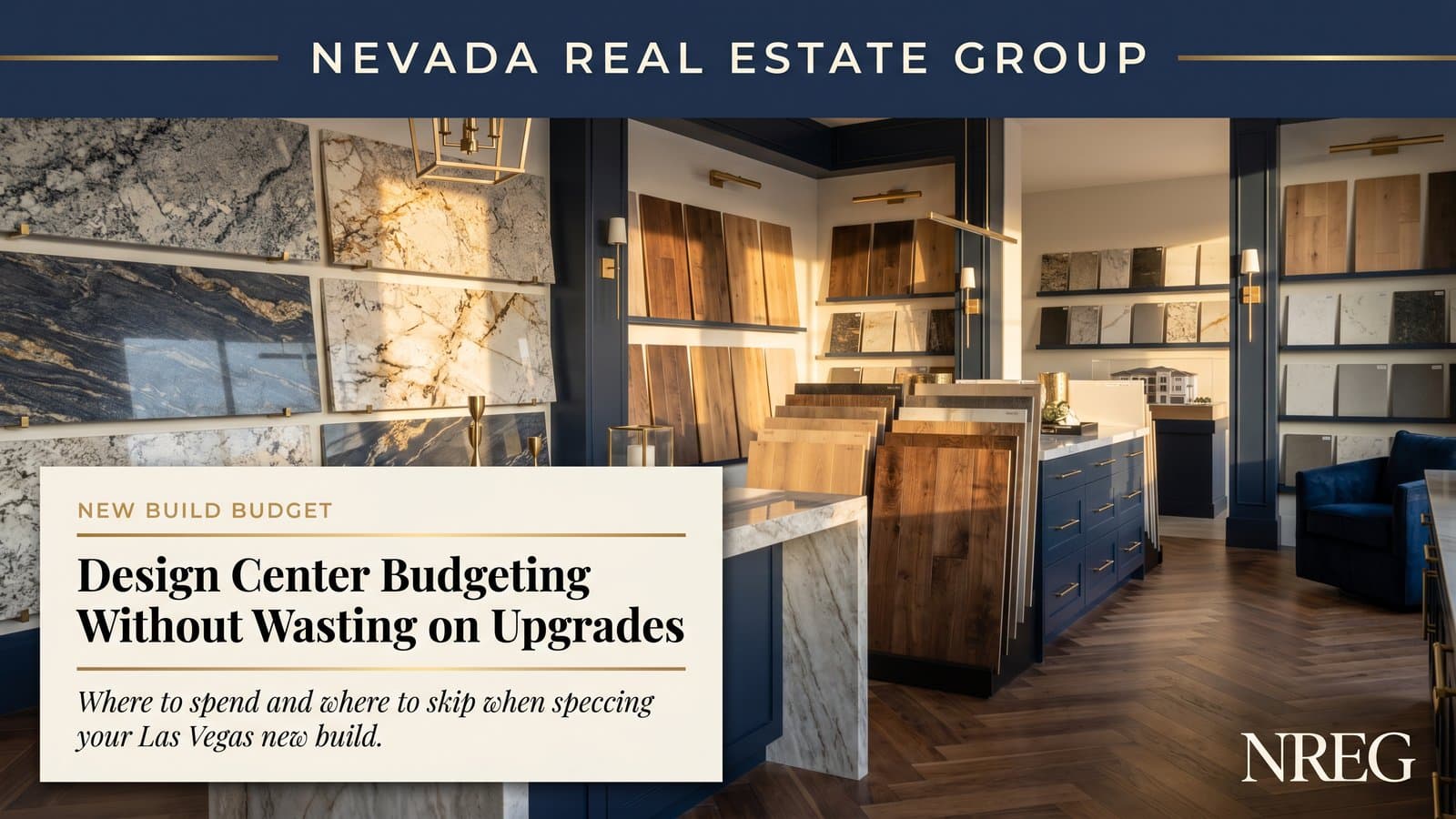
The builder design center is the showroom where new construction buyers select all their interior and many exterior finishes — flooring, cabinets, countertops, paint colors, lighting fixtures, faucets, appliances, electrical packages, structural options, exterior elevations, and dozens of other choices. The appointment typically runs 4-8 hours over one or two visits, scheduled 30-60 days after contract signing.
Every option carries a price tag relative to the "standard" baseline included with the base plan price. Standard cabinets cost $0 extra. The "premium" cabinet upgrade costs $4,000-$8,000. The "luxury" cabinet upgrade costs $10,000-$18,000. Same with flooring, countertops, lighting, plumbing fixtures, electrical packages — everything has a published upgrade price.
Why the markups are so high. Builders run design centers as profit centers, not break-even infrastructure. The standard package is intentionally basic so the buyer is motivated to upgrade. The upgrade prices include builder gross margin of 40-80% over the builder's cost. The buyer is paying retail-plus for what the builder sources at wholesale.
A specific example. A typical quartz countertop upgrade at a Las Vegas builder runs $5,500-$8,500 for a 50 sq ft kitchen. The same quartz from a local Las Vegas fabricator (Caesarstone, Cambria, Silestone — same manufacturers) costs $3,000-$4,500 fully installed, including tear-out of the old standard countertop. The builder markup is $2,000-$4,000 — roughly 60-90% over aftermarket.
This isn't dishonest — it's how the industry works. The builder is selling a service (one-stop coordination, no project management for the buyer, financed into the mortgage). For some buyers that service is worth the premium. For most buyers it isn't, because the same upgrade done 2-3 years post-closing produces an identical-looking kitchen for 40-60% of the design center price.
What Should I Always Upgrade Through the Builder?
These items must be selected and installed during construction because adding them aftermarket is either impossible, prohibitively expensive, or destructive to walls and slab.
Structural floor plan changes. Knocking out a wall to create an open-concept great room. Extending a kitchen by 4 feet into the dining room. Converting an office to a 4th bedroom (adding a closet and door). Adding a sliding door to the side yard. Adding a casita off the garage. All of these require structural framing modifications, drywall, electrical re-routing, and HVAC adjustment — work that costs 3-5x more aftermarket because the home has to be demolished and rebuilt around the change.
Covered patios and outdoor structures. Extending a 12-foot uncovered patio to a 24-foot covered patio with structural posts, roof framing, and electrical wiring. This is the single highest-ROI design center spend in Las Vegas. Builder cost: $8,000-$15,000. Aftermarket cost for the same work: $25,000-$45,000 (because the contractor has to tie into existing framing, pull permits, and work around an existing home). The builder version also matches the home's architecture perfectly — aftermarket additions often look bolted on.
Garage extensions and additional bays. Extending a standard 20-foot deep garage to 24 or 28 feet. Adding a 3rd bay. Adding a tandem 4th bay for RV/boat storage. Builder cost: $4,000-$18,000 depending on the extension. Aftermarket cost: $20,000-$60,000 because the foundation has to be poured and the home's exterior wall reconfigured.
Casita additions. A detached or semi-detached casita with bedroom, bath, and small living area off the garage or courtyard. Builder cost: $35,000-$75,000. Aftermarket cost as a custom addition: $80,000-$160,000.
Bedroom additions. Adding a 5th bedroom to a 4-bedroom plan (typically converting a loft or office). Builder cost: $8,000-$18,000. Aftermarket cost: $30,000-$60,000.
Bathroom additions. Adding a half-bath to a great room area, or adding a full bath to a flex space. Builder cost: $8,000-$15,000. Aftermarket cost: $20,000-$40,000.
| Structural Upgrade | Builder Cost | Aftermarket Cost | Builder Savings |
|---|---|---|---|
| Covered patio extension (24 ft) | $10,000-$15,000 | $30,000-$45,000 | $20,000-$30,000 |
| Garage tandem 4th bay | $8,000-$14,000 | $35,000-$50,000 | $27,000-$36,000 |
| Wall removal for open concept | $3,500-$6,000 | $12,000-$22,000 | $8,500-$16,000 |
| Casita addition | $45,000-$75,000 | $100,000-$160,000 | $55,000-$85,000 |
| 5th bedroom conversion | $10,000-$18,000 | $35,000-$60,000 | $25,000-$42,000 |
| Powder bath addition | $9,000-$13,000 | $22,000-$35,000 | $13,000-$22,000 |
| Sliding door to side yard | $4,500-$7,500 | $15,000-$25,000 | $10,500-$17,500 |
Bottom line on structural upgrades. If you want it, get it now. The builder savings vs aftermarket adds is 50-70% across the board. Structural is the one design center category where the builder is consistently the cheaper option.
What Should I Never Upgrade Through the Builder?
These items are easy to redo aftermarket at much lower cost. Take the standard package from the builder and upgrade later if you want something nicer.
Cabinets. Builder upgrade from standard to "premium": $4,000-$9,000. Aftermarket cabinet replacement from a local Las Vegas cabinet shop: $4,500-$8,000 for the same kitchen with comparable quality. Painted cabinet refinishing (if the standard cabinets are wood and you just want a different color): $2,500-$4,500. Wait at least 12-24 months after closing — your design preferences may shift once you live in the space.
Countertops. Builder upgrade from standard laminate or basic quartz to upgraded quartz/granite: $4,500-$9,000. Aftermarket replacement: $3,000-$5,500 for the same material. Quartz suppliers in Las Vegas (Stone Mart, Stone Center, Las Vegas Granite, Quartz Slabs) sell directly to homeowners.
Flooring. Builder upgrade from standard LVP/carpet to "premium" hardwood or upgraded LVP throughout: $8,000-$18,000. Aftermarket whole-home flooring replacement: $5,500-$12,000. Floor-and-decor stores in Las Vegas sell the exact same products at 50-60% of builder design center prices.
Lighting fixtures. Builder lighting "upgrade package": $1,800-$4,500. Aftermarket replacement of all major fixtures: $800-$2,500. Capital Lighting, Rejuvenation, or even Wayfair have higher-quality fixtures at lower prices.
Plumbing fixtures. Builder upgrade from standard fixtures to "premium" Moen or Kohler: $1,500-$3,500. Aftermarket replacement of all faucets and fixtures: $700-$1,800.
Window coverings. Builder window covering "package": $4,000-$10,000. Aftermarket: $2,000-$4,500 for the same window count from Budget Blinds, 3 Day Blinds, or Costco.
Closet organization. Builder closet upgrade with built-in shelving: $2,500-$6,000. Aftermarket from California Closets or local Las Vegas custom closet companies: $1,500-$3,500.
Appliances. Builder upgrade from base appliance package to "premium" or "luxury": $3,500-$15,000. Aftermarket replacement of all major appliances: $2,200-$10,000 — and the buyer can keep and sell the included base appliances on Facebook Marketplace for $800-$1,800.
| Cosmetic Upgrade | Builder Cost | Aftermarket Cost | Wait-and-Replace Savings |
|---|---|---|---|
| Cabinet upgrade | $4,000-$9,000 | $4,500-$8,000 | $0-$2,000 (similar) |
| Countertop upgrade | $4,500-$9,000 | $3,000-$5,500 | $1,500-$4,000 |
| Whole-home flooring | $8,000-$18,000 | $5,500-$12,000 | $2,500-$6,000 |
| Lighting fixtures | $1,800-$4,500 | $800-$2,500 | $1,000-$2,000 |
| Plumbing fixtures | $1,500-$3,500 | $700-$1,800 | $800-$1,700 |
| Window coverings | $4,000-$10,000 | $2,000-$4,500 | $2,000-$5,500 |
| Premium appliances | $4,500-$12,000 | $2,500-$8,000 | $2,000-$4,500 |
| Closet organization | $2,500-$6,000 | $1,500-$3,500 | $1,000-$2,500 |
Bottom line on cosmetic upgrades. Take the standard package. Live in the home 12-24 months. Decide what genuinely needs upgrading. Hire local contractors at 50-60% of builder design center pricing. Most Las Vegas buyers who do this save $15,000-$25,000 vs the design center package and end up with comparable or better finishes because they had time to develop preferences.
What Should I Upgrade Through the Builder for Long-Term Convenience?
The middle category. These items are not technically "inside the walls" but are dramatically easier to do during construction than after. Builders charge a premium, but the time savings and avoided disruption justify the markup for most buyers.
Electrical pre-wire and outlet additions. Adding extra outlets in specific locations (above the fireplace for a TV mount, in the kitchen island, in the master closet for ironing, in the garage workshop area, along the back patio for outdoor entertaining). Builder cost: $50-$250 per outlet. Aftermarket cost: $150-$400 per outlet plus drywall repair and paint. Worth doing through the builder for any outlet that requires running wire through finished walls.
Smart home pre-wire. Cat-6 ethernet to office, master bedroom, family room TV location. Conduit for future smart home cameras. Pre-wired ceiling speakers in family room. Builder cost: $1,500-$4,000 for full pre-wire package. Aftermarket retrofit: $3,500-$8,000 because of drywall cutting and repair.
Plumbing pre-stub for future additions. Plumbing rough-in for a future wet bar, future utility sink in the garage, future outdoor kitchen on the patio, future bathroom in a basement. Builder cost: $400-$1,200 per stub. Aftermarket: $1,500-$3,500 per stub because of foundation cutting or wall demolition.
Gas line pre-stub. Gas stub-out to the patio for future grill, fireplace, fire pit, or outdoor heater. Gas stub to the laundry for future gas dryer (if not standard). Gas stub to the kitchen for future gas cooktop replacement. Builder cost: $300-$800 per stub. Aftermarket: $800-$2,200 per stub.
Insulation upgrades. R-38 or R-49 attic insulation (better than minimum code R-30). Spray foam insulation in select areas. Sound-dampening insulation between bedrooms and shared walls. Builder cost: $1,500-$4,500 for whole-home upgrade. Aftermarket cost: $3,500-$8,000.
Solar pre-wire. Conduit and inverter mounting for future solar panels even if you don't install solar at closing. Builder cost: $1,200-$2,800. Aftermarket cost: $3,000-$5,500.
Tankless water heater. Some builders offer tankless as an upgrade. Builder cost: $1,500-$3,500 over standard tank water heater. Aftermarket replacement: $2,500-$4,500. Slightly cheaper through the builder.
Soft-water loop pre-plumb. Pre-plumbing for a whole-home water softener even if you don't install one at closing. Builder cost: $400-$900. Aftermarket retrofit: $1,500-$3,000.
These items typically cost the builder less than the cost of dispatching a plumber, electrician, or insulator separately. The marginal cost during construction is genuinely lower than aftermarket. The markup is justified for any buyer who values not having drywall holes 18 months from now.
What Are the Top 5 Highest-ROI Design Center Spends in Las Vegas?
Rank 1: Covered patio extension. Extending a 12-foot uncovered patio to a 24-foot covered patio with structural roof, lighting, and ceiling fans. Builder cost: $10,000-$15,000. Resale value added: $20,000-$35,000. Las Vegas summers make outdoor living impossible without shade — a covered patio is essentially a 3-season outdoor living room. Highest single-item ROI in the design center.
Rank 2: Bedroom or casita addition. Adding a 5th bedroom or a casita to a 4-bedroom plan. Builder cost: $10,000-$75,000. Resale value added: $25,000-$110,000. Las Vegas has strong multi-generational household demand, and the price-per-bedroom premium for 5-bedroom homes vs 4-bedroom is significant — typically $40,000-$80,000 in resale comp differential.
Rank 3: Garage extension or 4th bay. Adding a tandem 4th garage bay or extending the standard garage to 28 feet deep. Builder cost: $8,000-$18,000. Resale value added: $15,000-$35,000. Las Vegas buyers prioritize garage space because the desert climate makes street parking hard on vehicles and pool toys/golf carts/motorcycles all need indoor storage.
Rank 4: Floor plan opening to great room. Removing a wall between kitchen and family room to create open-concept layout. Builder cost: $3,500-$6,000. Resale value added: $8,000-$20,000. Open-concept homes consistently sell faster than walled-off layouts in the Las Vegas market.
Rank 5: Pool-ready electrical and gas pre-stub. Pre-wiring for a future pool (electrical pad ready, gas line for pool heater, sleeves under driveway for utilities). Builder cost: $1,800-$3,500. Resale value added: $5,000-$12,000. Las Vegas homes with pool-ready infrastructure sell faster and at slight premium even before the pool is built.
What Are the Top 5 Worst-ROI Design Center Spends in Las Vegas?
Rank 1: Upgraded base cabinets without changing the structure. $7,000-$12,000 to upgrade from "Cabinet Level 1" to "Cabinet Level 3" in the same physical configuration. Aftermarket cost for comparable: $5,000-$8,000. Buyer overpays $2,000-$4,000 for no functional gain.
Rank 2: Upgraded countertops on all bathrooms. Builder cost: $4,000-$8,000 to upgrade master + secondary + powder room countertops. Resale value gained: marginal. Bathroom countertops are small and rarely the deciding factor in resale. Skip and upgrade master only ($1,500-$2,500) if anything.
Rank 3: Premium tile in showers. $3,500-$7,000 upgrade from standard ceramic to natural stone or premium porcelain. Aftermarket replacement: $4,000-$8,000 (similar). Net savings from waiting: minimal. Wait until you live with the standard tile — many buyers find it perfectly fine.
Rank 4: Full lighting fixture upgrade package. Builder cost: $3,500-$7,500. Aftermarket: $1,500-$3,500 for comparable replacement of major fixtures. Builder markup is among the highest in the design center for lighting.
Rank 5: Premium garage flooring (epoxy or polyaspartic). $4,500-$9,000 builder upgrade. Aftermarket from a Las Vegas epoxy contractor: $1,800-$3,500. Builder version often uses identical or inferior product to aftermarket. Among the worst design center value propositions.
How Should I Approach the Design Center Appointment?
A successful design center appointment requires preparation. Most buyers walk in unprepared, get overwhelmed by 150+ decisions in 4 hours, and overspend by 30-50% on cosmetic items they didn't need.
Two weeks before the appointment. Request the full design center options list and pricing from the builder. Some builders provide this proactively; others require a written request. The list typically runs 30-80 pages of itemized options across cabinets, flooring, countertops, electrical, plumbing, structural, exterior, and miscellaneous categories.
One week before the appointment. Mark every option as one of four categories:
- Must-have structural. Anything inside the walls, in the slab, or affecting floor plan. These must go in during construction.
- Pre-wire / pre-stub. Convenience items that retrofit poorly. Worth the builder premium.
- Cosmetic — take standard. Cabinets, countertops, flooring, lighting, fixtures. Standard package only. Replace later if needed.
- Cosmetic — willing to overpay. Specific items where you genuinely prefer the builder version (often: range hood style, pendant lighting over island, faucet finish in master bath).
Day of the appointment. Stick to the pre-marked list. Bring the printed pricing sheet. When the design consultant suggests adding items, respond: "Let me look at that on the sheet and decide." Most consultants are paid on a small commission per dollar of upgrade selected — they have an incentive to upsell. They are professional, friendly, and persuasive. Your defense is your pre-marked list.
Common trap. The design consultant shows you a beautiful display kitchen with the maximum upgrade level. The kitchen costs $35,000 in upgrades over standard. You instinctively compare what you're seeing to standard and feel the standard kitchen will be "ugly." The display kitchen is designed to make you overspend. Standard cabinets and counters from any major Las Vegas builder in 2026 are perfectly acceptable — buyers who live with standard finishes consistently report being happy with them.
How Do Las Vegas Builders Differ in Design Center Pricing and Approach?
Pricing structures and design center experiences vary significantly across the major Las Vegas builders. Understanding the differences helps buyers anticipate the experience.
| Builder | Design Center Approach | Typical Buyer Spend | Structural Flexibility |
|---|---|---|---|
| Toll Brothers | Luxury studio, white-glove, extensive options | $80,000-$200,000+ | Highest |
| Lennar | "Everything's Included" — limited selection | $5,000-$15,000 | Lowest |
| Pulte / Del Webb | Curated good/better/best packages | $30,000-$70,000 | Medium |
| KB Home | Build It Your Way studio | $25,000-$55,000 | Medium |
| D.R. Horton | Limited Express, more flexibility on Freedom | $15,000-$45,000 | Medium-Low |
| Taylor Morrison | Canvas design studio, structured tiers | $40,000-$80,000 | Medium-High |
| Tri Pointe | Designed concierge experience | $45,000-$95,000 | Medium-High |
| Touchstone Living | Streamlined, lower markups | $15,000-$35,000 | Medium |
Lennar's Everything's Included approach is unique — many features that are upgrades at other builders are included in the base price, but design center flexibility is limited. Buyers who want structural changes or extensive personalization typically avoid Lennar.
Toll Brothers runs the most elaborate design centers with the deepest option lists. The buyer experience is luxurious and the prices reflect it. Toll Brothers buyers should expect to spend $80,000-$200,000 at design center because the home itself is in the $1M-$5M range. Markup percentages are similar to production builders, but absolute dollars are much higher.
D.R. Horton's Express series has the most limited design center experience because the homes are entry-level production builds. Express buyers often only see 5-8 cabinet color choices, 3-4 countertop options, and 4-5 flooring choices. Structural flexibility is essentially zero on Express — the floor plans are fixed.
Touchstone Living is the friendliest design center for budget-conscious buyers. Smaller markups, simpler choices, and an explicitly value-oriented sales approach. Touchstone design center spends are 40-60% lower than comparable spend levels at production competitors.
How Does Design Center Spending Get Financed Into the Mortgage?
This is one of the most misunderstood aspects of design center spending. Every dollar spent at the design center gets rolled into the recorded purchase price of the home — and therefore into your mortgage loan amount, your monthly payment, your property tax, and your homeowner insurance.
The math. A $500,000 base home with $40,000 in design center upgrades has a recorded purchase price of $540,000. With 20% down, the loan amount is $432,000 instead of $400,000. At a 6.90% rate over 30 years, the monthly payment goes up by approximately $213/month. Over the life of the loan, the buyer pays approximately $77,000 in total payments for the $40,000 in upgrades — meaning the financing cost of design center upgrades is roughly 92% of the underlying upgrade cost.
Why this matters. When buyers compare "$8,000 cabinet upgrade through the builder" vs "$6,500 aftermarket cabinet replacement," the apparent $1,500 builder premium is the wrong comparison. The right comparison includes the financing cost of the $8,000. The fully-loaded comparison: $8,000 financed at 6.90% for 30 years = $15,400 in total payments vs $6,500 paid cash post-closing. The real builder premium is $8,900, not $1,500.
This dynamic strengthens the case for skipping cosmetic upgrades at the design center and doing them aftermarket with cash or shorter-term financing.
Counterpoint. For buyers who are cash-poor at closing, financing upgrades through the mortgage may be the only realistic option. The trade-off is fine if you understand it. The mistake is not understanding it — buyers who think they're saving money by spending at the design center because "it's all included in one payment" are typically increasing their total cost vs aftermarket cash purchases by 90-110%.
What Should I Ask the Design Consultant Before Selecting Options?
Before committing to design center selections, force the conversation onto these eight questions. The consultant has answers; most just don't volunteer them.
- What is the standard package for each major category, and what does it look like installed? Many consultants only show upgraded displays. Ask to see a completed home with the standard package before deciding.
- Which upgrades are structural and which are cosmetic? This is the single most important sorting question.
- What is the marginal cost of pre-wiring outlets, gas lines, and plumbing stubs? These are usually inexpensive at the builder and very expensive aftermarket.
- If I take standard cabinets, can I have a specific door style or color from the standard options? Sometimes standard packages include multiple color options at $0 upgrade cost.
- Are there any current promotions or builder credits I can apply to design center spending? Many builders run "Design Center Promotion" months where $5,000-$15,000 in design center credit is included with contract signing.
- What is the cutoff date for changing my selections? Most builders allow changes for 14-30 days after the appointment; some allow longer for structural items.
- Will the design center selections delay my close date? Some highly customized selections add 2-6 weeks to the build schedule.
- What happens if a selected option goes out of stock or is discontinued? The contract should specify substitution rights — the builder cannot just substitute a different finish without your approval.
The eight questions take 20-30 minutes of additional consultation time. They typically save buyers $5,000-$15,000 in better selections and avoid post-close surprises.
What Are the Three Biggest Design Center Mistakes Buyers Make?
Mistake 1: Walking in unprepared. The 4-hour appointment runs fast. Without a pre-marked option list, buyers make 150+ decisions on the spot — and almost all of them lean toward upgrade. The cure: 1-2 hours of prep before the appointment to mark every option category and define the structural priorities.
Mistake 2: Confusing "wow" finishes with structural value. Buyers walk into the design center, see a stunning kitchen display with maxed-out upgrades, and instinctively want to recreate it. The display kitchen costs $35,000 in upgrades. Standard finishes plus a $25,000 covered patio addition produces a much more valuable and livable home for less money. Spend on the structural, not the kitchen visuals.
Mistake 3: Trusting the design consultant's "must-haves." The consultant is paid to upsell. Their incentive structure rewards upgrade dollars. Their advice is well-intentioned but biased. Treat their recommendations as one input among many, not as authoritative guidance. The buyer's own pre-marked priority list is more authoritative than the consultant's day-of recommendations.
Q: How much should I budget for the design center on a Las Vegas new construction home?
The right design center budget depends on the home's price tier. For entry-level production homes ($400,000-$600,000), budget $10,000-$25,000. For mid-market production homes ($600,000-$900,000), budget $25,000-$50,000. For luxury homes ($900,000-$2,000,000), budget $50,000-$150,000. For ultra-luxury homes ($2,000,000+), budget $150,000-$400,000. Within any budget, prioritize structural upgrades (covered patios, room additions, garage extensions) over cosmetic upgrades (cabinets, countertops, fixtures).
Q: What design center upgrades are worth the builder markup in Las Vegas?
Structural changes (room additions, wall removals, garage extensions, covered patios, casitas), pre-wire/pre-plumb items (electrical, gas, plumbing rough-ins), insulation upgrades, and exterior structural changes are worth the builder markup because they cost 50-70% more to do aftermarket. Cosmetic items (cabinets, countertops, flooring, lighting, fixtures) are NOT worth the builder markup because they can be redone aftermarket at 40-60% of design center pricing.
Q: Can I add a covered patio after closing on a Las Vegas new construction home?
Yes, but the aftermarket cost is dramatically higher than doing it at the design center. A covered patio extension during construction costs $10,000-$15,000. The same extension built post-closing as a custom contract costs $25,000-$45,000. The aftermarket version also typically requires city permitting, often looks bolted on, and disturbs your landscaping. Always add covered patios during construction.
Q: Should I upgrade cabinets and countertops through the builder?
Generally no. Builder cabinet upgrades cost $4,000-$9,000 and aftermarket replacement of the same kitchen costs $4,500-$8,000 — essentially equivalent. Builder countertop upgrades cost $4,500-$9,000 and aftermarket replacement costs $3,000-$5,500 — meaningful savings by waiting. Take the standard cabinets and countertops, live in the home 12-24 months, then upgrade through a local Las Vegas contractor if you genuinely want different finishes.
Q: What is the highest ROI design center upgrade in Las Vegas?
The highest-ROI single upgrade in 2026 is the covered patio extension — extending a 12-foot uncovered patio to a 24-foot covered patio with structural roof, lighting, and ceiling fans. Builder cost is $10,000-$15,000 and resale value added is typically $20,000-$35,000. Covered outdoor living is essentially required for Las Vegas summer climate, and homes with covered patios consistently sell faster than homes without.
Q: How long does the design center appointment usually take?
Most Las Vegas builder design center appointments run 4-6 hours over one or two visits, scheduled 30-60 days after contract signing. Luxury builders (Toll Brothers, Pardee Estate) often run 8-12 hours total across multiple appointments. Entry-level builders like D.R. Horton Express run 2-3 hours due to fewer choices. Always come prepared with a pre-marked option list to use the time efficiently.
Q: Can I add electrical outlets or gas lines aftermarket in Las Vegas?
Yes, but the cost is dramatically higher and the disruption is significant. An additional electrical outlet costs $50-$250 at the builder and $150-$400 aftermarket including drywall cutting, wire running, and paint touch-up. A gas line stub-out costs $300-$800 at the builder and $800-$2,200 aftermarket. Always pre-wire and pre-plumb anything you might want later — the builder cost is essentially marginal labor, while the aftermarket cost includes demolition and repair.
Q: Does Lennar's Everything's Included actually save money on design center?
Lennar's Everything's Included approach includes many features that are upgrades at other builders — quartz countertops, upgraded flooring, premium appliance package, smart home pre-wire, washer/dryer/refrigerator, blinds. Total included value runs $25,000-$45,000 above what a comparable production builder's standard package includes. The tradeoff is limited customization and minimal structural flexibility. Lennar tends to be the best choice for buyers who don't want to make 150 design decisions; less ideal for buyers who want unique structural changes.
Q: How do I avoid overspending at the builder design center?
Three rules: (1) Pre-mark every option as structural-must-have, pre-wire-keep, cosmetic-skip, or cosmetic-keep before walking in. (2) Bring the printed pricing sheet and stick to your pre-marked priorities — defer "look at this beautiful display" pitches by saying "let me check that on my sheet." (3) Budget 60% of your design center spend for structural and pre-wire items, 30% for cosmetic items you specifically prefer through the builder, and 10% reserve for items you change your mind about. Most buyers who follow these three rules save $10,000-$25,000 vs an unprepared appointment.
Nevada Real Estate Group represents new construction buyers in Las Vegas transactions at no cost to the buyer — the builder pays our commission. All design center pricing ranges reflect May 2026 market conditions verified across active Nevada Real Estate Group transactions at every major Las Vegas builder. Builder design center pricing changes quarterly. Consult a licensed Nevada real estate professional for builder-specific guidance.
About the Author: Chris Nevada leads Nevada Real Estate Group, the #1 real estate team in Nevada with 150+ licensed agents and 5,770+ verified five-star reviews. Licensed in Nevada (S.181401), Chris has closed 400+ new construction transactions across every major Las Vegas builder and walks every buyer client through the design center appointment with a pre-built option strategy. For new construction buyer representation, call (702) 637-1759 or email info@nevadagroup.com.
Nevada Real Estate Group · 8945 W Russell Rd, Suite 170 · Las Vegas, NV 89148 · (702) 637-1759
Related Reading:
- How Much Do Builder Closing Cost Credits Actually Save You in Las Vegas (2026)
- The 2-1 Rate Buydown Explained (2026 Real Math)
- Why Your Property Tax Bill Doubles in Year 2 of a New Build (Clark County 2026)
- Lot Premium Negotiation in Las Vegas New Construction (2026)
- SID and LID Fees Explained — Cadence, Inspirada, Henderson (2026)
- Las Vegas New Construction Buyer Guide