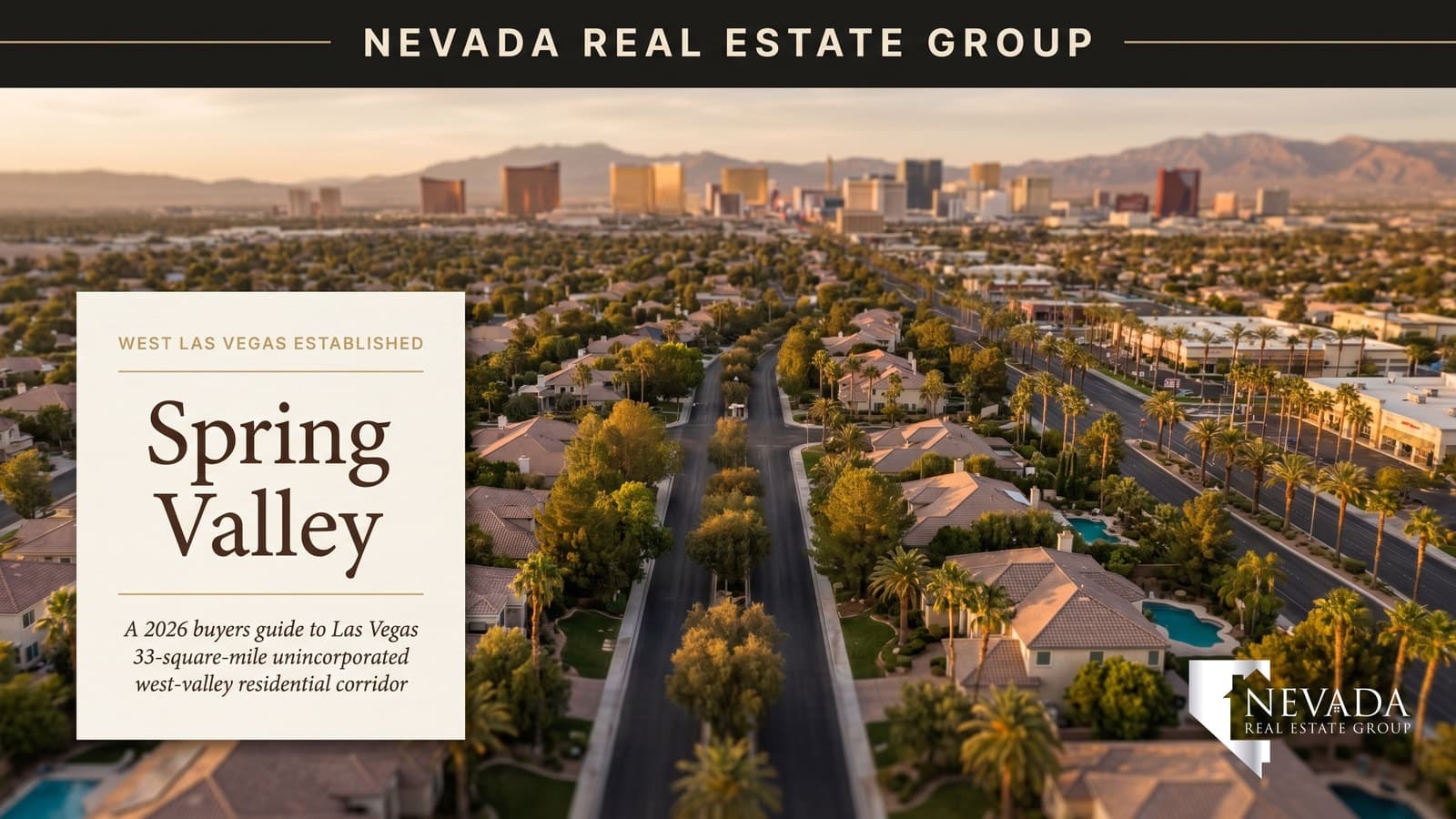

Spring Valley is the 33-square-mile unincorporated west Las Vegas district that contains over 60,000 homes and 180,000-plus residents — making it the largest established residential area in the Las Vegas metro outside of Henderson. Unlike the master-planned communities that dominate other recent NREG coverage (Summerlin, Henderson master plans, the newer northwest and southwest valley plans), Spring Valley is not a single planned community — it is a large unincorporated Clark County residential district that grew organically from the 1980s through the early 2000s with diverse housing types, sub-neighborhoods, and HOA structures spread across roughly 33 square miles stretching from the western edge of the Strip corridor west toward the Summerlin boundary.
What separates Spring Valley from the master-planned alternatives is price-to-location value combined with diverse inventory. Home prices in 2026 run from approximately $300,000 for entry-tier townhomes and smaller resale single-family up to approximately $700,000 for larger upgraded single-family homes in the more-desirable sub-neighborhoods. Adjacent guard-gated luxury enclaves — Canyon Gate Country Club, Spanish Trail, and The Lakes — reach into the $1 million to $3 million-plus range. The combination of central west-valley location (10-15 minute Strip commute, immediate Summerlin access), mature tree canopy, robust commercial infrastructure along Flamingo and Spring Mountain Road, and price entry well below newer master plans makes Spring Valley one of the structural value picks for first-time buyers, relocators on a budget, and real-estate investors.
This guide is the buyer-side map for Spring Valley in 2026: what the major sub-neighborhood groupings look like (with prices), what the adjacent guard-gated luxury options are, what Desert Breeze Park and the commercial corridors offer, which schools serve the address, how HOA dues vary, what the resale market is doing, what the investment / rental market looks like (Spring Valley has one of the strongest landlord-friendly metrics in the metro), and how Spring Valley compares to Summerlin and the southwest valley alternatives.
Spring Valley is a 33-square-mile unincorporated west Las Vegas residential district in Clark County, with over 60,000 homes and 180,000-plus residents developed primarily from the 1980s through early 2000s. Home prices in 2026 run from approximately $300,000 for entry-tier resale up to approximately $700,000 for larger upgraded single-family. Adjacent guard-gated luxury enclaves (Canyon Gate Country Club, Spanish Trail, The Lakes) reach $1 million to $3 million-plus. HOA dues range from approximately $25 to $200 per month depending on sub-neighborhood. Schools include Bonner Elementary (7/10), Becker Middle (6/10), Spring Valley High (5/10). Strip commute is just 10-15 minutes; Summerlin is 5-10 minutes. Median household income runs approximately $60,000; homeownership rate 52% (lower than master plans, reflecting heavy rental inventory).
- 33 square miles / 60,000-plus homes / 180,000-plus residents — the largest established residential district in the Las Vegas metro outside Henderson.
- Price range $300,000 to $700,000 across diverse sub-neighborhoods; adjacent guard-gated luxury (Canyon Gate, Spanish Trail, The Lakes) reaches $1M-$3M+.
- 10-15 minute Strip commute via Flamingo or Spring Mountain Road — one of the fastest Strip commutes in the metro.
- Strong investment / rental market: 52% homeownership rate (vs 70%+ in master plans) means the majority-owned-occupied dynamic of master plans flips toward landlord activity.
- Desert Breeze Park: wave pool, community center, Southern Nevada Railroad Museum — one of the best park facilities in the valley.
- HOA dues $25-$200 monthly — meaningfully lower than newer master plans; many sub-neighborhoods have no HOA at all.
- Schools rated lower than premium master plans but strong charter options (Doral 9/10, Coral Academy 8/10) within 15 minutes.
What exactly is Spring Valley in 2026?
Spring Valley is an unincorporated residential district in western Clark County, Nevada — meaning it does not fall within the corporate boundaries of any city (not Las Vegas, not Henderson, not North Las Vegas), but is governed directly by Clark County government for zoning, public safety, and infrastructure. According to the Clark County community development department, Spring Valley spans approximately 33 square miles from the western edge of the Strip corridor (roughly Decatur Boulevard) west toward the Summerlin boundary (roughly Hualapai Way), and from Sahara Avenue north to Sunset Road south.
The community is not a master-planned development — it grew organically from approximately 1981 onward as Clark County opened the western valley to residential development. Multiple builders, developers, and investors contributed to the housing stock over a 25-year window, producing a diverse inventory of single-family homes, townhomes, condominiums, and adjacent guard-gated luxury enclaves. ZIP codes spanning Spring Valley are 89117, 89147, 89148, and 89113. According to the U.S. Census Bureau American Community Survey, Spring Valley's population approaches 180,000-plus — making it the largest single Census-designated place in the Las Vegas metro outside Henderson.
The community contains 60,000-plus homes across an estimated 2,500-plus distinct sub-associations and HOA-governed neighborhoods, plus a meaningful share of homes with no HOA at all. According to closed-sales data from the Las Vegas REALTORS MLS, Spring Valley generates approximately 2,200-2,800 closed transactions per quarter across the broader district — among the highest single-area closing volumes in the metro because of the sheer scale and ownership turnover characteristic of older established districts.
Where is Spring Valley located and why does the central west position matter?
Spring Valley occupies the central west Las Vegas corridor, sitting strategically between the Strip and Summerlin. The district is bounded roughly by Decatur Boulevard to the east, Hualapai Way to the west (the Summerlin boundary), Sahara Avenue to the north (the Lakes / Desert Shores area), and Sunset Road to the south. This central-west position is the structural location advantage of Spring Valley — most residents are 10-15 minutes from the Strip, 5-10 minutes from Summerlin's Downtown Summerlin commercial core, and 15-20 minutes from Harry Reid International Airport via I-215.
Commute geography is excellent across all directions. According to Federal Highway Administration data, the typical 7-9 a.m. commute to the Strip via Flamingo Road or Spring Mountain Road runs approximately 10-15 minutes — among the fastest Strip commutes of any established Las Vegas area. Downtown is 18-22 minutes; Harry Reid Airport via I-215 is 15-20 minutes; Henderson master plans via I-215 East are 22-30 minutes.
The commercial infrastructure is a structural advantage. Flamingo Road and Fort Apache is the de facto commercial downtown for west Las Vegas — grocery, medical, fitness, dining within minutes of every home. Rainbow Boulevard and Spring Mountain Road add further density including the Las Vegas Chinatown corridor with exceptional restaurant offerings.
What sub-neighborhoods make up Spring Valley?
Spring Valley contains hundreds of sub-neighborhoods and sub-associations across the 33-square-mile footprint. The six recognizable sub-neighborhood groupings used by relocating buyers and real-estate professionals cover the bulk of the inventory.
| Sub-Neighborhood | Character | Dominant Housing | 2026 Typical Price |
|---|---|---|---|
| Fort Apache Corridor | Commercial-adjacent, convenient | Condos, townhomes, single-family | $300,000–$435,000 |
| Rainbow Corridor | Value-tier, rental-heavy | Single-family resale | $325,000–$455,000 |
| Spring Valley Ranch | 1990s-2000s family resale | Single-family detached | $350,000–$495,000 |
| Desert Shores Adjacent | Lakefront / lake-adjacent | Single-family + townhomes | $375,000–$565,000 |
| The Willows | Established family, larger plans | Single-family detached | $400,000–$565,000 |
| Spring Mountain Estates | Western edge, Summerlin-adjacent | Larger single-family + custom | $500,000–$700,000+ |
The largest pricing variable inside Spring Valley is specific street and HOA-or-no-HOA structure, not sub-neighborhood. Two homes on the same Spring Valley street can have meaningfully different HOA assessments because of sub-association boundaries that don't follow visible neighborhood lines. According to closing-file analysis we have reviewed across Spring Valley transactions, the single most important diligence step is requesting the resale package within 48 hours of contract acceptance to confirm the specific HOA structure — Spring Valley contains everything from $25/month master-only HOAs up to $200/month sub-association layered structures, and the difference materially affects the offer math.
What guard-gated luxury communities are inside or adjacent to Spring Valley?
Three of the most-recognized guard-gated luxury communities in west Las Vegas sit inside or immediately adjacent to the Spring Valley boundary: Canyon Gate Country Club, Spanish Trail, and The Lakes (Desert Shores). Each operates as a separate guard-gated community with its own HOA, amenity programming, and price tier — but local convention typically groups them with Spring Valley for relocation discussion because of geographic proximity and shared school and commercial infrastructure.
Canyon Gate Country Club is the 330-acre guard-gated golf community at the northern edge of Spring Valley along Sahara Avenue. The community includes the 18-hole Canyon Gate Country Club (private membership with separate initiation fees) plus approximately 1,800 homes ranging from approximately $700,000 for smaller resale homes up to over $2.5 million for premium golf-frontage estates. Canyon Gate HOA dues run approximately $200-$285 monthly with optional country club membership ($20,000-$45,000 initiation depending on category).
Spanish Trail is the 640-acre guard-gated golf and tennis country club community at the eastern edge of Spring Valley along Flamingo Road. Home prices run from approximately $700,000 for smaller resale homes up to over $3 million for trophy custom estates. Spanish Trail Country Club operates a private 27-hole golf course (designed by Robert Trent Jones Sr.) plus a full-service clubhouse with tennis, fitness, dining, and event programming. HOA dues run approximately $250-$400 monthly with mandatory country club membership for certain golf-frontage sections.
The Lakes (also called Desert Shores when discussing the broader sub-area) is the 600-home guard-gated lakefront community at the northwest edge of Spring Valley. The community is built around manmade lakes with several homes offering direct waterfront positioning and access to small private docks. Home prices run from approximately $500,000 for non-lakefront homes up to over $2 million for premium waterfront estates. HOA dues run approximately $185-$260 monthly with lakefront-position assessments adding sub-association layers.


What does Desert Breeze Park offer for daily life?
Desert Breeze Park is the 20-acre flagship park at the geographic center of Spring Valley and one of the most distinctive public-park facilities in the entire Las Vegas valley. According to the Clark County Parks & Recreation department, Desert Breeze Park includes a community wave pool (one of the few wave pools in the metro), the Desert Breeze Community Center with indoor recreation facilities, a skate park, multiple sports fields, a children's playground, walking trails, picnic pavilions, and the Southern Nevada Railroad Museum with operational miniature railroad rides on weekends.
The wave pool is the structurally distinctive amenity. Most Las Vegas community pools are standard rectangular or freeform pools; the Desert Breeze wave pool delivers a small-scale beach-style wave experience that draws families from across the broader west Las Vegas zone. According to Clark County Parks programming data, the park hosts approximately 60-80 organized community events per year including summer concerts, family movie nights, holiday celebrations, and the regular weekend Railroad Museum operations. For Spring Valley families with young children, Desert Breeze is the primary weekend daily-life amenity.
Beyond Desert Breeze, several smaller parks dot the Spring Valley footprint including Charlie Frias Park (30 acres with ball fields and trails) and Cimarron-Memorial Park (15 acres with pool and tennis courts). The total public park footprint inside Spring Valley exceeds 100 acres — meaningful amenity density for an unincorporated district that wasn't planned around community amenity infrastructure.
Which schools serve Spring Valley?
Spring Valley falls within the Clark County School District attendance area. The 33-square-mile footprint contains multiple elementary, middle, and high schools because of its size — buyers should always verify the specific assignment for any address using the CCSD school zone locator. According to GreatSchools ratings as of spring 2026, the primary central-Spring-Valley schools are Bonner Elementary (rating 7/10), Becker Middle School (6/10), and Spring Valley High School (5/10). Other Spring Valley elementaries vary from 5/10 to 8/10 depending on the specific boundary.
The Spring Valley High School rating (5/10) is meaningfully below the master-planned community alternatives. For families who weight public school ratings heavily, this is the single most material trade-off versus relocating to a Summerlin or Henderson master plan. The lower rating reflects both the demographic mix and the older school infrastructure rather than poor outcomes for individual students who engage with the academic program.
Strong charter and private alternatives within 15 minutes mitigate the school-rating concern for many families. Top options include Doral Academy of Nevada (K-8 charter, 9/10 rating), Coral Academy of Science (K-12 charter, 8/10), Bishop Gorman High School (the Diocese of Las Vegas Catholic college prep), The Meadows School (PreK-12 independent — the top-tier private day school in southern Nevada), and Faith Lutheran Middle and High School (Christian college prep). According to the Nevada State Public Charter School Authority, both Doral Academy and Coral Academy run multi-year kindergarten waitlists — families planning to use charters should apply early.
What HOA dues should buyers expect across Spring Valley?
HOA dues at Spring Valley vary dramatically because each sub-neighborhood and sub-association operates independently. The full range runs from $0 per month for the no-HOA sub-neighborhoods (a meaningful share of Spring Valley homes, particularly in the older Fort Apache and Rainbow corridors) up to approximately $200 per month in the most-amenity-rich planned-community-style sub-associations within the broader district.
| Sub-Neighborhood | Master HOA Monthly | Typical Inclusion |
|---|---|---|
| Older Fort Apache / Rainbow corridors | $0–$45 | Many no-HOA streets, master-only governance where present |
| Spring Valley Ranch | $50–$95 | Common areas, sub-association reserves |
| Spring Mountain Estates | $65–$120 | Common areas, mature landscape |
| The Willows | $75–$135 | Community pools, parks adjacency |
| Desert Shores Adjacent | $95–$165 | Lake access (some), common areas |
| Planned-community sub-associations | $135–$200 | Community pools, fitness, gated access (in some cases) |
The wide HOA spread reflects the organic development pattern of Spring Valley — older streets often have no HOA at all (developed before HOA-required entitlement became standard), while newer 1990s-2000s sub-associations carry full amenity-included assessments. According to Nevada Revised Statutes Chapter 116, Nevada common-interest community law requires HOAs to provide annual budget disclosures, reserve study summaries, and CC&R copies during the resale-disclosure window. Always request the 9.5 resale package within 48 hours of contract acceptance — Spring Valley's HOA structure varies more by specific street than by sub-neighborhood, and what looks like a no-HOA home can carry a $95 sub-association layer depending on the exact lot.
What is the resale market like at Spring Valley in 2026?
Spring Valley resale operates as the deepest and most-active resale market in the Las Vegas metro outside the broader Henderson region. According to closed-sales data from the Las Vegas REALTORS MLS for the trailing 12 months through Q1 2026:
- Median resale sale price: approximately $415,000
- Median price per square foot: approximately $230
- Median days on market: approximately 35-50 days
- Trailing-12 resale closings: approximately 2,200-2,800 (highest of any single Las Vegas-metro area)
- Median sale-to-list ratio: approximately 97.5%
The 2,200-2,800 trailing-12 closing volume is the highest of any single Las Vegas-metro area — reflecting Spring Valley's sheer scale (60,000+ homes) and the higher transaction velocity that characterizes older districts with more rental-investor activity.
The two most-resilient sub-segments in 2026 are Spring Mountain Estates western-edge larger-home positions (Summerlin-adjacent buyers paying near-Summerlin prices for SV addresses) and The Willows family-oriented mid-tier homes. Both pull near-list within 30-45 days when correctly priced. The slowest segment is entry-tier Fort Apache and Rainbow corridor condos/townhomes (45-65 days). See our national prices vs Las Vegas analysis for broader context.
What financing options work for Spring Valley buyers in 2026?
Spring Valley purchases split across a typical Las Vegas value-tier financing mix with the entry-and-mid-tier price points showing meaningful FHA and investor share. According to closing-file work and Mortgage Bankers Association data, Spring Valley transactions in 2026 are running approximately 35% conventional at 10-20% down, 30% FHA at 3.5% down (concentrated in the entry-tier Fort Apache and Rainbow corridor inventory), 10% VA at 0% down, 20% cash (heavier than other Las Vegas areas because of significant investor activity — Spring Valley is one of the most-active investor markets in the metro), and 5% specialty programs.
For first-time Spring Valley buyers, the FHA plus Nevada Home Is Possible combination remains the highest-leverage program. According to the Nevada Housing Division, Home Is Possible can provide a grant of approximately 4-5% of the loan amount that effectively reduces FHA's 3.5% down payment to approximately $0 out of pocket for eligible buyers. On a $350,000 Spring Valley purchase, the program eliminates the $12,250 FHA down payment, with the buyer still responsible for closing costs and prepaid escrows ($5,500-$9,500). We covered the broader landscape in our Las Vegas housing down payments analysis.
For investors purchasing Spring Valley properties for rental, DSCR (Debt Service Coverage Ratio) loans are the most-active program — they qualify the buyer on property rental income rather than personal income. DSCR loans typically require 20-25% down with rates running 0.75-1.25% above owner-occupied conventional. Spring Valley's high renter demand and rents supporting positive cash flow at most price points make it one of the strongest DSCR markets in the western U.S.
Is Spring Valley a good investment / rental market in 2026?
Spring Valley is one of the most active rental and investor markets in the entire Las Vegas metro. According to U.S. Census Bureau American Community Survey data, Spring Valley's homeownership rate is approximately 52% — meaning ~48% of homes are rentals, roughly 18-25 points lower than typical master plans (70-78%).
The investor opportunity: single-family entry-tier homes ($300K-$425K) in Fort Apache and Rainbow corridors rent for $1,800-$2,400/month; mid-tier ($425K-$565K) in Spring Valley Ranch, The Willows, and Spring Mountain Estates rent for $2,400-$3,200/month; townhomes/condos along Fort Apache rent for $1,600-$2,100/month (with higher HOA reducing net cash flow).
Value-add opportunities are strong in the 1990s-2000s stock. A $35,000-$60,000 kitchen + flooring + bath renovation typically returns 1.2-1.6x at resale. For BRRRR investors, Spring Valley delivers consistent renovation comp data and predictable refinance valuations.
What should buyers verify before contract on a Spring Valley home?
Six items deserve mandatory verification on every Spring Valley resale contract:
1. HOA structure (or no-HOA) — Spring Valley contains everything from no-HOA streets to layered master-plus-sub-association structures. Order the resale package immediately upon contract to confirm exact assessments and any sub-association layers, plus rental caps, exterior modification rules, and RV/boat parking restrictions.
2. School boundary — Spring Valley's 33-square-mile footprint contains multiple elementary, middle, and high school assignments. Verify the specific assignment for any address using the CCSD school zone locator before contract — boundaries can shift between adjacent streets.
3. Roof age — Many Spring Valley homes built 1990-2005 are now 20-35 years old. Standard concrete-tile roofs typically last 40-50 years, but the underlayment beneath the tile typically needs replacement at 25-30 years. Budget $10,000-$20,000 for underlayment replacement on older homes if not already done.
4. HVAC, water heater, electrical service — All three typically need replacement at 15-20 year intervals. Older Spring Valley homes may have original 1990s equipment at end-of-life. Budget $9,000-$15,000 for HVAC, $1,200-$2,400 for water heater, $3,000-$6,000 for electrical panel upgrade if needed.
5. Pool and irrigation — Spring Valley homes with pools (approximately 30-40% of inventory) typically have aging pool equipment on the 1990s-2000s cohort. Budget $4,000-$12,000 for pool equipment and resurfacing if showing wear.
6. Permit status of additions — Some Spring Valley homes have unpermitted additions (sunrooms, casitas, garage conversions). Always verify permit status with Clark County Building Department records — unpermitted work creates resale risk and insurance complications.
How does Spring Valley compare to Summerlin and the southwest valley?
Three west-valley areas are most often considered alongside Spring Valley by relocating buyers: Spring Valley (33 sq mi unincorporated district, $300K-$700K), Summerlin (22,500-acre master plan immediately west, $400K-$20M+), and the broader southwest valley areas including Mountains Edge (3,500-acre master plan, $350K-$650K) and Rhodes Ranch (1,350-acre guard-gated golf, $350K-$700K). Each has a distinct character; the decision usually comes down to price entry, master-plan vs unincorporated preference, and amenity priority.
| Dimension | Spring Valley | Summerlin | Mountains Edge | Rhodes Ranch |
|---|---|---|---|---|
| Type | Unincorporated district | Master plan | Master plan | Guard-gated master plan |
| Footprint | 33 sq mi | 22,500 acres | 3,500 acres | 1,350 acres |
| Home count | 60,000+ | 50,000+ | 12,000+ | 4,000+ |
| Price range (2026) | $300K–$700K | $400K–$20M+ | $350K–$650K | $350K–$700K |
| Median resale (2026) | $415K | $695K | $465K | $485K |
| Guard-gated options | Adjacent (Canyon Gate, Spanish Trail, The Lakes) | Many (The Ridges, Red Rock CC) | None inside | Yes (entire community) |
| Strip commute | 10-15 min | 22-30 min (western villages) | 20-26 min | 20-26 min |
| Master HOA monthly | $0–$200 | $95–$475+ (varies by village) | $50–$150 | $150–$350 |
| Homeownership rate | 52% | 78% | 78% | 72% |
| Investor / rental activity | Very high | Low-moderate | Moderate | Low-moderate |
The headline differences: Spring Valley is the central-location-and-investor choice — fastest Strip commute, highest investor activity, broadest price range across diverse housing types, but lowest school ratings of the four. Summerlin is the master-plan-quality choice — strongest amenities and schools, broader price ceiling, but higher entry and longer Strip commute from western villages. Mountains Edge is the value-and-Red-Rock choice — strongest park infrastructure, no SID/LID, lower HOA. Rhodes Ranch is the guard-gated-golf-at-value choice — only southwest valley community with 24/7 manned guard + championship golf at sub-$700K.
For owner-occupied buyers with families who prioritize school quality, Summerlin or Henderson master plans are usually the structural pick. For owner-occupied buyers prioritizing central location and budget, Spring Valley is competitive. For investors and value-add buyers, Spring Valley is one of the strongest value-add markets in the entire Las Vegas metro. If you'd like a private walkthrough of Spring Valley sub-neighborhoods, an introduction to the guard-gated adjacents (Canyon Gate, Spanish Trail, The Lakes), or a current list of investor or owner-occupier opportunities, the most direct path is to text or call Chris Nevada at (702) 637-1759.
Frequently Asked Questions
What is the price range across Spring Valley?
Spring Valley prices in 2026 run from approximately $300,000 for entry-tier condos and townhomes in the Fort Apache and Rainbow corridors up to approximately $700,000 for larger upgraded single-family homes in Spring Mountain Estates and The Willows. Adjacent guard-gated luxury communities (Canyon Gate, Spanish Trail, The Lakes) reach $1 million to $3 million-plus. The 2026 median resale runs approximately $415,000.
Is Spring Valley guard-gated?
No. Spring Valley itself is an open unincorporated residential district. However, three guard-gated luxury communities sit immediately adjacent or inside the broader Spring Valley boundary: Canyon Gate Country Club (guard-gated golf), Spanish Trail (guard-gated golf and tennis country club), and The Lakes / Desert Shores (guard-gated lakefront). Buyers who specifically want guard-gated luxury within the Spring Valley footprint typically target these three communities.
Which schools serve Spring Valley?
Spring Valley's 33-square-mile footprint contains multiple CCSD schools — buyers should verify the specific assignment for any address. The primary central-area schools are Bonner Elementary (7/10), Becker Middle School (6/10), and Spring Valley High School (5/10). Strong charter alternatives include Doral Academy of Nevada (9/10) and Coral Academy of Science (8/10). Private options within 15 minutes include Bishop Gorman, The Meadows School, and Faith Lutheran.
How long is the commute from Spring Valley to the Strip?
Typical 7-9 a.m. commute via Flamingo Road or Spring Mountain Road runs approximately 10-15 minutes — one of the fastest Strip commutes of any established Las Vegas area. Downtown is 18-22 min. Harry Reid Airport via I-215 is 15-20 min. Summerlin is 5-10 min west.
Is Spring Valley a good rental investment market?
Yes — Spring Valley is one of the most active rental and investor markets in the metro. Homeownership rate is approximately 52% (vs 70-78% in master plans), meaning approximately 48% of homes are rentals. Single-family entry-tier ($300K-$425K) homes typically rent for $1,800-$2,400/month; mid-tier ($425K-$565K) homes for $2,400-$3,200/month. Strong DSCR loan market supports investor financing. Value-add renovation opportunities are particularly strong in the 1990s-2000s housing stock.
What's the difference between Spring Valley and Summerlin?
Summerlin is a 22,500-acre master-planned community with developer-led amenity programming, top-rated schools, and consistent architectural standards across distinct villages. Spring Valley is a 33-square-mile unincorporated district that grew organically with diverse housing types and HOA structures. Summerlin price entry runs higher ($400K+ vs Spring Valley's $300K+). Spring Valley Strip commute is faster (10-15 min vs 22-30 min from western Summerlin villages). For families with school priorities, Summerlin is usually the pick; for central location and investor activity, Spring Valley is competitive.
Which Sources Inform This Spring Valley Guide?
This guide draws on public records, MLS sales data, CCSD attendance maps, Clark County zoning and parks data, and closing-file work from buyer-and-seller representation across the Spring Valley district through Q1 2026. Authoritative sources cited above include: Clark County and its community development department for entitlement, zoning, and unincorporated-area governance; the Clark County Parks & Recreation department for Desert Breeze and other park amenity data; the Clark County Building Department for permit-status verification context; the Clark County School District for school attendance boundaries; GreatSchools for school ratings; Las Vegas REALTORS for resale market statistics; Nevada Revised Statutes Chapter 116 for common-interest community law; the U.S. Census Bureau American Community Survey for demographic and ownership data; the Federal Highway Administration for commute-time benchmarks; the Nevada State Public Charter School Authority for charter enrollment trends; the Mortgage Bankers Association for DSCR and conventional loan composition; and the Nevada Housing Division for Home Is Possible down-payment-assistance program details.
For a Spring Valley sub-neighborhood walkthrough, a Canyon Gate / Spanish Trail / The Lakes guard-gated introduction, or a current list of owner-occupier or investor opportunities, contact Chris Nevada directly at (702) 637-1759 or info@nevadagroup.com.