
Published May 11, 2026 · Updated May 11, 2026 · By Chris Nevada, Nevada Real Estate Group · NV License S.181401
Direct Answer: Third-party pre-drywall inspections on Las Vegas new construction identify construction defects on approximately 60-75% of homes inspected — issues that disappear behind drywall and become difficult to address after close. Common findings include HVAC duct routing problems, insulation gaps in specific wall and attic sections, plumbing connection issues that may not leak immediately but will eventually, electrical wiring concerns including improperly connected outlets and switch boxes, structural connection issues at framing joints, exterior flashing problems around windows and roof penetrations, and waterproofing membrane issues. Cost: typically $400-$700 for the pre-drywall walkthrough by a qualified Las Vegas-area home inspector. Value: $2,500-$15,000+ in builder-paid corrections during the comprehensive 1-year warranty period, plus avoided post-close surprises that emerge 6-24 months later. Some Las Vegas builders welcome third-party inspections; others resist them with subtle or explicit pushback. This guide covers what inspectors find, what it costs, why builders react differently, and how to handle pushback with proper broker representation.
Key Takeaways
- Pre-drywall inspections find correctable defects on 60-75% of Las Vegas new construction homes
- Cost: typically $400-$700 for pre-drywall walkthrough; $600-$1,000 for pre-drywall + pre-close combined
- Value: $2,500-$15,000+ in builder-paid corrections during warranty period
- Common findings: HVAC, insulation, plumbing, electrical, structural framing, flashing, waterproofing
- Some Las Vegas builders welcome inspections; others resist with subtle pushback
- Pre-drywall timing is critical — many issues hide behind drywall once installed
- 11-month warranty inspection extends coverage of additional issues
- Total inspection investment $900-$1,500 over 12 months protects $5,000-$30,000 of value
- Buyer representation helps navigate builder relationships during inspection process
- Inspection findings strengthen builder warranty enforcement
Why Do New Construction Homes Need Inspection at All?
The most common first-time buyer assumption: new construction doesn't need inspection because everything is brand new. The assumption is intuitive but factually wrong. New construction in Las Vegas — like new construction anywhere — has meaningful defect rates because of the volume and complexity of work involved in building a modern home.
The complexity scale. A typical Las Vegas new construction home involves:
- 50,000-150,000+ individual construction steps and decisions
- 15-25 different trades (framing, electrical, plumbing, HVAC, roofing, drywall, flooring, painting, landscape, and dozens of others)
- Multiple inspection points by Clark County building inspectors who review code compliance — not workmanship quality
- Compressed construction timelines that pressure work quality
- Variable individual contractor crew quality across trades
Code inspections vs workmanship inspections. Clark County building inspectors inspect new construction for code compliance — does the home meet minimum safety, structural, and life-safety requirements? This is necessary but limited. Code-compliant work can still be poorly executed, improperly aligned, badly insulated, leaky in non-obvious ways, or inadequately connected. Code compliance is the floor, not the ceiling.
Builder quality control. Builders themselves conduct quality control throughout construction. But QC is performed by builder employees evaluating their own work — a structural conflict of interest. Even well-run builders have defect rates that quality control doesn't fully catch.
Third-party inspection adds an independent layer. A third-party inspector represents the buyer's interests rather than the builder's. The inspector has no incentive to overlook issues, no schedule pressure, and no relationship to protect with subs. Findings reflect what the inspector actually observed, not what the builder's QC team chose to address.
The combination of construction complexity, schedule pressure, contractor variability, and code-inspection limitations means even high-quality Las Vegas builders produce homes with correctable defects on most builds. The third-party inspection identifies these defects.
What Is a Pre-Drywall Inspection and Why Is the Timing Critical?
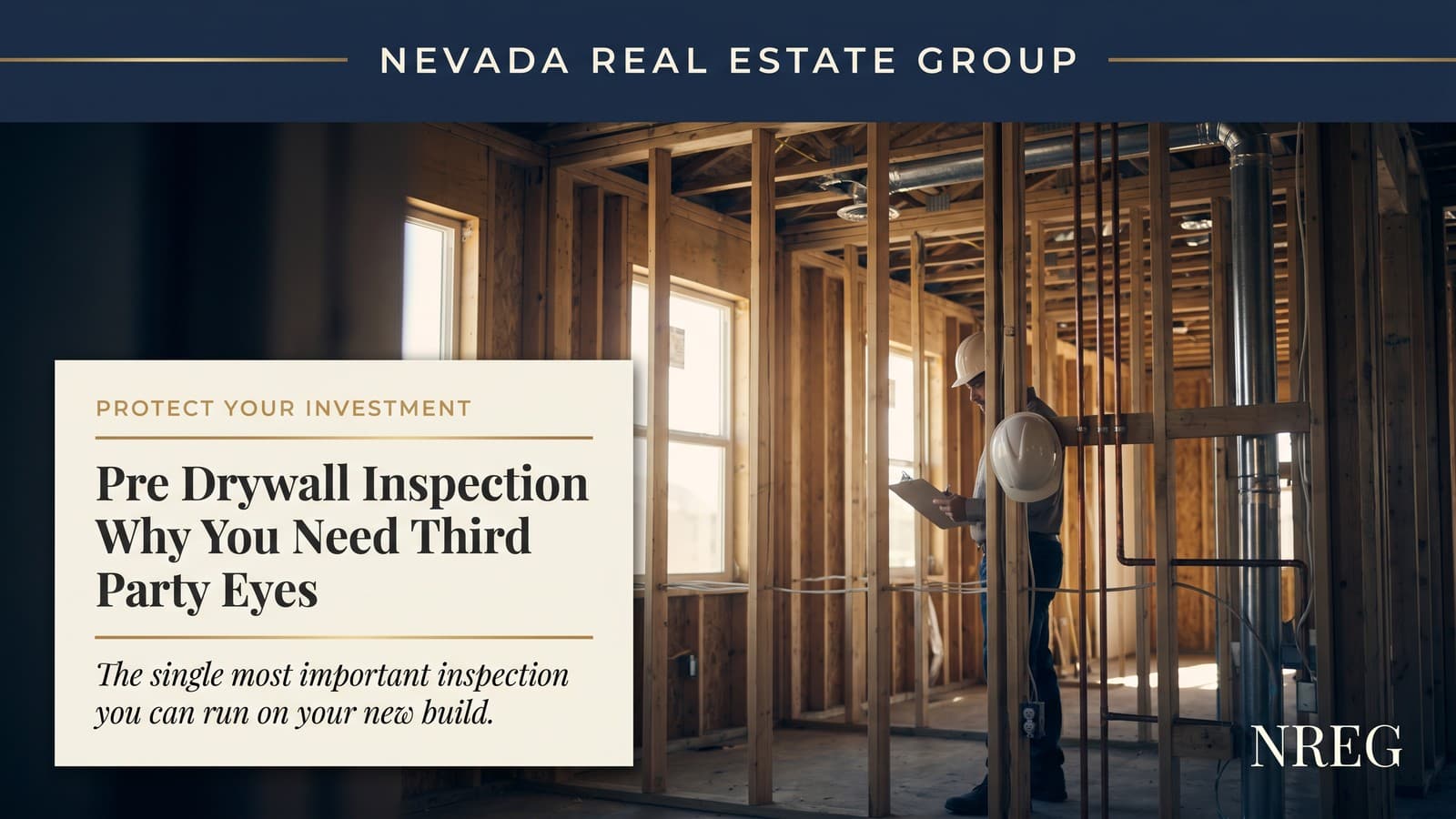
A pre-drywall inspection is a third-party inspector walkthrough conducted after framing, electrical, plumbing, HVAC, and insulation work is substantially complete — but BEFORE drywall installation closes the walls.
Why pre-drywall timing matters. Many of the most expensive new construction defects are hidden behind drywall once installed. Electrical wiring issues, plumbing connection problems, HVAC duct routing concerns, insulation gaps, and structural framing problems are all visible during the pre-drywall phase. Once drywall goes up, these issues become invisible — you can't see what you can't see.
The pre-drywall window in Las Vegas construction. Pre-drywall inspections typically occur approximately 3-5 months into a 9-13 month build, with the specific timing varying by builder and floor plan. Buyers should coordinate with the builder construction manager early to identify the right window for pre-drywall inspection. Some builders pre-schedule the buyer pre-drywall walkthrough; others require buyer initiative.
What the inspection covers during pre-drywall.
Framing. Structural framing connections at headers, beams, joists, and load-bearing walls. Proper nailing patterns at framing joints. Plumb and level walls. Adequate header sizing for openings. Connection plates and straps where required.
Electrical. Wire routing through framing, junction box installation, outlet and switch box positioning, wire connection quality at boxes, panel installation, GFCI placement at appropriate locations, dedicated circuit installation, smoke detector wiring, low-voltage rough-in for media, security, and smart home systems.
Plumbing. Pipe routing through framing, joint quality at connections, drain venting, pipe support and bracing, water heater rough-in, gas line installation, fixture rough-in dimensions, water hammer arrestors where needed.
HVAC. Duct routing through ceilings, walls, and floor systems. Duct connection quality at joints. Insulation around ducts in unconditioned spaces. Equipment positioning and clearances. Refrigerant line routing. Condensate drain installation.
Insulation. Wall insulation completeness in all bays. Attic insulation distribution and depth. Insulation around windows and doors. Insulation around plumbing penetrations. Vapor barrier installation if required.
Roof and exterior. Roof framing connections, sheathing nailing patterns, flashing installation at roof-to-wall joints, exterior wall sheathing, window flashing and waterproofing membrane, exterior penetration sealing.
General construction. Floor joist installation, subfloor sheathing quality, stair framing, deck framing connections if applicable.
A thorough pre-drywall inspection takes 3-5 hours for a typical 2,500-3,500 sq ft Las Vegas home.
What Defects Do Pre-Drywall Inspectors Actually Find?
Real findings from Las Vegas new construction pre-drywall inspections demonstrate the value. The following are common across multiple Las Vegas builders.
HVAC duct routing problems. Ducts that take unnecessarily long routes increase static pressure and reduce airflow. Ducts not properly sealed at connections leak conditioned air into unconditioned spaces. Duct sizing mismatches that don't match the equipment's design specifications. Duct insulation gaps in unconditioned spaces (attic, garage walls).
Real impact of HVAC findings. Poorly routed or installed ductwork in a Las Vegas home causes 15-30% higher cooling costs during summer months. Over a 10-year hold, this can add $3,000-$8,000 in unnecessary utility costs. Builder corrections during the warranty period are typically free.
Insulation gaps. Wall cavities with missing or improperly compressed insulation. Attic areas with thin or missing insulation distribution. Insulation gaps at top plates, around windows, around plumbing penetrations, and behind electrical boxes.
Real impact of insulation findings. Insulation gaps cause measurable summer cooling cost increases and create comfort issues (hot/cold spots in specific rooms). Repairs after drywall installation require cutting drywall, blowing in or batt-installing additional insulation, then repairing drywall — expensive and disruptive. Repairs during pre-drywall phase: free, fast, simple.
Plumbing connection issues. Solder joints that are inadequately heated. PEX connections at fittings that aren't fully seated. Drain venting routing problems. Inadequate pipe support causing future sag and joint stress.
Real impact of plumbing findings. Inadequate plumbing connections may not leak immediately but typically develop leaks 12-36 months later. Post-close leak discovery requires drywall cutting, plumber service calls, and water damage remediation. Pre-drywall correction: free, complete fix during normal construction.
Electrical issues. Junction boxes that don't have proper wire connections. Outlets wired incorrectly with reversed polarity. Switch boxes with inadequate clamping of wires. GFCI placement that doesn't meet code at specific locations.
Real impact of electrical findings. Electrical defects range from minor (outlet works but with safety concern) to serious (potential fire hazard or shock risk). Post-close electrical repairs require electrician service calls and sometimes drywall cutting. Pre-drywall correction: free during normal electrical work.
Structural framing issues. Header connections at openings not properly nailed. Hold-downs not fully secured. Connections at load-bearing wall intersections incomplete.
Real impact of structural findings. Structural framing defects can affect home safety (in severe cases) or cause long-term settling and cracking. Post-close correction is expensive and disruptive. Pre-drywall correction: typically free with normal framer return visit.
Exterior waterproofing and flashing. Window flashing not properly installed. Waterproofing membrane gaps at exterior wall penetrations. Roof flashing at chimney, vent, or wall intersections inadequate.
Real impact of flashing findings. Inadequate flashing causes water intrusion that may not show until first significant rain (Las Vegas gets ~4 inches annually but storms can be intense). Water intrusion damages drywall, framing, insulation, and creates mold risk. Repair costs $5,000-$25,000 if discovered post-close, $0 if corrected pre-drywall.
What Does a Pre-Drywall Inspection Cost in Las Vegas?
Las Vegas-area home inspectors typically charge $400-$700 for a pre-drywall walkthrough on a standard 2,500-3,500 sq ft new construction home. Pricing varies by:
Home size. Larger homes (4,000+ sq ft) typically run $550-$800. Smaller homes (under 2,000 sq ft) typically run $350-$550.
Inspector experience and reputation. Established Las Vegas inspectors with strong reputations and detailed reporting typically charge in the $500-$700 range. Less-established inspectors may charge less but provide less thorough reports.
Report deliverable. Some inspectors deliver simple checklist reports; others deliver detailed photo-documented reports with specific recommendation language ready for builder correspondence. The detailed photo-documented report is worth the premium pricing.
Combined inspection packages. Most buyers benefit from combining pre-drywall plus pre-close inspection. Combined packages typically run $600-$1,000 — saving $100-$200 vs separate inspection bookings. Some buyers add an 11-month warranty inspection (additional $300-$500) for total inspection coverage of $900-$1,500 across the first year.
ROI math. Average pre-drywall inspection finds $2,500-$15,000+ in builder-paid corrections. Investment of $400-$700 produces typical 4x-25x return. Even when findings are modest (a few hundred dollars in corrections), the inspection cost is justified by the peace-of-mind alone.
| Inspection Scope | Typical Cost | Typical Findings Value |
|---|---|---|
| Pre-drywall only | $400-$700 | $2,000-$10,000 |
| Pre-close only | $350-$550 | $1,500-$5,000 |
| Pre-drywall + pre-close combined | $600-$1,000 | $3,500-$15,000+ |
| Full coverage: pre-drywall + pre-close + 11-month | $900-$1,500 | $5,000-$25,000+ |
How Do Builders React to Third-Party Inspections?
Builder reactions to third-party inspection vary across a spectrum from welcoming to subtly resistant. Understanding the reactions helps buyers handle them.
Welcoming builders. Some Las Vegas builders welcome third-party inspection because they view findings as opportunities to deliver better product. These builders typically have strong internal QC programs and view third-party inspection as a complement to their own quality control. Custom luxury builders and some semi-custom production builders typically fall in this category.
Neutral builders. Most major Las Vegas production builders are neutral — they neither welcome nor actively resist third-party inspection. The buyer-paid inspector arrives, conducts the inspection, submits findings to the builder, and the builder addresses legitimate findings as warranty matters. The relationship is professional and transactional.
Subtly resistant builders. Some builders subtly resist third-party inspection through procedural friction. Examples: making it difficult to schedule the pre-drywall walkthrough, providing limited advance notice of when the home will be at the pre-drywall phase, having sales staff express skepticism about the value of inspection, classifying borderline findings as "warranty-not-required" rather than addressing them, or slowing response time on correction requests.
How to handle each reaction.
Welcoming builder. Simple coordination. Schedule the inspection, share findings with the builder construction manager, expect prompt addressing of legitimate concerns.
Neutral builder. Standard professional process. Provide adequate advance notice for inspection scheduling, deliver findings in writing with photo documentation, follow up on correction commitments.
Subtly resistant builder. This is where broker representation becomes most valuable. Brokers experienced with the specific builder can navigate the resistance — pushing back on procedural friction, escalating to builder management when sales staff resists, and ensuring legitimate findings get addressed despite builder reluctance.
Explicit resistance is rare. Builders almost never explicitly forbid third-party inspection (state laws generally prohibit such restrictions). The resistance is procedural rather than explicit. A buyer with broker representation typically navigates around the friction without major issue.
When Should the Pre-Drywall Inspection Be Scheduled?
Timing the pre-drywall inspection correctly is essential. Too early and key work isn't complete; too late and drywall has already started going up.
The ideal pre-drywall window. The inspection should occur when:
- Framing is fully complete and inspected by Clark County
- Plumbing rough-in is complete and tested
- Electrical rough-in is complete (wiring pulled, boxes installed)
- HVAC ductwork installation is complete
- Insulation is installed in walls and attic
- AT THE SAME TIME: drywall has NOT yet been installed
- AT THE SAME TIME: ideally before drywall delivery to the site (drywall stacked in the home suggests installation is imminent)
Communication with builder construction manager. Most builder construction managers can identify when the home will be at the ideal pre-drywall window — typically 3-7 days before drywall installation begins. The buyer (or buyer's broker) should establish communication with the construction manager early and request notification when the home approaches pre-drywall window.
Avoiding scheduling problems. Common timing failures:
- Builder doesn't notify the buyer until drywall is already installed (post-drywall inspection has reduced value)
- Buyer doesn't engage an inspector early enough to schedule within the 5-7 day window
- Inspector is booked solid and can't fit the inspection within the window
- Construction schedule shifts faster than expected and the window closes earlier than projected
The solution. Engage your inspector early in the build process — typically when foundation is being poured. Discuss likely pre-drywall timing with the inspector and establish a flexible scheduling agreement. Establish communication with builder construction manager and request advance notice of the pre-drywall window. Plan for one rescheduling if needed.
What Happens After the Inspection — How Findings Get Addressed
The inspection itself is just the beginning. The post-inspection process determines whether findings actually result in corrections.
Inspector report delivery. Most Las Vegas-area inspectors deliver written reports within 24-72 hours of inspection. Reports include photo documentation, specific descriptions of findings, severity assessments, and recommended actions. Strong reports use language directly applicable to builder correspondence.
Builder communication. The buyer (or buyer's broker) submits the inspection report to the builder construction manager and the builder's warranty service team. Submission should include the full report plus a cover letter highlighting the most critical findings and requesting timeline for corrections.
Builder response. Builders typically respond within 1-2 weeks of report submission, classifying each finding into categories:
- Will correct before drywall. Legitimate findings the builder accepts and will address before drywall installation.
- Will correct under warranty. Findings the builder accepts but will address as part of the post-close 1-year comprehensive warranty.
- Will discuss further. Findings where the builder questions the severity or necessity of correction.
- Will not correct. Findings the builder considers outside scope of warranty or builder responsibility.
Negotiation on contested findings. Some findings will be contested. The buyer's broker advocates for legitimate findings, references specific builder warranty language, and escalates to builder management as needed. Most legitimate contested findings are eventually addressed when properly documented and advocated.
Post-correction verification. After the builder addresses findings, the buyer (or buyer's broker) should verify the corrections were actually completed and completed properly. Some inspectors offer brief return visits ($150-$250) to verify pre-drywall corrections; this is worthwhile for significant findings.
Pre-close re-inspection. The pre-close inspection captures any new issues that emerged between pre-drywall and close, plus verification that pre-drywall findings were properly addressed.
How Does the Pre-Drywall Inspection Compare to Other Inspections?
A complete new construction inspection program includes multiple inspection points across the build cycle. Each has distinct purpose and value.
| Inspection Type | Timing | Cost | Primary Purpose |
|---|---|---|---|
| Pre-drywall | 3-5 months in build | $400-$700 | Catch hidden defects before they're concealed |
| Pre-close (final walk-through) | 1-2 weeks before close | $350-$550 | Catch final-stage defects before keys handed over |
| 11-month warranty | Month 11 of ownership | $300-$500 | Identify remaining issues before warranty expires |
| Annual maintenance | Year 2 and beyond | $300-$450 | Ongoing condition assessment |
Pre-drywall inspection. The single highest-leverage inspection because it catches defects that hide behind finished construction.
Pre-close inspection. Critical for catching final-stage defects (appliance installation, final paint, fixture installation, exterior completion). Distinct from pre-drywall — different defect categories.
11-month warranty inspection. Often overlooked but valuable. The 1-year comprehensive workmanship warranty expires at month 12. An inspection at month 11 identifies issues that have emerged during the first year of occupancy, allowing builder warranty correction before the window closes.
The complete inspection program. Combined pre-drywall + pre-close + 11-month inspections typically cost $1,050-$1,750 over 12 months. Total value of findings across all three inspections: typically $5,000-$30,000+ in builder-paid corrections.
How Should I Choose a Las Vegas-Area Home Inspector?
Not all Las Vegas-area home inspectors deliver equivalent value. Choosing the right inspector materially affects the inspection's usefulness. Five factors to evaluate.
Factor 1: New construction experience. Some inspectors specialize in resale homes and have limited new construction experience. New construction inspection is a distinct discipline focused on construction phase work rather than evaluating aging systems in established homes. Choose inspectors with substantial new construction Las Vegas experience.
Factor 2: Reporting quality. Strong inspectors deliver detailed photo-documented reports with specific recommendation language ready for builder correspondence. Weak inspectors deliver simple checklists with limited photo documentation. Ask to see a sample report before booking.
Factor 3: Builder relationships. Some inspectors are too friendly with specific builders, softening findings to maintain relationships. Independent inspectors prioritize buyer interests. Ask the inspector directly about their relationships with specific builders and whether findings are influenced by those relationships.
Factor 4: Certifications and credentials. Look for inspectors certified by ASHI (American Society of Home Inspectors), InterNACHI (International Association of Certified Home Inspectors), or other recognized certifying bodies. Nevada licensing is also relevant.
Factor 5: Availability and timing flexibility. Pre-drywall windows are narrow and can shift with construction schedules. Inspectors who book solid 3-4 weeks out may not fit the actual window. Choose inspectors who can flex within 7-10 days for pre-drywall scheduling.
Sample selection process. Get 3 inspector quotes including sample reports. Verify new construction experience. Confirm timing flexibility. Compare pricing against sample report quality. Make the decision based on report quality + experience + flexibility rather than lowest price alone. The price differential between strong and weak inspectors is typically $100-$200 — well worth the value differential in findings quality.
What Are Common Misconceptions About New Construction Inspection?
Misconception 1: "New construction is built to code, so inspection isn't needed." Code compliance is the minimum, not the standard. Code-compliant work can still have meaningful workmanship defects that the third-party inspector identifies.
Misconception 2: "The builder warranty covers everything, so I don't need to find issues before close." The warranty does provide coverage, but enforcement requires identifying issues. Issues discovered late or after the warranty period expires may not be addressed. Pre-drywall and pre-close inspections create the documentation foundation for effective warranty enforcement.
Misconception 3: "Builder QC catches issues, so third-party inspection is redundant." Builder QC is performed by builder employees evaluating their own work. The structural conflict of interest means QC catches some issues but misses others. Independent inspection adds genuine value.
Misconception 4: "The Clark County building inspector already inspected it." Clark County inspects code compliance — not workmanship quality. The two are different. A home can be 100% code-compliant and still have $5,000-$10,000 of correctable workmanship defects.
Misconception 5: "Inspection findings will delay my close." Most pre-drywall findings are addressed as part of normal construction without affecting close timeline. Only severe findings (rare) cause schedule delays, and in those cases the delay is genuinely warranted to prevent worse outcomes.
Misconception 6: "Inspectors will find things to justify their fee." Reputable Las Vegas-area inspectors report only legitimate findings. Reputation in the local market depends on accurate reporting; inflated findings damage the inspector's standing with builders, agents, and future buyers.
How Does Nevada Real Estate Group Help With New Construction Inspections?
Nevada Real Estate Group represents new construction buyers across every major Las Vegas builder, and inspection coordination is part of our standard buyer representation.
Inspector selection. We maintain working relationships with several established Las Vegas-area inspectors with strong reputations for thorough, accurate reporting. We recommend inspectors matched to the specific builder and home characteristics.
Scheduling coordination. We coordinate with builder construction managers to identify the ideal pre-drywall window and schedule the inspection appropriately. This protects against missed timing and rushed scheduling.
Report review and prioritization. We review inspection reports with buyers to prioritize findings — which require pre-drywall correction, which can wait for warranty, which are minor enough to skip. Not every finding requires full correction.
Builder communication. We submit inspection findings to the builder using language and documentation that maximizes legitimate correction. We follow up on commitment delivery and escalate to builder management when needed.
Post-correction verification. We coordinate post-correction walk-throughs to verify findings were actually addressed properly.
Builder pushback navigation. When builders subtly resist inspection process, we know which builders, which managers, and which escalation paths work. This is where broker representation provides the most value during inspection process.
No buyer cost. The builder pays our commission on new construction transactions. Inspection coordination and advocacy is part of standard buyer representation provided at no additional cost.
Q: Do I really need a pre-drywall inspection on a new construction home?
Yes. Third-party pre-drywall inspections identify correctable defects on approximately 60-75% of Las Vegas new construction homes. Common findings include HVAC duct routing issues, insulation gaps, plumbing connection problems, electrical wiring concerns, structural framing issues, and exterior waterproofing problems. Most findings are correctable for free during normal construction but become expensive or impossible to address after drywall is installed. Investment of $400-$700 typically delivers $2,000-$10,000+ in builder-paid corrections.
Q: How much does a pre-drywall inspection cost in Las Vegas?
Las Vegas-area home inspectors typically charge $400-$700 for a pre-drywall walkthrough on a 2,500-3,500 sq ft home. Larger homes (4,000+ sq ft) run $550-$800. Smaller homes (under 2,000 sq ft) run $350-$550. Combined packages including pre-drywall + pre-close inspection typically run $600-$1,000 — saving $100-$200 vs booking separately. Full coverage adding 11-month warranty inspection runs $900-$1,500 total.
Q: When should I schedule the pre-drywall inspection?
Schedule pre-drywall inspection when framing, electrical, plumbing, HVAC, and insulation are complete but BEFORE drywall installation begins. The typical window is 3-7 days before drywall starts going up — usually 3-5 months into a standard 9-13 month build. Coordinate with the builder construction manager to identify the ideal window. Engage your inspector early in the build to ensure scheduling availability within the window.
Q: Will the builder resist a third-party inspection?
Builder reactions vary. Welcoming builders view third-party inspection as a quality complement and address findings promptly. Most major Las Vegas production builders are neutral — professional and transactional but neither welcoming nor resistant. Some builders subtly resist through procedural friction (difficult scheduling, slow response to findings, classifying borderline findings as out-of-scope). Explicit resistance is rare. Broker representation helps navigate any pushback effectively.
Q: What do inspectors typically find on Las Vegas new construction?
Common pre-drywall inspection findings include HVAC duct routing problems and connection seal issues, insulation gaps in wall cavities and attic distribution, plumbing connection problems including improperly soldered joints and inadequate pipe support, electrical wiring issues including reversed polarity and inadequate junction box clamping, structural framing connection issues, and exterior waterproofing problems including window flashing and roof penetration sealing. Approximately 60-75% of inspections find at least one significant correctable defect.
Q: How long does a pre-drywall inspection take?
A thorough pre-drywall inspection on a 2,500-3,500 sq ft Las Vegas home typically takes 3-5 hours. Larger homes (4,000+ sq ft) can take 5-7 hours. The inspection covers framing, electrical, plumbing, HVAC, insulation, roof framing, exterior waterproofing, and general construction. Buyers are typically welcome to attend the inspection. Reports are typically delivered 24-72 hours after inspection.
Q: What is the difference between pre-drywall and pre-close inspections?
Pre-drywall inspection occurs mid-construction (3-5 months into build) and focuses on items that will be hidden behind drywall — framing, electrical, plumbing, HVAC, insulation. Pre-close inspection occurs at the end of construction (1-2 weeks before close) and focuses on final-stage items — appliances, fixtures, finishes, paint, exterior completion, landscape. Both inspections cover different categories of defects and are typically valuable to combine.
Q: Should I do an 11-month warranty inspection?
Yes, in most cases. The 1-year comprehensive workmanship warranty on Las Vegas new construction expires at month 12. An inspection at month 11 identifies issues that have emerged during the first year of occupancy — settlement cracks, HVAC efficiency issues, plumbing concerns, electrical problems. Costs $300-$500 and typically identifies $1,000-$5,000 in builder-paid warranty corrections before the window closes.
Q: Are inspection findings tied to my mortgage closing?
Generally no for pre-drywall findings — they're addressed as part of normal construction without delaying close. Pre-close inspection findings can affect close if the builder hasn't addressed them by the scheduled close date. Most builders address legitimate pre-close findings within 5-10 days. Severe findings (rare) can delay close, but the delay protects the buyer from worse outcomes than rushing to close with unresolved issues.
Nevada Real Estate Group represents new construction buyers and coordinates inspection processes at no cost to the buyer — the builder pays our commission. All cost estimates and finding patterns reflect May 2026 market conditions based on Nevada Real Estate Group's coordination of inspections across hundreds of represented Las Vegas-area new construction transactions. Specific inspection outcomes vary with builder, inspector, and home characteristics.
About the Author: Chris Nevada leads Nevada Real Estate Group, the #1 real estate team in Nevada with 150+ licensed agents and 5,770+ verified five-star reviews. Licensed in Nevada (S.181401), Chris has coordinated new construction inspections at every major Las Vegas builder including Toll Brothers, Lennar, Pulte, KB Home, D.R. Horton, Tri Pointe, Taylor Morrison, Richmond American, and others. For new construction representation and inspection coordination, call (702) 637-1759 or email info@nevadagroup.com.
Nevada Real Estate Group · 8945 W Russell Rd, Suite 170 · Las Vegas, NV 89148 · (702) 637-1759
Related Reading:
- 7 First-Time Buyer New Construction Mistakes Las Vegas (2026)
- Design Center Budgeting in Las Vegas New Construction (2026)
- How Much Do Builder Closing Cost Credits Save You (2026)
- Lot Premium Negotiation in Las Vegas New Construction (2026)
- Why Your Property Tax Bill Doubles in Year 2 (Clark County 2026)
- Las Vegas New Construction Buyer Guide