

Published May 15, 2026 · Last updated May 15, 2026 · By Chris Nevada
Direct Answer: The Las Vegas luxury real estate market entered 2026 in a structurally different position than it occupied at the start of any prior cycle since 2008. As of Q1 2026, active inventory of homes priced $1 million and above stands at approximately 1,850 listings across Clark County per Las Vegas REALTORS data — roughly 8% of total active inventory, with the deepest concentration in Summerlin's Ridges, Henderson's MacDonald Highlands and Ascaya, and the broader luxury hillside corridor. Median days on market at the $1M–$3M tier runs 38–54 days; at the $3M–$5M tier, 65–95 days; at the $5M+ trophy tier, 110–180+ days depending on positioning. Cash transactions account for an estimated 55–70% of $2M+ closings, dominated by relocating California buyers, Northeast professionals, and a growing share of international buyers from the Pacific Rim. The story of 2026 is not whether luxury Las Vegas appreciated — it did, modestly, by 4–7% year-over-year per the FHFA Home Price Index — but how sharply the market has bifurcated between move-in-ready trophy assets that transact quickly and aspirational homes that sit until pricing meets the market.
An editorial read on the Las Vegas luxury real estate market in 2026 — where supply sits, what's driving demand, how the $1M through $30M+ tiers actually behave, and which communities are setting the pace from The Ridges to MacDonald Highlands to Lake Las Vegas.
- Key Takeaways.
- How Big Is The Las Vegas Luxury Market In 2026.
- Where Is The Luxury Inventory Actually Concentrated.
- What's Driving Luxury Pricing In Las Vegas This Year.
- How The $1M Tier Compare To The $3M And $10M Tiers.
What Should Readers Know First?
- Approximately 1,850 active listings priced $1M+ across Clark County in Q1 2026 — about 8% of total active inventory (Las Vegas REALTORS)
- The trophy tier ($5M+) appreciated 4–7% year-over-year per FHFA Home Price Index Las Vegas-Paradise MSA data
- Cash transactions represent roughly 55–70% of $2M+ closings in Clark County (Nevada Department of Taxation deed records analysis)
- The Ridges entry sits at approximately $2M; The Summit Club entry at $5M+; MacDonald Highlands at $2.5M+; Ascaya at $3M+
- California migration into Nevada continues at roughly 50,000–60,000 net new residents per year (U.S. Census Bureau ACS data)
- Nevada Real Estate Group ranks among the top 100 teams nationwide per RealTrends 2025, with significant transaction volume at the $1M–$10M tier
For deeper coverage of specific submarkets, see our luxury communities hub, guard-gated communities, Lake Las Vegas, and new construction breakdowns.
How Big Is The Las Vegas Luxury Market In 2026?
The Las Vegas luxury market has matured into something genuinely different from what it was a decade ago. In 2015, the metro had roughly 350–500 active $1M+ listings at any given moment, fewer than 30 active $3M+ listings, and a trophy tier ($5M+) that traded in single-digit volume annually. According to Las Vegas REALTORS, as of Q1 2026, per Las Vegas REALTORS statistical reports, those numbers have changed dramatically: roughly 1,850 active $1M+ listings, approximately 240 active $3M+ listings, and 75–95 active $5M+ listings depending on the week.
That growth reflects two parallel forces. First, the migration story: California, the Pacific Northwest, and the Northeast have collectively sent tens of thousands of households into Clark County over the past five years, with a meaningful share of those households arriving with $750,000–$5,000,000+ in equity from a coastal home sale. Per U.S. Census Bureau American Community Survey data, Nevada has consistently ranked among the top five U.S. states for net domestic in-migration, with most of that flow landing in Clark and Washoe Counties. Second, the supply story: master plans like Summerlin West (Stonebridge, Kestrel, Redpoint, The Cliffs) and Cadence (Henderson) have delivered thousands of new homes in the $700K–$3M range over the past five years, while ultra-luxury communities like The Summit Club, Ascaya, MacDonald Highlands, and the new phases of The Ridges have added a steady drumbeat of trophy-tier product.
The aggregate dollar volume tells the story most clearly. According to Las Vegas REALTORS, las Vegas REALTORS MLS data shows that closings at $1M+ in Clark County totaled approximately 4,200–4,800 transactions in 2025, with a combined dollar volume in the $9.5–11.5 billion range. The $5M+ trophy segment alone produced roughly $1.2–1.6 billion in transaction volume. By any meaningful measure, Las Vegas is no longer a "Strip-and-suburbs" residential market — it is a genuine luxury-tier American real estate market, comparable in scale to Phoenix, Denver, and approaching Seattle.

Where Is The Luxury Inventory Actually Concentrated?
Luxury inventory in Las Vegas is not evenly distributed. It concentrates in specific submarkets that share three traits: master-plan brand identity, defensible scarcity (limited buildable land), and an established track record of price stability through prior cycles. The top luxury concentrations as of Q1 2026:
| Submarket | $1M+ Active Listings | Trophy ($5M+) Listings | Median DOM (Luxury) | Signature Communities |
|---|---|---|---|---|
| Summerlin (all villages) | ~580 | 28–35 | 42 days | The Ridges, The Summit Club, Red Rock CC, Mesa Ridge |
| Henderson (Black Mountain) | ~380 | 18–22 | 58 days | MacDonald Highlands, Ascaya, Anthem CC, Seven Hills |
| Lake Las Vegas | ~120 | 5–8 | 95 days | South Shore, Promontory Pointe, Reflection, Vita Bella |
| Southwest LV | ~140 | 4–6 | 65 days | Southern Highlands, Spanish Hills, Mountains Edge premium |
| Centennial / NW LV | ~95 | 2–4 | 72 days | Skye Canyon premium, Iron Mountain |
| High-Rise Towers | ~180 | 12–16 | 110 days | Waldorf Astoria, Four Seasons PR, Panorama, Turnberry |
| Boulder City | ~25 | 1–2 | 130 days | Lake Mead views, hillside acreage |
According to Las Vegas REALTORS, active listing counts per Las Vegas REALTORS Q1 2026 MLS data, with DOM (days on market) calculated for the $1M+ tier. Trophy tier ($5M+) varies week to week based on new listings.
The implication for a buyer working the Las Vegas luxury market is that the location decision often matters more than the absolute price decision. A $2.5M home in The Ridges sits in a fundamentally different long-run price stability position than a $2.5M home in an outlying area without the brand identity or land scarcity. According to FHFA Home Price Index, per long-run Home Price Index data, the established luxury master plans in Las Vegas have outperformed metro-wide appreciation by 1.5–2.5 percentage points annually over rolling 10-year windows.
What's Driving Luxury Pricing In Las Vegas This Year?
Three forces are setting the tone for luxury pricing in Las Vegas in 2026, and they pull in different directions.
Demand from California migration continues to provide a steady floor. Per U.S. Census Bureau ACS data, California-to-Nevada migration remains in the 45,000–55,000 net new residents per year range, with a meaningful share of those movers in the high-income brackets that translate to luxury home purchases. The structural drivers of that migration — Nevada's zero state income tax, California's housing costs, the absence of inheritance and estate tax — have not changed. If anything, they have intensified as Washington State added a capital gains tax (2022), Oregon raised top brackets, and California's housing affordability gap widened further.
Supply from new construction has been the offsetting force. Howard Hughes Corporation's continued development of Summerlin West (Stonebridge, Kestrel, Redpoint, The Cliffs) has added thousands of new homes in the $700K–$3M tier over the past five years per Howard Hughes Corporation quarterly reports. Discovery Land Company's continued buildout of The Summit Club, Olympia Companies' development at MacDonald Highlands, and Christopher Homes / Blue Heron / Toll Brothers production across Summerlin have all added meaningful trophy-tier inventory. The result has been that prices have appreciated modestly (4–7% per FHFA) rather than running away.
Interest rate environment has been the wild card. Mortgage rates remained in the 6.0–7.0% range through most of 2025 and early 2026 per Freddie Mac PMMS data. At the luxury tier, the rate impact is moderated by the high share of cash transactions — but for the 30–45% of $2M+ buyers who do finance, the rate environment has slowed some transactions and pushed others toward portfolio loans with private banking institutions where rates and terms differ from the conforming/jumbo market.
The net effect of these three forces has been a market that grinds forward at modest single-digit appreciation rather than the double-digit moves we saw in 2020–2022. That is, in my read, exactly the kind of market that rewards careful buyer selection and disciplined pricing on the listing side. Hot markets reward speed; mature markets reward discipline.
How Does The $1M Tier Compare To The $3M And $10M Tiers?
Each tier of the Las Vegas luxury market behaves like a different animal. The $1M tier is essentially the upper-middle market — most homes are owner-occupied family residences in established master plans, financing is the norm rather than the exception, and days-on-market discipline holds tightly. The $3M tier is where the trophy-adjacent market begins — guard-gated entry, larger lots, more cash purchases, longer marketing periods. The $5M+ tier is genuine trophy product, where each home is meaningfully unique and the buyer pool is dramatically smaller.
| Tier | Median Sq Ft | Median Lot | Typical Communities | DOM Median | Cash % |
|---|---|---|---|---|---|
| $1M–$2M | 3,400 | 7,500 sq ft | Summerlin mid-villages, Henderson Anthem, Inspirada premium | 42 days | 25–35% |
| $2M–$3M | 4,200 | 10,500 sq ft | Red Rock CC, Anthem CC, Seven Hills, MacDonald Highlands lower | 58 days | 40–50% |
| $3M–$5M | 5,500 | 15,000 sq ft | The Ridges, MacDonald Highlands mid, Ascaya lower phases | 78 days | 55–65% |
| $5M–$10M | 7,500 | 22,000 sq ft | The Ridges Mesa, MacDonald Highlands upper, Ascaya | 110 days | 65–75% |
| $10M+ | 11,000+ | 35,000+ sq ft | The Summit Club, top of MacDonald Highlands, custom estates | 165+ days | 75–85% |
According to Las Vegas REALTORS, median square footage, lot size, and cash percentage per Las Vegas REALTORS Q1 2026 MLS data and Clark County Assessor recorded deed analysis.
The structural pattern that matters: the higher the tier, the more cash-driven the market becomes, and the more individual property positioning matters. At the $1M tier, two reasonably comparable homes in the same village will sell within 5–10% of each other. At the $10M+ tier, two homes in the same gated community can transact 30–50% apart based on view positioning, architect, builder, or even the listing agent's marketing depth. Trophy property is a market of one — every home its own micro-market.
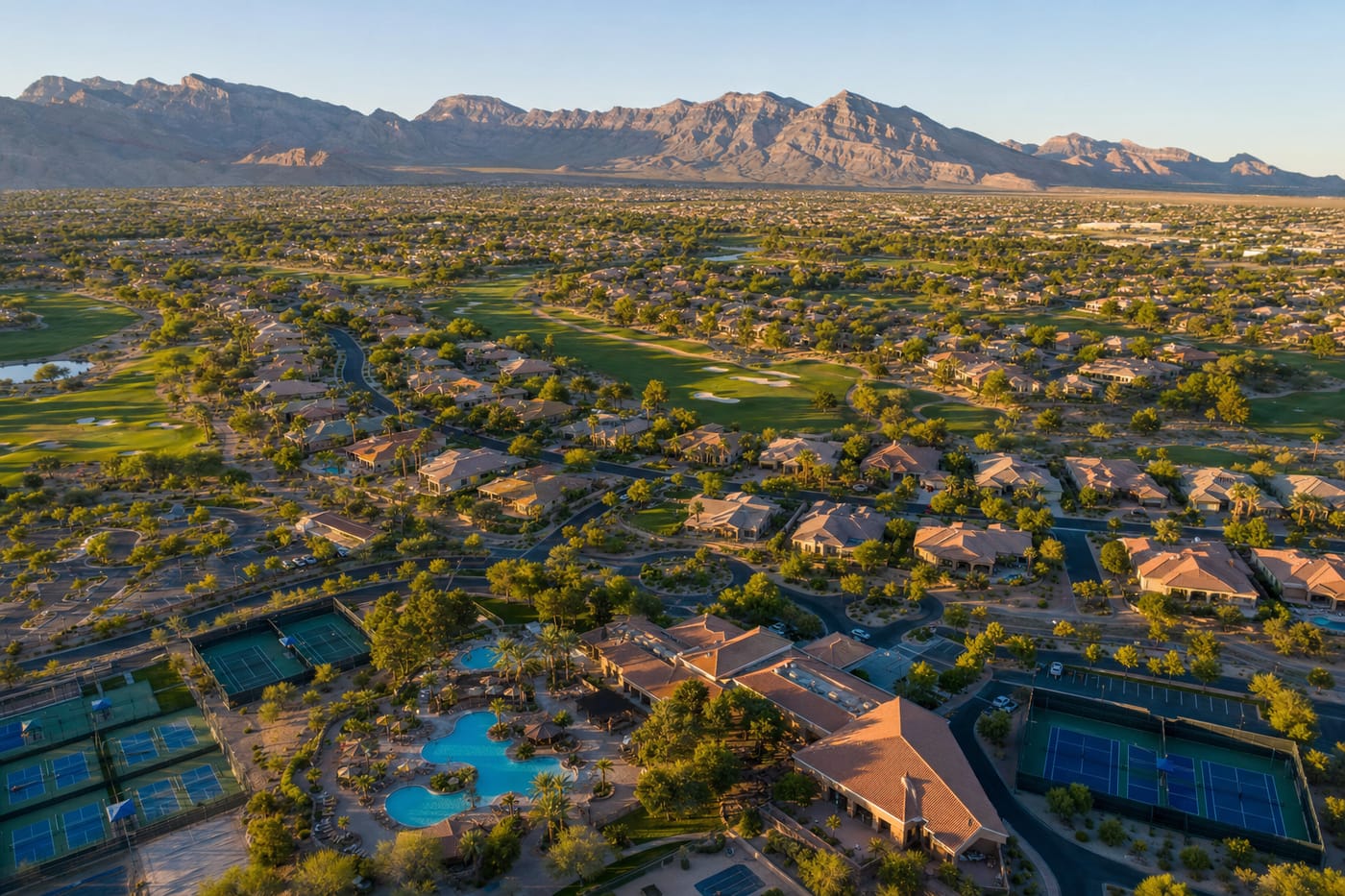
Why Are California And Northeast Buyers Dominating The Luxury Pool?
The buyer profile at the Las Vegas luxury tier in 2026 is dominated by three groups, in roughly this order of volume: relocating California households (Southern California more than Bay Area in recent quarters), Northeast professionals (New York metro, Boston, Connecticut), and Pacific Northwest movers (Seattle, Portland, with a growing share from Washington State after the 2022 capital gains tax).
The California pattern is the largest and most predictable. Per U.S. Census Bureau ACS data, California has been the single largest source state for Nevada in-migration every year since 2014, and that pattern has only intensified through the 2020–2025 period. Within California, the luxury Las Vegas buyer pool skews heavily toward Southern California (Orange County, San Diego County, the Westside of LA) rather than the Bay Area in recent quarters — Bay Area sellers have largely already moved or are moving to other Western markets like Austin and Phoenix.
The Northeast pattern is newer but growing. New York's "convenience of the employer" tax doctrine has created an asymmetry: relocating to Nevada doesn't necessarily eliminate New York state income tax on wages, but it does eliminate state income tax on equity income, capital gains, and most non-wage income — categories that often dominate the income mix of high-net-worth households. Per data from the IRS Statistics of Income and state migration reports, the New York metro has been a steady source of Nevada in-migration since approximately 2021.
The Pacific Rim international story is smaller in absolute numbers but has been the fastest-growing buyer segment at the trophy tier through 2024–2026. Buyers from Hong Kong, Singapore, mainland China, Taiwan, and South Korea have been actively acquiring trophy product in Summerlin and Henderson, often through trust structures that complicate disclosure but show up clearly in Clark County Assessor recorded deed patterns.
What unifies all three groups is portability of income (most are remote workers, equity holders, retirees, or business owners not tied to a specific local labor market), capital that has appreciated significantly in their origin markets, and a willingness to trade that capital into a market — Las Vegas — that offers favorable tax treatment, year-round livability, and major-airport accessibility.
What's Happening In The Ridges And The Summit Club?
The Ridges and The Summit Club are the two anchors of the Las Vegas trophy market, and they tell complementary stories. The Ridges, developed by Howard Hughes Corporation as a 1,300-acre Summerlin enclave with Bear's Best Las Vegas golf course at its center, opened in 2003 and has built out steadily over two decades. Current entry pricing sits at approximately $2M for the smaller older sections, climbing to $5M–$10M+ for premium positions on the elevated Mesa, with custom-built trophy estates above $10M.
What I'm seeing in The Ridges in 2026: tight inventory at the entry level, a meaningful pool of older 2003–2008-era homes that are trading 25–40% below new construction in the same gated community, and steady demand from California buyers who consistently rank The Ridges as their #1 target after a relocation tour. Days-on-market at The Ridges entry level (2,800–3,500 sq ft, $2M–$3M) runs 45–75 days; at the Mesa elevated positions (4,500–7,000 sq ft, $4M–$10M), 90–180 days.
The Summit Club is a different animal — a Discovery Land Company private golf community on 555 acres at the western edge of Summerlin, with strict equity-required membership ($475,000+ initiation as last published), 26 custom estate sites, and an architecturally curated environment. Current Summit Club closings have ranged from $5M to over $30M, with several lots trading in the $4M–$8M range alone before any custom build. Per Discovery Land Company and recorded deeds, the community remains in active buildout, with new closings every quarter.
The Summit Club represents the most exclusive piece of the Las Vegas luxury market, but it is also the most opaque — many transactions occur off-MLS via private listings, with marketing handled through the developer or curated buyer networks rather than traditional MLS exposure. For buyers serious about the $10M+ Las Vegas tier, working with an agent who has either prior Summit Club closings or direct relationships with Discovery Land Company is materially more valuable than at any other Las Vegas community.
What's Happening In MacDonald Highlands And Ascaya?
The Henderson side of the trophy market is anchored by MacDonald Highlands and Ascaya, two adjacent guard-gated hillside communities along the Black Mountain ridge that compete directly for the same buyer profile. MacDonald Highlands, developed by Olympia Companies starting in 2003, encompasses approximately 1,500 acres with 1,200+ home sites across multiple elevations. Ascaya, a Henderson Black Mountain development by Excel Group, opened more recently (with the first homes delivering circa 2014) and has positioned itself as the more architecturally curated and lot-size-generous of the two.
In MacDonald Highlands, current entry pricing sits at approximately $2.5M for older established homes in lower terraces, climbing to $5M–$15M for premium positions on the upper elevations with full city and Strip views. Per recorded deed data from the Clark County Assessor, MacDonald Highlands has averaged 35–45 closings per year over the past three years at a median price approaching $4M. The community contains the DragonRidge Country Club with private golf, tennis, and a 50,000+ sq ft clubhouse.
Ascaya entry begins at approximately $3M, with most active inventory in the $4M–$12M range. The community is smaller — 313 home sites total — with substantially larger custom lots (most in the 0.75–2 acre range). Ascaya has emphasized architectural review and contemporary modernist design, with several signature homes by globally recognized architects. The community's positioning as "the Bel Air of Las Vegas" reflects both its hillside topography and its curatorial approach to design.
The buyer choice between MacDonald Highlands and Ascaya is often a question of community size and amenity preference: MacDonald Highlands offers private golf and a larger established community; Ascaya offers smaller, more curated, more architecturally distinctive. Both deliver Strip views from upper elevations. Both have meaningful Pacific Rim and California buyer presence. Both reliably trade trophy-tier inventory above the $5M mark.
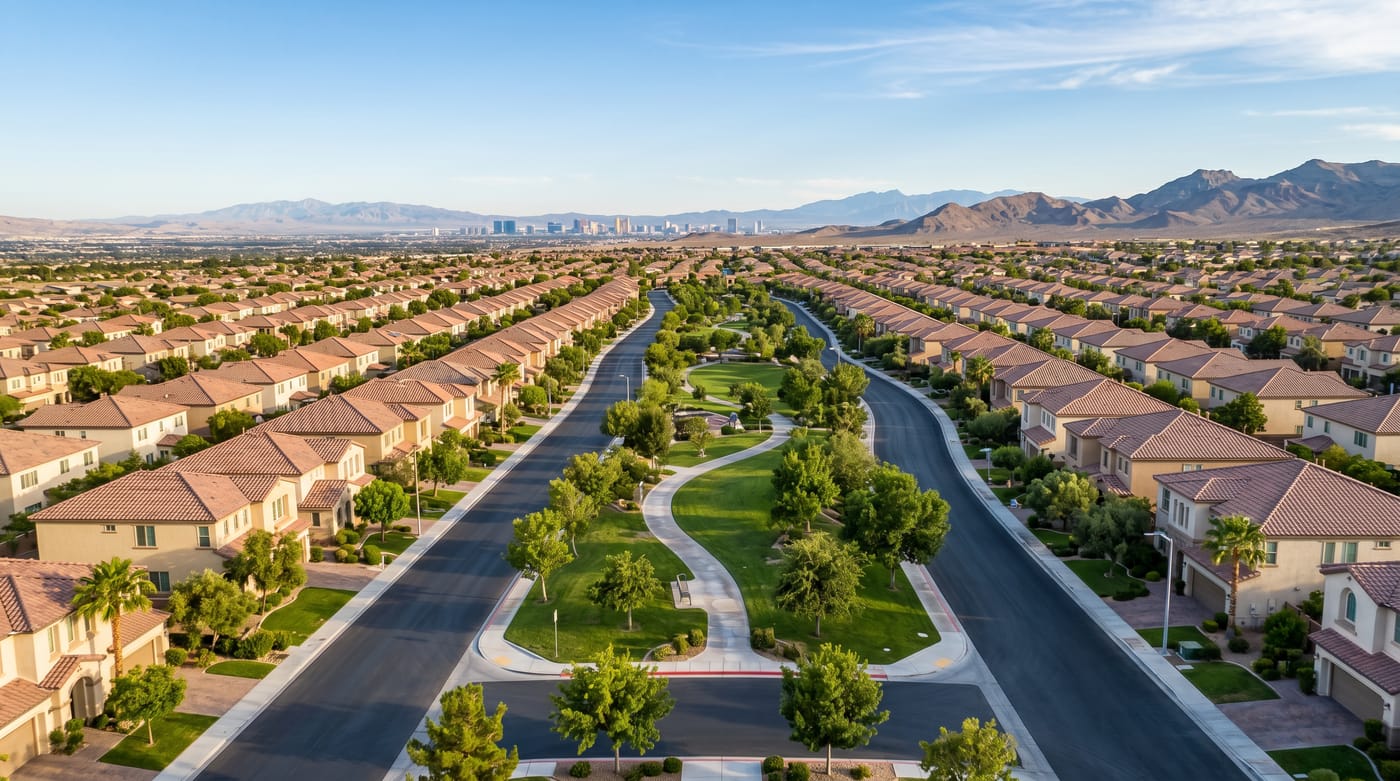
What's Happening At Lake Las Vegas?
Lake Las Vegas sits in a unique structural position in the Las Vegas luxury market. As the only large-scale lakefront development in southern Nevada, it has a moat that no other community can replicate — the lake itself, a 320-acre artificial reservoir built in the early 1990s — and a Mediterranean architectural identity reinforced by the MonteLago Village retail district, two private golf courses, and a Hilton hotel anchor.
What's happening at Lake Las Vegas in 2026 is a story of strong demand in specific positions and softer demand in others. Lake-front and lake-view positions in communities like Promontory Pointe, Viera, South Shore Resort, and The Reflection trade actively in the $1.5M–$8M range. Non-water-facing positions inside the master plan trade meaningfully softer — the lake premium is real and significant. Trophy-tier custom estates above $8M trade slowly but at consistent absolute price levels per Clark County Assessor recorded transactions.
The HOA dynamics at Lake Las Vegas matter at the luxury tier. Lake-front communities carry meaningful HOA dues ($350–$650+ per month) to maintain the lake, golf course access, marina infrastructure, and resort amenities. For buyers comparing Lake Las Vegas to a similarly priced inland home in MacDonald Highlands or The Ridges, the HOA delta should be factored into the carry comparison.
How Are New Construction Builders Performing At The Luxury Tier?
New construction at the luxury tier in Las Vegas comes from a handful of specialized builders, each with distinct positioning. The major players: Toll Brothers (production luxury, $850K–$3M in Summerlin and Henderson), Christopher Homes (semi-custom luxury, $1.5M–$5M+), Blue Heron (modernist semi-custom, $2M–$15M+), Pardee Homes (Cliffs and Summerlin West, $700K–$2M), Lennar (Heritage at Cadence, Heritage at Stonebridge active-adult luxury), Richmond American (premium production at $700K–$1.5M), and Pulte / Del Webb (active-adult luxury at $500K–$1.2M).
| Builder | Price Range | Style | Communities | Build Time |
|---|---|---|---|---|
| Toll Brothers | $850K–$3M | Production luxury | Multiple Summerlin + Henderson | 8–14 months |
| Christopher Homes | $1.5M–$5M+ | Semi-custom | The Ridges, MacDonald Highlands | 14–24 months |
| Blue Heron | $2M–$15M+ | Modernist semi-custom | Summit Pointe, custom valley-wide | 18–36 months |
| Pardee Homes | $700K–$2M | Production family-luxury | The Cliffs, Summerlin West | 7–12 months |
| Lennar Heritage | $520K–$1.1M | Active-adult luxury | Cadence, Stonebridge | 6–10 months |
| Toll Brothers Regency | $650K–$1.1M | 55+ luxury | Summerlin Regency | 8–12 months |
| Richmond American | $700K–$1.5M | Premium production | Various Summerlin/Henderson | 7–11 months |
Build times and price ranges per builder published data and Howard Hughes Corporation reporting, current as of Q1 2026.
The dynamic worth understanding: builders at the $1M–$3M tier are offering meaningful incentives in 2026 — $25,000–$60,000 in rate buydowns, closing cost credits, or design center allowances are common per Builders' Show tracking and our team's direct community visits. Builders at the $3M–$10M+ tier rarely offer incentives because their buyer pool is largely cash and the marketing dynamics are different. For buyers targeting the $1M–$3M new-construction tier, working with a buyer's agent who registers the relationship before the first builder visit is essential to capture those incentives — builders pay the buyer's agent commission either way, and walking in unrepresented routinely costs $20K–$50K in unclaimed incentives.
What Does The Luxury Rental Market Look Like?
The luxury rental market in Las Vegas is smaller and less liquid than the luxury sale market, but it is a real market with its own pricing dynamics. Per MLS data and our team's tracking, current monthly rents at the luxury tier:
- $1M–$2M home: $4,500–$7,500 per month
- $2M–$4M home: $7,500–$15,000 per month
- $4M–$8M home: $15,000–$25,000 per month
- $8M–$15M trophy home: $25,000–$50,000+ per month
- $15M+ ultra-trophy: $50,000+ per month, often furnished short-term
Cash-on-cash returns at the luxury rental tier are typically weaker than the workforce rental tier (which dominates Las Vegas rental yield economics). For an investor purchasing a $2M Las Vegas home for pure rental yield, the cap rate typically runs 3.5–4.5%, compared to 5.0–6.5% for a $400K–$600K workforce property. Luxury rental investments make sense when the buyer's primary thesis is appreciation rather than current yield, or when the property serves a dual purpose (second home with periodic rental).
The short-term rental landscape adds complexity. Each jurisdiction in Clark County has its own short-term rental rules — Las Vegas city, unincorporated Clark County, Henderson, and North Las Vegas operate under different regulatory regimes per their respective city codes. Most luxury master plans (The Ridges, Anthem Country Club, Seven Hills, etc.) have HOA-level prohibitions on short-term rentals regardless of city law. Buyers planning short-term rental income should verify both city and HOA rules before transacting.
What Are Days On Market And List-To-Sale Ratios Telling Us?
Two metrics tell most of what you need to know about a luxury submarket: median days on market (DOM) and median list-to-sale ratio (the percentage of asking price that homes actually close at). These metrics, tracked over time, show whether a submarket is tightening or softening.
As of Q1 2026 per Las Vegas REALTORS MLS data:
- $1M–$2M tier: 42 day median DOM, 96.5% median list-to-sale ratio — healthy seller's market
- $2M–$3M tier: 58 day median DOM, 95.0% median list-to-sale ratio — balanced market tilting toward sellers
- $3M–$5M tier: 78 day median DOM, 93.2% median list-to-sale ratio — balanced market
- $5M–$10M tier: 110 day median DOM, 91.5% median list-to-sale ratio — selective market
- $10M+ tier: 165+ day median DOM, 88–92% median list-to-sale ratio — patient market
The pattern is consistent: as the price tier rises, the market becomes slower and more selective, with larger discount-to-ask on closing. For sellers at the $5M+ tier, this means pricing discipline matters more than at the $1M tier — an aggressive list price will result in extended marketing time and a larger eventual discount, while a market-realistic list price will transact closer to ask.
For buyers, the implication is the inverse: trophy-tier listings that have been on market 60–90+ days are often genuinely negotiable, and a thoughtful offer 5–10% below ask is reasonable. At the $1M–$2M tier, expecting more than 3–4% off ask is generally unrealistic in 2026's market conditions.
What's My Read On The Next Six Months?
My read on the second half of 2026, based on what I'm seeing in transactions and conversations across the team: stable to modestly positive at the $1M–$3M tier, mixed but skewed positive at the $3M–$10M tier, and selectively strong at the $10M+ trophy tier.
The $1M–$3M tier is the bread-and-butter of the Las Vegas luxury market — the largest absolute volume, the most consistent buyer demand from California relocations, and the deepest inventory. I expect this tier to continue grinding forward at 4–6% annual appreciation through year-end, with no material softening signals visible in current data.
The $3M–$10M tier is more sensitive to interest rates and overall confidence in financial markets. If rates stay in the 6.0–6.75% range and equity markets remain stable, this tier should continue at low-single-digit appreciation. If rates ease materially (say, into the 5.5% range), this tier will accelerate noticeably as fence-sitting buyers move.
The $10M+ trophy tier moves on its own clock and is largely insulated from interest rate moves (because most transactions are cash). What matters here is the supply of trophy product — and Summit Club, MacDonald Highlands upper phases, and Ascaya continue to produce trophy product at a steady pace. I expect a handful of high-profile transactions in the $15M–$30M+ range over the next six months as inventory clears.
The risk factor to watch: a meaningful economic recession that compresses the upper-income brackets in California and the Northeast would slow the migration story, which is the demand engine. So far, the data doesn't show that — California departures continue at established rates per state migration reports.
What Mistakes Are Luxury Buyers Making Right Now?
Three patterns recur in luxury buyer mistakes that we coach against repeatedly.
Buying the trophy without buying the position. At the $5M+ tier, two homes in the same gated community can be functionally different markets based on lot positioning, view orientation, and street location. A buyer who pays $5.5M for a north-facing lot with neighbor-house views often regrets the position relative to a $5.5M south-facing lot with valley views in the same community. View, orientation, and elevation matter dramatically more at the trophy tier than buyers initially appreciate.
Underpricing the carry. A $3M home in Las Vegas costs roughly $180,000–$250,000 per year to carry when financed, including mortgage P&I, property tax, insurance, HOA, and maintenance reserves. Many California buyers, accustomed to thinking of the mortgage payment in isolation, dramatically underestimate the total all-in cost. Solid pre-purchase analysis includes a 5-year carry projection for the specific property.
Skipping the right inspection scope. Luxury homes carry more systems than median homes — pools, spas, multi-zone HVAC, smart home infrastructure, generator backups, security systems, sometimes custom water features and landscaping irrigation. The standard 5–6 hour inspection that covers a median home doesn't cover a trophy estate adequately. Plan for separate specialist inspections: pool & spa, smart home & low-voltage, generator, landscape irrigation, and (in some communities) golf cart paths and HOA infrastructure. Total inspection budget at the $3M+ tier should be $2,500–$5,000+ — well-spent insurance.
A fourth pattern: relying on the listing agent to represent both sides. Dual agency in Nevada is legal but creates an inherent conflict of interest. At the luxury tier in particular, the value of independent buyer representation typically exceeds the implicit "savings" of dual representation by several multiples.
Frequently Asked Questions
What's the entry price for luxury real estate in Las Vegas in 2026?
The Las Vegas luxury tier starts at approximately $1 million in 2026, which represents roughly 2.1× the metro median home price of $470,000 per Las Vegas REALTORS. True trophy luxury — guard-gated, architecturally distinctive, view positioning — begins at approximately $2.5M and runs into the $30M+ trophy estate range at communities like The Summit Club, The Ridges Mesa, Ascaya, and MacDonald Highlands upper phases.
Is the Las Vegas luxury market a buyer's or seller's market right now?
It depends on tier. The $1M–$3M tier is a balanced market tilting toward sellers (42–58 day median DOM, 95–96% list-to-sale ratio). The $3M–$10M tier is balanced. The $10M+ trophy tier is a patient buyer's market where 60–90+ day marketing periods are normal and thoughtful offers below ask are reasonable. Within any tier, individual property positioning matters dramatically more than tier-level averages.
What's the most exclusive luxury community in Las Vegas?
By any objective measure of exclusivity — equity-required membership, architectural curation, lot scarcity, transaction prices, and brand recognition — The Summit Club in Summerlin is the most exclusive community in Las Vegas. With only 26 estate sites across 555 acres, equity-required membership at $475,000+, and recent transactions ranging from $5M to over $30M, The Summit Club operates as a fundamentally different market than even other ultra-luxury communities. MacDonald Highlands, Ascaya, and The Ridges Mesa each occupy their own elite positions but with more public market exposure.
Are luxury homes still selling fast in Las Vegas?
At the $1M–$2M tier, yes — median 42-day DOM with 96.5% list-to-sale ratio. At the $2M–$3M tier, still healthy at 58-day median DOM. At the $5M+ trophy tier, "fast" is measured in months rather than weeks — 110-day median DOM at $5M–$10M and 165+ days at $10M+. The "fast" question is really a "right pricing" question — well-priced trophy homes transact within 60–90 days; aggressively priced ones sit until pricing adjusts.
What are the property taxes on a luxury home in Nevada?
Approximately 0.5–0.7% of assessed value annually per Nevada Department of Taxation rules. Nevada assesses residential property at 35% of taxable value, and primary residences carry a 3% annual cap on tax increases per Nevada Revised Statutes 361. A $3M Henderson home typically pays $14,000–$19,000 in annual property tax. The 3% cap is one of the most significant long-term advantages of Nevada residency — over a 15-year hold, the effective rate often declines well below the headline rate.
How are luxury buyers paying — cash or financing?
Mixed and tier-dependent per Clark County Assessor recorded deed data. At $1M–$2M, roughly 65–75% of transactions are financed. At $2M–$3M, about 50–60% financed. At $3M–$5M, 35–45% financed. At $5M–$10M, 25–35% financed. At $10M+, 15–25% financed. The cash percentage rises with tier because the buyer pool at higher tiers contains more high-net-worth households where mortgage financing is optional rather than necessary.
What's the best luxury community for a buyer relocating from California?
Depends on lifestyle and household profile. For families with school-age children prioritizing top schools and amenity quality, Summerlin's The Ridges, Red Rock Country Club, or the newer Cliffs/Stonebridge villages are typically the strongest fit. For empty-nesters or retirees prioritizing low-maintenance luxury and resort-style amenities, Lake Las Vegas, Anthem Country Club, or 55+ communities like Regency or Heritage offer compelling options. For ultra-luxury buyers seeking maximum exclusivity and architectural distinction, The Summit Club, MacDonald Highlands upper, or Ascaya are the trophy targets.
Ready To Make A Move In The Luxury Tier?
The Las Vegas luxury market in 2026 is one of the most active and most submarket-specific in the American West. Whether the priority is a $1M family residence in Summerlin's flagship villages, a $3M guard-gated home with mountain views in Henderson, or a $10M+ trophy estate in The Summit Club or MacDonald Highlands, the difference between getting it right and getting it wrong usually comes down to position rather than tier — and to having representation that knows which specific lots, streets, and view positions actually deliver long-run value.
At Nevada Real Estate Group, our 150+ Nevada-licensed agents include dedicated specialists for luxury communities, guard-gated communities, new construction, and 55+ active adult communities. Our team covers every major submarket in the valley — Summerlin, Henderson, Lake Las Vegas, and the broader Clark County luxury corridor. Per RealTrends 2025 rankings, our team ranks among the top 100 real estate teams nationwide.
For relocating buyers from California, the Pacific Northwest, or the Northeast, we coordinate the home search alongside CPA referrals for residency planning, school district analysis for families, and direct introductions to lenders specializing in jumbo and portfolio financing at the luxury tier. Buyer representation is at no cost to the buyer in nearly every Nevada transaction.
To start a Las Vegas luxury search calibrated to your specific tier, timeline, and household, call (702) 637-1759 or email info@nevadagroup.com. We respond to qualified inquiries within 15 minutes during business hours (8 AM – 8 PM Pacific, seven days a week).
Chris Nevada · Nevada Real Estate License S.181401 · Nevada Real Estate Group · LPT Realty · 8945 W Russell Rd, Suite 170 · Las Vegas, NV 89148 · (702) 637-1759 · License verifiable at red.nv.gov.
Which Sources Inform This Las Vegas Real Estate Analysis?
Market data, closing volumes, and median price figures in this analysis come from Greater Las Vegas Realtors monthly MLS statistics through April 2026. Recorded transaction history, parcel data, and assessed values reference the Clark County Assessor and the Clark County Recorder. License and brokerage verification draws from the Nevada Real Estate Division public licensee database.
Macro housing context references the U.S. Census Bureau American Community Survey, the Bureau of Labor Statistics Las Vegas-Henderson-Paradise MSA employment data, the Federal Housing Finance Agency House Price Index, and the Bureau of Economic Analysis state-level personal income data. Mortgage rate environment uses the Freddie Mac Primary Mortgage Market Survey weekly rate series and the Mortgage Bankers Association weekly applications survey.
Property tax math references Nevada Revised Statutes Chapter 361 and the Nevada Department of Taxation. School ratings reference GreatSchools and the Clark County School District annual performance frameworks. Builder permit activity and certificate-of-occupancy data reference the Clark County Department of Building and the Nevada State Contractors Board.
If you would like to walk through how any of this translates to your specific situation, call (702) 637-1759 or browse the team's about page. Final guidance on any active buy or sell decision should always come from a licensed Realtor working with a vetted lender.