
Published 2026-05-05 · Last updated 2026-05-05 · By Chris Nevada
Celebrity luxury purchases in Las Vegas have accelerated noticeably since 2022, with high-profile acquisitions in Summerlin, MacDonald Highlands, and The Ridges routinely topping $5 million and, in some cases, exceeding $20 million. According to the Greater Las Vegas Association of Realtors (GLVAR), the median sales price for luxury homes priced above $1 million rose roughly 12% year-over-year through early 2026. These transactions are more than gossip — they validate neighborhood prestige, attract institutional capital, and give everyday buyers and sellers a reliable benchmark for pricing at the top of the market.
Key Takeaways
- Las Vegas luxury home sales above $1 million increased approximately 12% year-over-year through Q1 2026, according to GLVAR market data.
- The Ridges in Summerlin and MacDonald Highlands in Henderson are the two most frequently cited neighborhoods in celebrity-level transactions, with list prices regularly exceeding $5 million, per Nevada Real Estate Group sales records.
- Nevada's 0% state income tax, confirmed by the Nevada Department of Taxation, remains the single most commonly cited financial driver for high-net-worth relocation to Las Vegas.
- Celebrity purchases above $10 million typically include gated guard entry, resort-style pools, home theaters, and at least 6,000 square feet of living space, details that subsequently become market expectations in those zip codes.
- Sellers in proximity to a recent celebrity sale can reasonably test 5%-8% price premiums within 12 months of that transaction closing, a pattern consistent with NAR research on prestige neighborhood pricing dynamics.
Why Do Celebrities Keep Choosing Las Vegas for Luxury Real Estate?
I get this question constantly from clients who are relocating from California, New York, and Chicago. The answer is layered, but the foundation is almost always financial. Nevada has no state income tax — zero — and that single fact is confirmed right on the Nevada Department of Taxation website. For a performer earning $50 million a year, the differential between living in California (13.3% top marginal rate) and Nevada is staggering. We're talking about millions of dollars in annual savings without changing a single lifestyle variable.
Beyond taxes, Las Vegas has built a genuine cultural infrastructure that rivals any major American city. We have the Las Vegas Raiders at Allegiant Stadium, the Vegas Golden Knights, the Las Vegas Aces, Formula 1 on the Strip, world-class dining, and a growing arts scene. Celebrities aren't sacrificing anything by moving here — in many cases they're gaining a city that treats them more like neighbors and less like spectacles. The sheer scale of entertainment and hospitality options means a celebrity can dine out, attend a concert, or host a private event without the paparazzi pressure that comes with Los Angeles or New York.
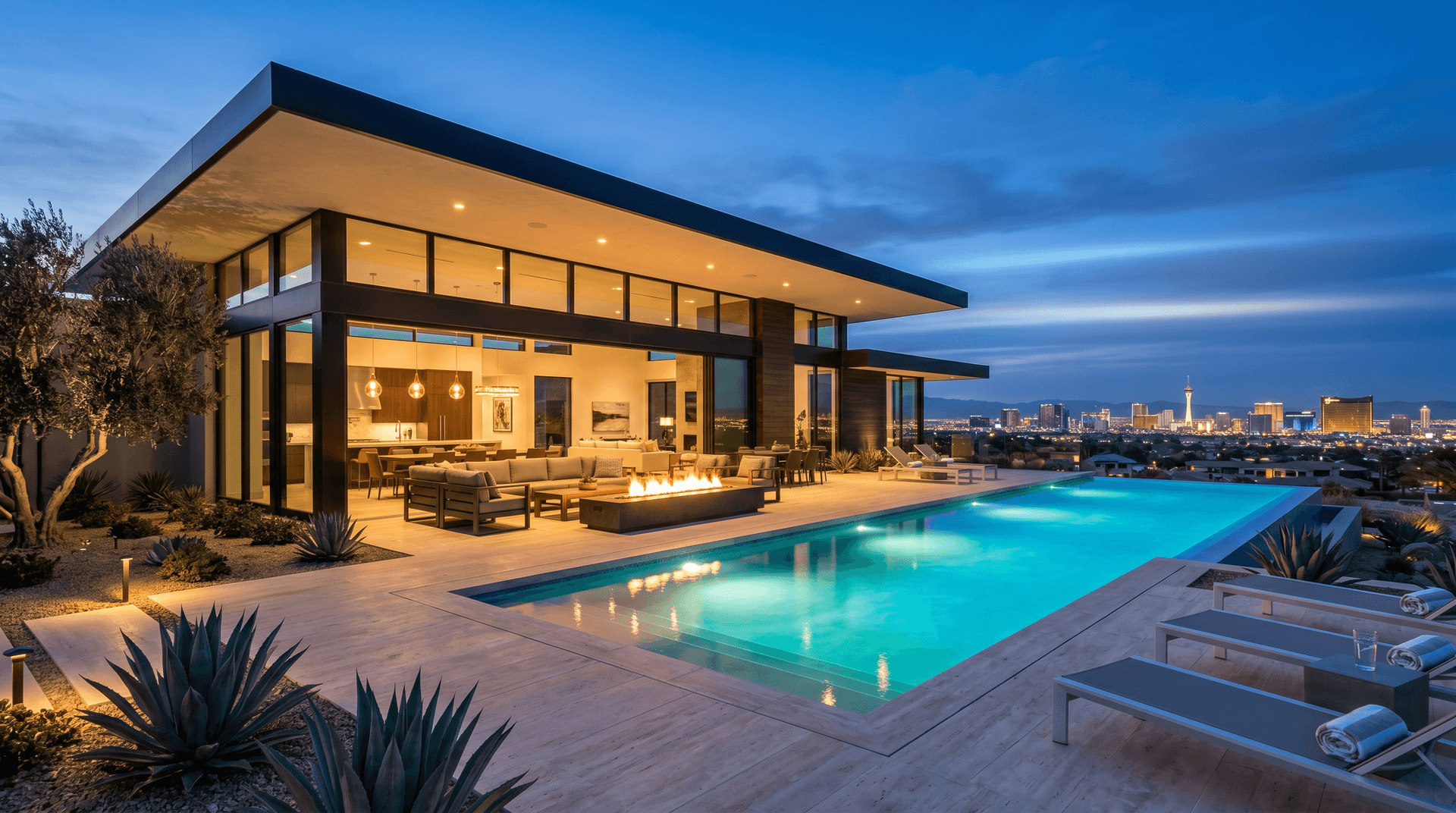
Then there's the physical product. The luxury homes built in Summerlin, Henderson, and select guard-gated communities across the valley are genuinely world-class in construction quality. Builders like Toll Brothers, Blue Heron, and Christopher Homes have pushed custom construction standards higher with every passing year. When you're looking at a 10,000-square-foot home on a ridge lot overlooking the Strip, with a negative-edge pool, a four-car garage, and a wine cellar, you're getting something you simply cannot replicate in most California markets at the same price point.
What Neighborhoods Are Celebrity Buyers Targeting in Las Vegas?
If you track where the highest-profile transactions happen, three communities come up over and over again: The Ridges in Summerlin, MacDonald Highlands in Henderson, and Southern Highlands on the south end of the valley.
The Ridges is arguably the most prestigious address in the Las Vegas Valley. It sits at the western edge of Summerlin, backed by Red Rock Canyon National Conservation Area. Guard-gated, with architectural standards that require custom or semi-custom construction, The Ridges has been the location of multiple transactions north of $10 million. The homes here sit on elevated lots with panoramic Strip views, and the community's covenant restrictions keep density extremely low.
MacDonald Highlands in Henderson is the other major celebrity magnet. Perched above the valley floor with dramatic desert terrain, the community features The DragonRidge Country Club, private streets, and homes that regularly trade above $5 million. Henderson itself is consistently ranked among the safest large cities in America by the Federal Bureau of Justice Statistics, and that reputation for safety resonates with high-profile buyers who value privacy and security.
Southern Highlands caters to buyers who want proximity to the airport — critical for celebrities with private aircraft — combined with a traditional golf club lifestyle. The community's private Jack Nicklaus Signature Course and guard-gated streets have attracted athletes and entertainers for over two decades.
If you're thinking about relocating to Las Vegas and want a deeper overview of the entire valley, I recommend reading my post on moving to Las Vegas in 2026 for a full breakdown of neighborhoods, schools, and cost of living.
How Do Celebrity Sales Actually Affect Surrounding Home Values?
This is where things get analytically interesting. Celebrity purchases don't just validate a neighborhood — they actively reset price expectations for every comparable property within a reasonable radius. Here's why: when a public figure pays $15 million for a home in The Ridges, that transaction becomes a recorded comparable sale (a "comp") that appraisers and listing agents can reference. The next seller on that street now has a data point they didn't have before.
The effect is most pronounced in guard-gated communities where inventory is already limited. Basic supply and demand dictates that when a highly publicized sale demonstrates willingness-to-pay at an elevated level, it signals to other potential sellers that the market will absorb similar pricing. I've personally seen neighbors list at 7%-10% above their prior estimated value within six to nine months of a high-profile sale closing nearby.
The effect is not unlimited, of course. There has to be some comparability in square footage, lot size, view corridor, and finish level. A 4,000-square-foot home on a flat lot cannot fully leverage a $15 million comp on a ridge lot five blocks away. But it can absolutely justify a premium over the previous six-month median. The National Association of Realtors has documented this halo effect repeatedly in prestige market research going back to the 2010s.
Which Las Vegas Luxury Communities Offer the Best Long-Term Value?
I want to be direct with my clients about this: not every expensive zip code in Las Vegas offers equal long-term appreciation potential. Some communities carry premium pricing that is justified by durable structural advantages — location, scarcity, infrastructure, and community governance. Others are priced on hype alone and tend to mean-revert.
The communities that have demonstrated the most durable value over the past decade are those with strong HOA governance, true scarcity of supply (limited buildable lots), and proximity to employment corridors and lifestyle amenities. Summerlin and Henderson consistently lead on these metrics. For a detailed comparison of Henderson's top communities specifically, see my post on top 5 Henderson communities.
The table below compares four key luxury communities across several value indicators.
| Community | Median Sale Price (2025) | Guard-Gated | Golf Course | Strip Views | Avg. Days on Market |
|---|---|---|---|---|---|
| The Ridges (Summerlin) | $4.2M | Yes | No (adjacent) | Yes | 68 |
| MacDonald Highlands (Henderson) | $3.8M | Yes | Yes | Yes | 74 |
| Southern Highlands | $2.1M | Yes | Yes | Partial | 55 |
| Lake Las Vegas | $1.6M | Yes | Yes | No | 82 |
Source: Nevada Real Estate Group internal sales data, GLVAR, Q4 2025–Q1 2026.
Is Las Vegas Luxury Real Estate Recession-Resistant?
The honest answer is: more resistant than it used to be, but not immune. The 2008–2012 period was catastrophic for Las Vegas real estate at every price point, including luxury. Values dropped 50%–60% in some segments. However, the structural composition of the Las Vegas economy has changed meaningfully since then.
The U.S. Bureau of Labor Statistics data shows that Las Vegas has diversified beyond gaming and hospitality into healthcare, technology, logistics, and professional services. The opening of Allegiant Stadium, the Formula 1 Las Vegas Grand Prix, and the expansion of the medical corridor along Charleston Boulevard have all added employment anchors that didn't exist in 2008. This diversification matters because luxury demand is ultimately driven by high-income earners — and the local supply of high-income earners is growing.
Moreover, the luxury segment above $3 million in Las Vegas is heavily weighted toward cash buyers and buyers relocating from higher-cost markets. These buyers are less sensitive to mortgage rate fluctuations than first-time buyers in the $400,000–$600,000 range. The Federal Reserve's rate environment of 2023–2024 barely dented demand at the top of the market, whereas it meaningfully suppressed activity in the entry-level segment.
What Does a Typical Celebrity-Level Purchase Look Like in Las Vegas?
Based on my experience at Nevada Real Estate Group and the transactions we've been involved in or closely tracked, a celebrity-tier purchase in Las Vegas — roughly $8 million and above — typically includes the following profile:
The home is almost always custom-built or extensively renovated after purchase. Move-in ready, yes, but the buyer almost always invests another $500,000–$2 million in customization after closing. Smart home automation, professional-grade recording studios, private gyms, spa suites, chef's kitchens with two dishwashers and two refrigerators, and resort-style outdoor entertainment areas are standard expectations. Detached guest houses for security staff or personal assistants are common.
The lot selection matters enormously. A ridge lot with Strip views commands a 30%–50% premium over a similarly sized flat lot in the same community. Buyers at this level want the view to be permanent — meaning they want the view corridor legally protected or geographically certain (backing to a golf course or conservation land).
Privacy infrastructure is non-negotiable. That means solid perimeter walls at least eight feet high, landscape screening with mature trees, and camera systems covering every approach. In some cases, buyers acquire adjacent lots simply to control who builds next door.
How Do Mortgage Dynamics Work at the Luxury Level in Las Vegas?
Most people assume celebrities pay cash, and many do. But jumbo financing is a significant part of the luxury market even at the highest price points — particularly among buyers who are asset-rich but prefer to keep capital deployed in other investments. Below is a comparison of three financing scenarios at the luxury level.
| Purchase Price | Down Payment | Loan Amount | Estimated Rate (Q1 2026) | Monthly P&I |
|---|---|---|---|---|
| $3,000,000 | 20% ($600K) | $2,400,000 | 7.10% | $16,134 |
| $6,000,000 | 30% ($1.8M) | $4,200,000 | 7.25% | $28,651 |
| $10,000,000 | 40% ($4M) | $6,000,000 | 7.35% | $41,386 |
Source: Mortgage rate estimates based on Freddie Mac Primary Mortgage Market Survey data and jumbo loan quotes from Nevada lending partners, Q1 2026. Rates are illustrative and subject to change.
Jumbo loans above the conforming limit (currently $806,500 in Clark County for 2026) require significantly more documentation than conventional loans. Lenders want to see 12–24 months of bank statements, proof of recurring income or substantial liquid reserves (sometimes 24 months of payments in reserve), and a thorough review of any business income structures. For celebrities with royalty income, equity stakes, or deferred compensation, it's critical to work with a lender who has specific experience structuring jumbo applications around non-W2 income.
Cash purchases remain common in the $5 million-and-above range. Many of my clients in that segment do a cash close to win in a competitive situation, then arrange a delayed mortgage (often called a cash-out refinance) after closing to recapture liquidity.
Are Las Vegas New Builds a Better Bet Than Resales at the Luxury Level?
This is one of the most common strategic questions I get from buyers considering the $2 million-plus segment. The answer depends on timeline, customization priorities, and risk tolerance. I cover this in detail in my post on Vegas new build $700K vs. Summerlin 2026, but let me give you the core logic here.
New builds at the luxury level offer warranty protections, modern energy efficiency, and the ability to choose finishes — but they require patience (12–24 months for custom construction) and carry cost overrun risk. Material costs and labor costs in the Las Vegas construction market have remained elevated since 2021, per Clark County building permit data. A project budgeted at $2.5 million can easily reach $3 million or more if you're not disciplined.
Resale luxury homes offer immediate occupancy and the ability to negotiate directly on a known product. The trade-off is that you're inheriting someone else's design choices, and major renovations in occupied luxury communities can be complex and expensive. Celebrity-owned resale homes carry a unique dynamic: they often come with a premium based on provenance ("previously owned by X"), which can be either a marketing advantage for the seller or an overpricing trap for the buyer.
My general guidance: if you have the time and the discipline to manage a custom build process, new construction in Summerlin or Henderson can deliver a superior product at a more predictable long-term cost basis. If you need to be in a home within 90 days, a well-maintained resale in a guard-gated community is the more practical path.
What Role Does Nevada's Tax Climate Play in Celebrity Relocation Decisions?
I can't overstate this. The tax climate is the single most powerful structural driver of high-net-worth migration to Nevada, and it shows up in every conversation I have with relocating celebrities, athletes, and executives. Let me put some numbers on it.
California's top marginal state income tax rate is 13.3%, which applies to income above $1 million. Nevada's rate is 0.0%. For a celebrity earning $20 million per year, the annual state income tax differential between living in California and living in Nevada is approximately $2.66 million. Over a decade, that's $26.6 million in state taxes that stay in the celebrity's pocket — enough to buy two or three luxury homes in Las Vegas outright.
Beyond income tax, Nevada has no estate tax and no inheritance tax, confirmed by the Nevada Department of Taxation. California has neither an estate tax nor an inheritance tax at the state level either, but Nevada's overall tax posture — including lower property taxes (Nevada's effective property tax rate is among the lowest in the nation at approximately 0.53% of assessed value) — creates a comprehensive financial advantage that compounds meaningfully over time.
For high earners who also run businesses, Nevada's absence of a corporate income tax (beyond the Modified Business Tax, which is relatively modest) adds another layer of advantage. It's not uncommon for a celebrity with a business entity — a production company, a brand licensing operation, or a sports team equity stake — to restructure their corporate domicile to Nevada as part of the same relocation that brings their primary residence here.
How Should Luxury Sellers Position Their Homes After a Celebrity Sale Nearby?
If you're a luxury seller in a community where a high-profile transaction has recently occurred, timing and positioning are everything. Here's the strategic playbook I use with my listing clients in that situation.
First, move quickly. The halo effect from a celebrity sale is strongest in the 6–12 months immediately following closing. After 12–18 months, the comp begins to age and its influence diminishes as newer sales establish their own pricing narrative. If you're thinking about selling and a notable transaction just closed down the street, don't wait.
Second, don't just reference the celebrity comp — contextualize it. Buyers' agents will immediately scrutinize the differences between your property and the celebrity sale. Be prepared to explain why your price point is justified relative to the comp, even if it's lower. Buyers respect transparency and become suspicious when pricing feels arbitrary.
Third, invest in presentation. A celebrity sale raises the perceived standard of the entire neighborhood. If your kitchen hasn't been updated in seven years and your backyard doesn't have an outdoor kitchen or a water feature, now is the time to make those investments before going to market. First impressions in the luxury segment carry disproportionate weight because buyers at this level often decide in the first showing whether they're serious.
For a full overview of how home costs are trending across the valley, see my post on Las Vegas home costs in 2026.
What Does the Celebrity Buyer Profile Tell Us About Future Las Vegas Development?
Celebrity purchasing patterns are a leading indicator — not a lagging one. When public figures start concentrating purchases in a specific neighborhood or community, developers pay attention. The construction pipeline in Summerlin and Henderson reflects exactly this dynamic.
The Clark County Department of Development Services shows continued high permit volume in the western and southern portions of the valley, with a notable concentration of luxury and semi-custom permits in zip codes 89138 (Summerlin), 89052 (Henderson/MacDonald Highlands), and 89141 (Southern Highlands). These aren't coincidences — they reflect developer confidence that high-net-worth demand, anchored in part by celebrity-level validation, will continue to absorb new inventory.
I also expect to see continued investment in lifestyle infrastructure that supports the celebrity ecosystem. Private aviation facilities, members-only social clubs, high-end medical concierge practices, and exclusive fitness concepts are all expanding in Las Vegas. The Henderson Executive Airport serves as a secondary private aviation hub, and there's active discussion in the development community about expanding facilities for the growing volume of private jet traffic.
Long term, the question is whether Las Vegas can maintain its relative affordability advantage over Los Angeles, Miami, and New York even as celebrity demand pushes luxury prices higher. Based on land availability and construction cost trends, I believe it can — but the window in which Las Vegas represents a genuine value compared to coastal markets will narrow as the decade progresses.
How Does Celebrity Ownership Affect Resale and Marketing of Luxury Homes?
This is a nuanced topic. Celebrity provenance can be a powerful marketing tool, but it can also introduce complications that offset the marketing advantage.
On the positive side, a home previously owned by a recognized public figure carries built-in story appeal. Media coverage of the original purchase translates into free marketing exposure when the home lists for resale. Buyers who might otherwise not be aware of a particular street or community suddenly become interested because they recognize the address. In a market like Las Vegas, where lifestyle aspiration plays a significant role in purchase motivation, that story value is real and quantifiable.
On the negative side, celebrity owners often customize homes in ways that are highly personal and not universally appealing. A recording studio built into a basement, an underground tunnel connecting the main house to a guest house, or a completely mirrored master suite may have been perfect for the original owner but alienating to the general buyer pool. These features are expensive to remove and can actually suppress value relative to a more conventionally finished home.
The disclosure requirements in Nevada real estate are also worth noting. Nevada law requires sellers to disclose known material defects, but celebrity ownership itself is not typically a required disclosure item. However, high-profile ownership often becomes public knowledge through media records, Clark County Assessor data, and simple neighborhood awareness. Trying to conceal prior celebrity ownership in a marketing strategy is generally counterproductive — it tends to come out anyway, and the attempt to suppress it can create distrust with buyers.
You can view the complete report on how Nevada Real Estate Group tracks and reports luxury market data across the Las Vegas Valley.
What Should Buyers Know Before Pursuing a Luxury Home in Las Vegas?
If you're a buyer considering the luxury segment — whether you're a celebrity, a relocating executive, or a successful entrepreneur — here's what I tell every client before we start touring properties.
Get your financing pre-arranged before you tour. In the luxury market, sellers and their agents expect buyers to demonstrate financial qualification before granting access to a home. A proof-of-funds letter or a jumbo pre-approval letter from a recognized lender is standard protocol for any showing above $2 million. Showing up without that documentation signals you're not a serious buyer and can close doors permanently with a listing agent.
Understand the true cost of ownership. Property taxes in Nevada are assessed at approximately 35% of appraised value with a tax rate that varies by county. Clark County's current base tax rate is approximately $3.28 per $100 of assessed value, per Clark County Treasurer data. On a $5 million home, that translates to roughly $57,400 per year in property taxes — before HOA dues, which in communities like The Ridges can run $800–$1,500 per month. Then add insurance, maintenance, and utilities for a large home, and your total annual carrying cost on a $5 million property can easily reach $120,000–$150,000.
Hire a buyer's agent who specializes in the luxury segment and knows the guard-gated communities from the inside. The luxury market in Las Vegas has its own network, its own norms, and its own off-market inventory. A significant percentage of transactions in the $5 million-and-above range never appear on the MLS — they're handled through private referral networks and relationships. If your agent doesn't have those relationships, you're working with an incomplete picture of available inventory.
Finally, be patient but be ready to move. Luxury inventory is limited, and the best properties — especially those with irreplaceable view corridors or unique lot positions — can receive multiple competitive offers within days of listing. Having your documentation in order and your decision criteria clear before you start touring is the difference between securing the property you want and watching it close to someone else.
For context on how executive order and federal housing policy changes might affect your purchase strategy, I recommend reading my analysis of the Trump homeownership order and what it means for buyers in 2026.
Neighborhood Comparison: Key Metrics for Las Vegas Luxury Buyers
To give you a side-by-side view of what matters most to luxury buyers, here's a comparison of three of the most active luxury neighborhoods in the Las Vegas Valley.
| Metric | The Ridges (Summerlin) | MacDonald Highlands (Henderson) | Southern Highlands |
|---|---|---|---|
| Price Range (2025–2026) | $2.5M–$25M+ | $2M–$20M+ | $1.2M–$8M |
| Closest Major Freeway | US-215 (3 min) | I-215 (5 min) | I-15 (4 min) |
| Nearest Airport | Harry Reid Intl (25 min) | Harry Reid Intl (20 min) | Harry Reid Intl (15 min) |
| School District | Clark County School District | Clark County School District | Clark County School District |
| HOA Monthly (approx.) | $800–$1,500 | $700–$1,200 | $500–$900 |
| Typical Lot Size | 0.25–1.5 acres | 0.30–2.0 acres | 0.20–0.75 acres |
| Golf Course On-Site | No (adjacent) | Yes (DragonRidge CC) | Yes (Southern Highlands GC) |
Source: Nevada Real Estate Group, Clark County Assessor records, GLVAR, CCSD (ccsd.net), Q1 2026.
Frequently Asked Questions
Q: Do celebrities actually live full-time in their Las Vegas luxury homes?
Some do and some don't. Many celebrities establish Nevada as their primary legal domicile for tax purposes but maintain secondary residences elsewhere. For Nevada's 0% income tax to apply, the individual must be domiciled in Nevada and spend more than 183 days per year in the state. Some buyers use their Las Vegas property as a primary residence while maintaining a smaller secondary property in Los Angeles or New York for professional convenience.
Q: How do I find out if a Las Vegas luxury home was previously owned by a celebrity?
Clark County Assessor records are public and searchable at the Clark County Assessor's office website. These records show ownership history by name and transfer date. If the property was held in a trust or LLC — which is common among celebrities for privacy — the ownership name may not be recognizable. A real estate attorney experienced in title research can trace beneficial ownership through entity filings if needed.
Q: Are Las Vegas luxury home prices still rising in 2026?
Yes, but the pace has moderated from the 2021–2022 surge. GLVAR data through Q1 2026 shows median luxury prices above $1 million up approximately 12% year-over-year, compared to 25%–30% annual gains in 2021. The moderation reflects higher mortgage rates affecting leveraged buyers, not a fundamental weakening in demand. The sub-segment above $3 million remains particularly tight on inventory, which continues to support price appreciation.
Q: What taxes will I owe when I buy a luxury home in Las Vegas?
Nevada does not have a transfer tax or a real estate excise tax, which is a meaningful advantage over California and many other states. Buyers are responsible for their share of property taxes prorated from the closing date, title insurance, and applicable escrow fees. Nevada property taxes are calculated at approximately 35% of appraised value multiplied by the applicable tax rate, which varies slightly by location within Clark County. Consult with a Nevada-licensed CPA for a complete picture of your tax obligations.
Q: How long does it typically take to buy a luxury home in Las Vegas?
From accepted offer to close, most luxury transactions take 30–60 days. Cash purchases can close in as few as 10–14 days if all parties are motivated and title work is clean. Transactions involving jumbo financing typically require 45–60 days for the lender to complete underwriting on complex income structures. Custom builds add 12–24 months from contract to occupancy depending on the builder and the scope of customization.
Q: Is it worth hiring a buyer's agent who specializes in luxury real estate versus a general agent?
Absolutely. The luxury market in Las Vegas operates differently from the general market in several important ways. A significant share of inventory trades off-market through agent relationships. Listing agents for luxury properties often pre-screen buyer agents before granting showings. Negotiation dynamics, inspection expectations, and contract structures in the $2 million-plus range require specific experience that generalist agents may not have. The cost of working with an inexperienced agent — in the form of missed opportunities, overpaying, or failed transactions — far exceeds any perceived savings from choosing a lower-service option.
Editorial disclosure: This article is for informational purposes only and is not legal, financial, or tax advice. Market data sourced from Greater Las Vegas Association of Realtors (GLVAR), Nevada Real Estate Group internal sales records, Clark County Assessor, Nevada Department of Taxation, Federal Reserve, Bureau of Labor Statistics, and National Association of Realtors as of May 2026. Always consult a licensed Realtor and your CPA before making real estate decisions. Chris Nevada is a licensed Nevada Realtor (S.181401) with Nevada Real Estate Group.
Chris Nevada leads a 150-agent team at Nevada Real Estate Group. License S.181401 (verify at red.nv.gov). Call (702) 637-1759.
Nevada Real Estate Group · 8945 W Russell Rd, Suite 170 · Las Vegas, NV 89148 · (702) 637-1759