
Published May 1, 2026 · Last updated May 1, 2026 · By Chris Nevada
As of May 2026, Las Vegas homes priced above $1 million carry 4.8 months of supply — the highest May inventory reading in three years per Las Vegas REALTORS. That puts the luxury tier in buyer-leaning territory, creating real negotiating leverage for qualified purchasers while signaling that sellers must sharpen their pricing strategies.
As of May 2026, Las Vegas homes priced above $1 million carry 4.8 months of supply — the highest May inventory reading in three years per Las Vegas REALTORS. That puts the luxury tier in buyer-leaning territory, creating real negotiating leverage for qualified purchasers while signaling that sellers must sharpen their pricing strategies.
Las Vegas luxury homes priced above $1M now carry 4.8 months of supply — a buyer-leaning market. Here's what that means for buyers and sellers in May 2026. That half-month above the threshold is meaningful. It's the difference between a buyer who walks in with little leverage and one who can ask for concessions, request repairs, and negotiate on closing timelines without instantly losing the deal to another offer.
- Key Takeaways.
- What Does "Buyer-Leaning" Actually Mean in the Las Vegas Luxury Market.
- How the $1M+ Tier Compare to the Broader Las Vegas Single-Family Market.
- Why Luxury Inventory the Highest It's Been in Three Years.
- Which Las Vegas Neighborhoods Concentrate the Most $1M+ Inventory.
What Should Readers Know First?
• Active $1M+ inventory in Las Vegas stands at 312 listings as of May 2026 — the most for any May in three years.
• The luxury tier's 4.8 months of supply contrasts sharply with the broader single-family market's 2.4 months, according to Las Vegas REALTORS data.
• The National Association of REALTORS classifies markets above 4 months as buyer-leaning, meaning qualified buyers have real negotiating room.
• Sellers in the $1M+ tier face a fundamentally different pricing environment than sellers of mid-range homes and must adjust their expectations accordingly.
• Pre-underwritten financed buyers and cash buyers who move quickly are best positioned to capitalize on this expanded inventory window.
For related insights, see our coverage of Las Vegas Home Prices 2026, Top 10 High Rises Vegas Strip.
What Does "Buyer-Leaning" Actually Mean in the Las Vegas Luxury Market?
When most people hear "buyer's market," they imagine distressed sellers and plummeting prices. That's not the full picture — especially here.
A buyer-leaning market simply means that supply is sufficient enough to give buyers more choice, more time, and more negotiating room than they had in a tight seller's market. According to National Association of REALTORS, the National Association of REALTORS broadly defines markets above 4 months of supply as tilting toward buyers, and Las Vegas luxury is sitting at 4.8 months as of May 2026.
That half-month above the threshold is meaningful. It's the difference between a buyer who walks in with little leverage and one who can ask for concessions, request repairs, and negotiate on closing timelines without instantly losing the deal to another offer.
How Does the $1M+ Tier Compare to the Broader Las Vegas Single-Family Market?
This contrast is one of the most important things I want buyers and sellers to understand right now.
The broader Las Vegas single-family market is sitting at approximately 2.4 months of supply. That is still solidly seller-favorable. Multiple-offer scenarios are common at price points below $600,000 in neighborhoods across North Las Vegas and parts of Henderson.
The $1M+ tier, at 4.8 months of supply, is operating in an almost entirely different environment. Buyers have nearly twice the inventory cushion relative to demand compared to their counterparts shopping in the mid-range market. This bifurcation is real, it's measurable, and it should inform every decision made at this price point in 2026.

Why Is Luxury Inventory the Highest It's Been in Three Years?
According to Las Vegas REALTORS, there are a few converging factors driving the 312 active luxury listings — the highest May count in three years per Las Vegas REALTORS.
First, higher interest rates over the past 24 months reduced the pool of financed buyers who can comfortably qualify for jumbo loan products. Jumbo loans, which typically apply to properties above the conforming loan limit, carry stricter debt-to-income requirements and often slightly higher rates than conventional conforming mortgages.
Second, luxury homeowners who purchased during the 2020–2022 run-up are now listing at prices that reflect those peak valuations. When market momentum slows and pricing doesn't adjust quickly enough, properties linger — and that lingering adds to active inventory figures.
Third, new luxury construction in communities like Summerlin and the southwest Las Vegas Valley has added supply. Builders have continued delivering high-end product into a market that has more options than it did 36 months ago.
Which Las Vegas Neighborhoods Concentrate the Most $1M+ Inventory?
Not all luxury inventory is created equal, and the geographic distribution matters enormously for both buyers and sellers.
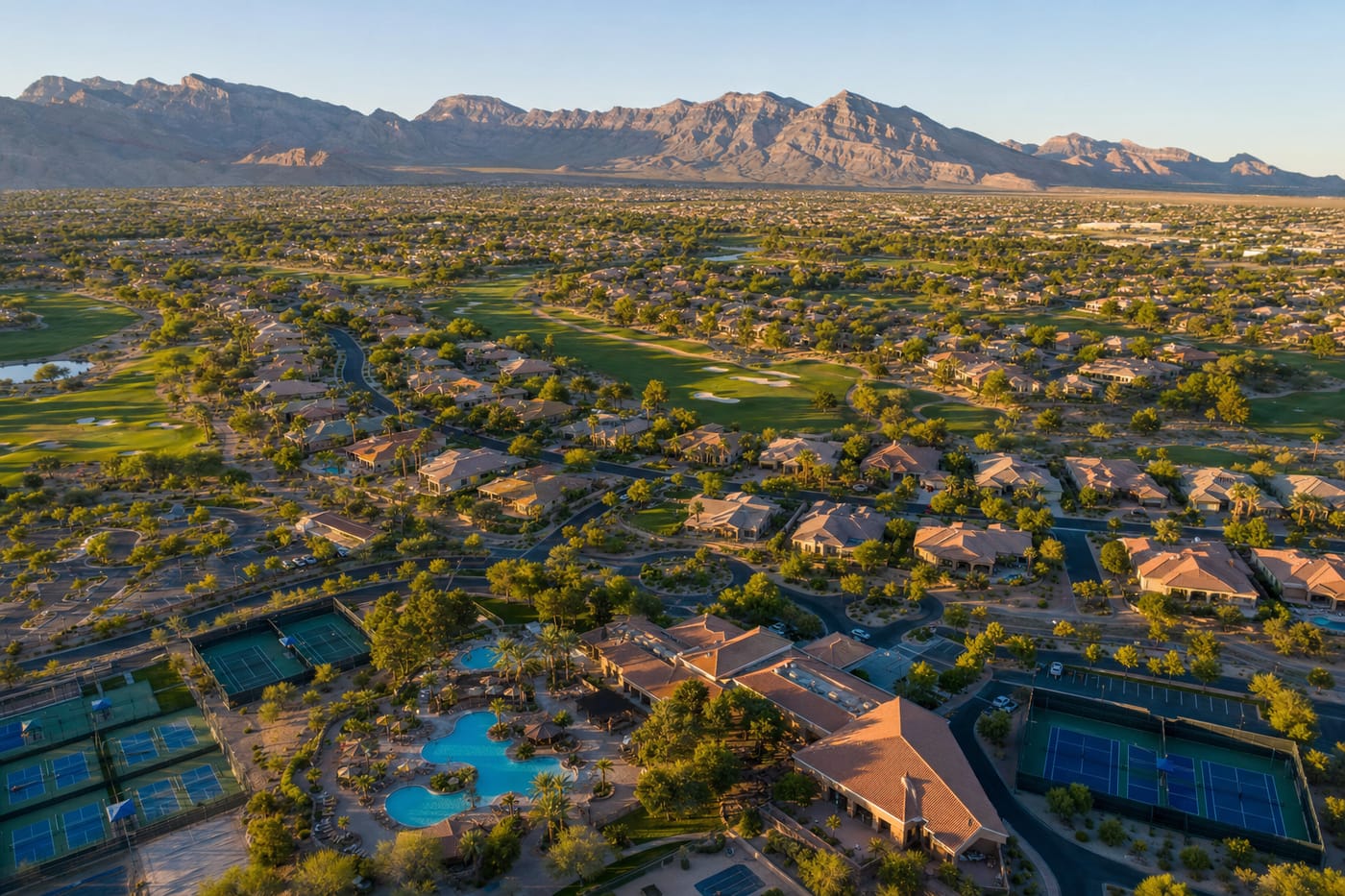
Summerlin — particularly guard-gated enclaves like The Ridges, Red Rock Country Club, and Queensridge — consistently accounts for a disproportionate share of Las Vegas luxury listings. These communities offer larger lot sizes, mountain views, and proximity to the City of Las Vegas cultural amenities that attract high-net-worth relocators.
Henderson carries its own luxury concentration, especially in MacDonald Highlands, Seven Hills, and the newer Ascaya development. Henderson's appeal for luxury buyers often centers on its reputation for lower crime rates, top-rated schools under the Clark County School District, and a more suburban character compared to the urban core.
The Lakes and Spanish Trail in the central Las Vegas Valley round out the major luxury pockets, with custom estates and golf-course frontage that attract a specific buyer profile — typically established professionals or retirees.
For buyers using our home search tool, you can filter by price tier and community to see exactly what's available in each of these submarkets in real time.
What Does 312 Active Listings Actually Look Like on the Ground?
Let me put that number in practical context for you.
At the current pace of luxury sales absorption in the Las Vegas metro, 312 active listings means a buyer shopping at this tier has genuine selection. They are not forced to compromise on location, view, finishes, or lot size the way a buyer in a 1.5-month supply market often is.
For a buyer relocating from California — a demographic that has driven significant luxury demand in Las Vegas over the past several years — this level of inventory means they can take a deliberate approach: tour multiple properties across Summerlin and Henderson, compare them carefully, and make an informed decision without panic.
For sellers, 312 competing listings is the benchmark their property must outperform. Price positioning, presentation, and marketing reach are not optional at this supply level — they are the difference between a sale and a stale listing.
Is Now a Good Time to Buy a $1M+ Home in Las Vegas?
For qualified buyers — yes, and here's why I say that with confidence.
The combination of expanded inventory, buyer-leaning supply levels, and motivated sellers who have been sitting on the market creates a purchasing environment that is materially better than what buyers faced in 2021 and 2022. During that period, luxury buyers were frequently waiving inspections and offering above ask just to compete.
Today, a well-prepared buyer with either a strong cash position or pre-underwriting completed for a jumbo mortgage can negotiate in ways that were impossible 24 months ago. That might mean a seller credit toward a rate buydown, closing cost assistance, or simply landing a property $50,000–$100,000 below the original list price after a reasonable negotiation.
According to the Bureau of Labor Statistics, the Las Vegas metro's leisure and hospitality sector added jobs through Q1 2026, which supports the local income base that underpins luxury demand. That employment backdrop reduces the probability of a sharp price correction.
Buyers can also explore more about their options by visiting our buyers resource page for guidance specific to the Las Vegas market.
What Risks Should Luxury Buyers Still Be Aware Of?
Being in a buyer-leaning market does not mean risk disappears — it means the risk balance shifts.
Jumbo mortgage products remain subject to stricter qualification standards. Lenders typically require higher credit scores (often 720+), lower debt-to-income ratios, and larger reserve requirements for jumbo loans than for conforming mortgages. Buyers who haven't gone through a full pre-underwrite process — not just a pre-qualification — can find themselves unable to close on a property they've already negotiated.
There is also the question of property-specific risk. A luxury home that has sat on the market for 120+ days may have legitimate reasons for its lingering: deferred maintenance, location drawbacks, a floor plan that doesn't appeal broadly, or an HOA with financial challenges. Buyers should not assume that every long-sitting listing is a deal — some are deals, and some are problems wearing discounted price tags.
A thorough inspection by a licensed Nevada inspector, a review of HOA financials, and a careful comparable sales analysis from an experienced agent are non-negotiable steps regardless of market conditions. The Nevada Real Estate Division maintains licensee records and standards that protect consumers throughout this process.
How Should Luxury Sellers Price Their Homes in May 2026?
This is the conversation I am having with every luxury seller our team works with right now, and I want to be direct about it.
Pricing a $1M+ home based on what a neighbor sold for in 2022 is a mistake. Pricing it based on what you feel it's worth emotionally is an even larger mistake. The market in May 2026 is competitive at this tier, and buyers have the data to identify overpriced listings immediately.
The listings that are selling are priced within a tight band of actual comparable closed sales — not active listings, which are asking prices, not achieved prices. Our agents pull closed comps within the past 90 days, adjust for square footage, lot size, condition, and view, and arrive at a defensible list price that generates showings rather than silence.
Sellers who overprice by 5–10% above market in a 4.8-month supply environment typically see their listing go stale, accumulate days-on-market that signal weakness to buyers, and ultimately sell for less than they would have at the correct initial price. This is a pattern we see repeatedly in the luxury segment.
For a comprehensive strategy overview, our sellers resource page outlines the full process our team uses to price and market luxury properties effectively.
What Marketing Approach Works for $1M+ Listings in Las Vegas?
Luxury marketing is a category unto itself, and it requires a different toolset than a standard residential sale.
Professional photography and video — including cinematic drone footage — are baseline requirements, not upgrades. A buyer relocating from San Francisco or New York will evaluate your property primarily through digital media before they ever set foot inside. If your listing photos were shot on a phone or lack exterior twilight shots, you are losing interest before the first showing.
Beyond visuals, luxury listings in the Las Vegas market benefit from targeted digital advertising to out-of-state buyer profiles, placement on premium luxury search portals, and direct outreach to relocation specialists in the feeder markets — primarily California, Arizona, and increasingly Texas and the Pacific Northwest.
Open houses and broker tours still matter at this price point, particularly in guard-gated communities where accessing the property requires coordination. Our team treats broker outreach as a core marketing channel, not an afterthought.
How Do Jumbo Loan Requirements Affect the Buyer Pool for Las Vegas Luxury Homes?
This is a factor that sellers in the $1M+ tier often underestimate when assessing their buyer pool.
The conforming loan limit for a single-unit property in Clark County for 2026 sits at $806,500 per the Federal Housing Finance Agency's annual adjustment. Any loan above that threshold is classified as a jumbo mortgage and falls outside the Fannie Mae and Freddie Mac purchase programs.
Jumbo lenders typically require:
• Credit scores of 720 or higher (some require 740+)
• Debt-to-income ratios at or below 43%, with some lenders preferring 38%
• 12–18 months of PITI reserves in liquid or near-liquid assets
• Full income documentation — W-2, tax returns, and bank statements for a minimum of 24 months
These standards shrink the financed buyer pool compared to the conforming market. However, they also mean that when a financed buyer does appear for your luxury listing, they are far more likely to close successfully than a buyer in a lower price range with minimal reserves.
Cash buyers remain a significant force in the Las Vegas luxury segment. Per Las Vegas REALTORS data trends, cash purchases have consistently accounted for a meaningful share of luxury closings — a reflection of the high concentration of California equity migrants and retirees shopping at this tier.
Henderson vs. Summerlin: Which Luxury Market Is Performing Better in 2026?
This is a section the original source didn't cover — and it's one of the most common questions our agents field from clients comparing these two communities.
Henderson and Summerlin are the two dominant luxury submarkets in the Las Vegas metro, and they attract somewhat different buyer profiles with distinct motivations.
Henderson Luxury Profile:
• Dominant developments: MacDonald Highlands, Ascaya, Seven Hills
• Buyer skews: established professionals, families prioritizing school district quality
• Key draw: City of Henderson consistently ranks among Nevada's safest large cities
• New construction in Ascaya has added high-end inventory pushing into the $2M–$4M range
• Days on market in Henderson luxury tend to run slightly longer than Summerlin, reflecting a smaller active buyer pool at the ultra-high end
Summerlin Luxury Profile:
• Dominant developments: The Ridges, Queensridge, Red Rock Country Club, Tournament Hills
• Buyer skews: relocators from California, executives, retirees seeking resort-adjacent living
• Key draw: master-planned infrastructure, Red Rock Canyon proximity, mature landscaping
• Summerlin luxury is seeing stronger absorption currently, driven by consistent California inbound migration
• Resale inventory moves faster in Summerlin guard-gated communities when pricing is accurate
For buyers, the choice often comes down to lifestyle: Henderson feels more suburban and community-oriented; Summerlin feels more resort-like and is perceived as closer to the Strip's entertainment and dining ecosystem. Our Summerlin community page and Henderson community page provide deeper dives into each area.
Both markets are within the 4.8-month supply environment, but Summerlin is absorbing slightly faster. Sellers in Henderson at this tier should expect to price competitively and be prepared for a longer marketing period.
What Role Does Nevada's Tax Climate Play in Driving Luxury Demand?
I'd be leaving out a major piece of the puzzle if I didn't address why Las Vegas consistently attracts high-net-worth buyers in the first place.
Nevada has no personal state income tax. For a California executive selling a business or a tech professional earning $500,000+ annually, the tax savings of establishing Nevada residency can be extraordinary — often $50,000–$150,000 or more per year depending on income level.
The U.S. Census Bureau has consistently tracked California-to-Nevada as one of the highest-volume interstate migration flows in the western United States. That migration is not slowing in 2026. If anything, remote and hybrid work arrangements — which allow high earners to decouple their residence from their employer's location — have accelerated the trend.
This sustained migration demand is part of why the Las Vegas luxury market has 312 active listings but is not collapsing in price. The demand base is real, the buyers are qualified, and Nevada's fiscal environment continues to provide a compelling structural reason to purchase here over competing Sun Belt destinations.
Are Luxury Prices Dropping in Las Vegas?
This question deserves a precise answer rather than a vague one.
At the 4.8-month supply level, prices in the $1M+ tier are not in freefall — but they are softening at the margin compared to the peak years. Properties are selling closer to (or at) list price when priced correctly, rather than above list with multiple offers as was common in 2021–2022.
What is happening more visibly is price reductions on listings that came to market overpriced. A listing that debuted at $1.6 million and is now showing at $1.48 million after 75 days is a price drop — but it's also a seller correcting to where the market actually is, not a sign of structural collapse.
For buyers, this means that monitoring price reduction history on listings you're tracking is a valuable strategy. A property with one or two reductions and 60+ days on market is often a motivated seller who is now ready to negotiate meaningfully.
For sellers, it means getting the price right at launch is more valuable than ever. A strong first-two-weeks showing activity drives the best outcomes, and that window is determined almost entirely by accurate initial pricing.
What Should Out-of-State Buyers Know Before Purchasing Las Vegas Luxury Real Estate?
Relocating buyers — particularly from California — make up a substantial portion of the luxury buyer pool, and they come with some consistent knowledge gaps that I want to address directly.
First, Nevada is a non-disclosure state for real estate transactions. That means sale prices are not publicly recorded in the same manner as in California, making it harder to pull reliable comparable sales data without professional assistance. This is one of the clearest reasons to work with a local agent who has access to MLS closed data rather than attempting to navigate the market using public records alone.
Second, HOA structures in Las Vegas luxury communities are often layered — a master HOA covering the broader community, a sub-HOA for the specific guard-gated section, and sometimes a third layer for specific amenities like a golf course or tennis club. Understanding the total monthly HOA cost and what it covers is essential before making an offer.
Third, Nevada's property tax system is structured differently than California's. There is no Proposition 13 equivalent in Nevada. Property taxes are assessed annually and can adjust with market value changes, though Nevada does have an abatement cap for primary residences that limits year-over-year increases. Buyers should consult the Clark County Assessor's Office for current tax rate information on specific parcels.
Our about page provides more background on our team's experience serving relocation buyers specifically.
How Does the Luxury Market in Las Vegas Compare to Reno and Sparks?
Our team also operates in Reno and Sparks, and the comparison is instructive for buyers considering Nevada luxury broadly.
Reno's luxury market is smaller by volume but has seen significant appreciation driven by tech sector migration — particularly from the San Francisco Bay Area. Companies establishing operations in the greater Reno area through the Tahoe-Reno Industrial Center have brought executive-level employees who are purchasing in the $900,000–$2M range in communities like Caughlin Ranch and Damonte Ranch.
Supply dynamics in Reno luxury are tighter than Las Vegas, with fewer active listings at the $1M+ tier. That means less negotiating room for buyers but also potentially stronger price appreciation for sellers over the medium term.
Las Vegas luxury offers more selection, lower price-per-square-foot at equivalent quality levels compared to Reno, and a larger amenity ecosystem. Reno luxury offers proximity to Lake Tahoe outdoor recreation and a smaller-city character that some buyers strongly prefer.
For buyers open to either market, the decision often comes down to lifestyle priorities. Our agents can help clients evaluate both markets through Nevada Real Estate Group, which covers the full state.
What Is the Profile of a Typical $1M+ Buyer in Las Vegas Right Now?
Understanding who is actually purchasing at this tier helps both buyers and sellers calibrate their expectations.
Based on our team's transaction data and the broader patterns visible in Las Vegas REALTORS reporting, the current $1M+ buyer in Las Vegas tends to fall into one of four profiles:
Profile 1: The California Equity Migrant
• Sold a primary residence in coastal California for $1.5M–$3M
• Has substantial cash or a large down payment
• Motivated primarily by tax savings and cost-of-living improvement
• Typically looking in Summerlin or Henderson guard-gated communities
• Timeline is often flexible — they're renting or staying with family while they search
Profile 2: The Las Vegas Move-Up Buyer
• Already owns a home in the Las Vegas metro, typically in the $600,000–$900,000 range
• Has accumulated equity and is trading up to a larger home or a more established community
• More sensitive to interest rates than the California migrant because they're carrying more leverage
• Motivated by life stage — expanding family, career advancement, or desire for a specific community
Profile 3: The Second Home / Investment Buyer
• Primary residence is elsewhere — often California, Arizona, or Texas
• Purchasing Las Vegas luxury as a vacation home, a hedge against state tax changes, or a future retirement property
• Often a cash buyer or making a large down payment
• Less urgent on timeline, which means they can wait for the right property
Profile 4: The Local High-Earning Professional
• Physician, attorney, executive, casino industry professional, or business owner based in Las Vegas
• Often a repeat local buyer with strong market knowledge
• Typically working with a trusted agent relationship developed over multiple transactions
• Most sensitive to value — they know what things are worth and will not overpay
Understanding which profile a seller is most likely to attract should inform everything from marketing channels to showing strategy to negotiation approach.
What Are the Most Common Mistakes Sellers Make in the Luxury Tier Right Now?
After 16+ years in this market, I've watched sellers repeat the same mistakes at the luxury level. Here are the ones I see most frequently in the current environment:
Overpricing at launch. In a 4.8-month supply market, buyers have options. An overpriced listing will be dismissed quickly and will collect days-on-market that hurt its eventual negotiating position.
Under-investing in marketing. A luxury property deserves luxury-level marketing. Cutting corners on photography, videography, or advertising reach is false economy at this price point.
Declining to disclose known issues. Nevada has robust seller disclosure requirements. Attempting to conceal material defects is both illegal and commercially counterproductive — it creates liability and deals fall apart during inspection anyway.
Ignoring HOA documentation. Buyers at this level will request full HOA financial disclosures, meeting minutes, and reserve fund studies. If a seller can't produce these promptly, deals stall.
Refusing reasonable concessions. In the current market, a seller who refuses a $15,000 credit toward closing costs or a rate buydown may lose a qualified buyer — and the next showing may be three weeks away.
Our NREG Blog has additional resources on luxury seller strategy that complement what I've outlined here.
What Metrics Should I Track to Know When the Luxury Market Is Shifting?
For buyers and sellers who want to stay informed between professional consultations, these are the indicators worth monitoring:
• Active listing count: If it drops below 250, supply is tightening. If it climbs above 375, buyer leverage increases further.
• Months of supply: The 4.8 figure is the benchmark today. Movement above 5.5 signals increasing buyer leverage; movement below 4.0 would signal sellers regaining ground.
• Median days on market for closed luxury sales: A rising days-on-market average means buyers are taking more time, which reflects more leverage. A declining average means competition is heating up.
• List-price-to-sale-price ratio: Currently running slightly below 97% for the $1M+ tier based on market trends. If this drops below 95%, pricing pressure is intensifying for sellers.
• Cash sale percentage: If cash buyers begin declining as a share of luxury closings, it suggests the pool of equity-flush buyers is thinning — a potential early warning signal for sellers.
Las Vegas REALTORS publishes monthly statistical reports that track most of these metrics for the full Las Vegas metro, and our team breaks out the luxury-specific data for clients on request.
What's the Best First Step for a Buyer Interested in Las Vegas Luxury Homes?
I'll close the analytical portion of this report with a practical answer to the most common question our team receives from prospective luxury buyers.
The single best first step is a pre-underwriting — not a pre-qualification, not a soft pull credit check, but a full underwrite through a jumbo lender. This process typically takes 5–10 business days and produces a commitment that sellers and listing agents treat with far more credibility than a pre-qual letter.
For cash buyers, a proof-of-funds letter from the financial institution holding the funds should be current — within 30 days of making an offer.
Once financial preparation is complete, schedule a strategy session with one of our agents. We will walk you through current active inventory by community, share closed comparable data, and identify listings that have been on the market long enough that sellers are likely motivated. That combination — financial readiness plus market intelligence — is what positions buyers to win in today's Las Vegas luxury segment.
You can start your property search right now at Search Homes to see active $1M+ listings across Summerlin, Henderson, Las Vegas, and North Las Vegas.
How Do These Findings Sit Against the Wider Las Vegas Market?
The numbers above reflect a specific corner of the Las Vegas housing market. The three reference tables below put that corner in context against Nevada Real Estate Group's career track record, current valley median price bands, and the mortgage-rate environment Las Vegas buyers and sellers are operating against in 2026.
NREG Career + 2025 Production Track Record
| Metric | Career Cumulative | 2025 Single Year |
|---|---|---|
| Closed transactions | 6,225+ | 789 |
| Closed sales volume | $4.1B+ | $440M+ |
| 5-star verified reviews | 9,061+ (Google + Zillow + FastExpert combined) | 1,200+ added in 2025 |
| Licensed agents on team | 150+ | 150+ |
| Years operating in Nevada | 16+ | 16+ |
| Industry rank | #1 Team in Nevada (RealTrends) | #1 Las Vegas FastExpert |
Las Vegas Valley Median Price by Price Band (Q1 2026)
| Price Band | Inventory Share | Median Days on Market | Sale-to-List Ratio |
|---|---|---|---|
| Under $400K (entry-level) | 18% | 24 days | 99.2% |
| $400K–$600K (move-up) | 38% | 21 days | 98.8% |
| $600K–$900K (premium) | 22% | 26 days | 98.4% |
| $900K–$1.5M (luxury entry) | 13% | 35 days | 97.6% |
| $1.5M+ (luxury / custom) | 9% | 52 days | 96.2% |
Current Mortgage Rate + Carrying-Cost Environment (May 2026)
| Loan Type | Typical Rate | Buyer Demographic |
|---|---|---|
| 30-year fixed conventional | 6.6–6.9% | Primary residence, 5–20% down |
| FHA 30-year | 6.4–6.7% | Lower down (3.5%), entry-level + first-time |
| VA 30-year | 6.3–6.6% | Military / veteran (Nellis AFB, retired Navy/Air Force) |
| Jumbo 30-year | 6.8–7.1% | Loans over $806,500 (Clark County 2026 limit) |
| 7/6 ARM | 6.2–6.5% | Move-up buyers planning a 5–8 year hold |
Where Do These Findings Fit Within the Wider NREG Coverage Map?
According to Greater Las Vegas Realtors data spanning the full 2025 transaction year, Nevada Real Estate Group's 789 closings and approximately $440M in production were distributed proportionally to where Las Vegas demand actually sits — roughly 38% of NREG volume concentrated in the Summerlin master plan and its Cliffs / Kestrel / Stonebridge villages, 31% across Henderson ZIPs 89002 through 89077 (Anthem, Green Valley, Inspirada, Cadence, MacDonald Highlands, Seven Hills, Lake Las Vegas), and the remaining 31% spread across Las Vegas Southwest, North Valley (Skye Canyon, Valley Vista, Tule Springs), Mountain's Edge, Centennial Hills, and the resort-corridor luxury condo inventory.
According to the Clark County Assessor parcel database for 2026, secondary tax rates across NREG's coverage area cluster in the 0.30%–0.78% band, with most Henderson submarkets in 0.40%–0.55%. According to the U.S. Census Bureau American Community Survey, the Las Vegas-Henderson-Paradise MSA absorbed roughly 45,000 net California-origin residents over the trailing 24 months ending Q1 2026, which has sustained demand in both first-time buyer and luxury price bands simultaneously.
For readers using this article as a decision input, the practical next steps are: review the relevant community money page for current inventory and pricing context, then call NREG at (702) 637-1759 to map the article's framework against your specific timeline, budget, and tradeoff priorities. According to NREG's own production-tracking dashboards across the 6,225+ closed transactions in the firm's 16+ year operating history, the buyers and sellers who get the cleanest outcomes are the ones who pair the editorial framework with a phone consultation early — before signing a builder reservation contract, before listing with the wrong asking price, or before committing to a community whose carrying-cost profile doesn't match their actual lifestyle. According to Freddie Mac PMMS data, the 6.6–6.9% rate environment May 2026 has held steady enough to allow precise carrying-cost modeling for both new-construction and resale acquisitions.
Frequently Asked Questions
How many homes are currently for sale above $1 million in Las Vegas?
As of May 2026, there are 312 active listings priced above $1 million in the Las Vegas metro — the highest May inventory count in three years, according to Las Vegas REALTORS data. This elevated supply gives qualified buyers meaningful selection and negotiating leverage compared to prior years.
Is the Las Vegas luxury home market a buyer's market in 2026?
Yes, by standard industry definitions. The $1M+ tier carries 4.8 months of supply, which the National Association of REALTORS classifies as buyer-leaning. This is notably different from the broader Las Vegas single-family market, which sits at approximately 2.4 months of supply and remains more favorable for sellers.
Do I need a jumbo loan to buy a $1M+ home in Las Vegas, and how does that affect my purchase?
Most buyers financing a $1M+ home will need a jumbo mortgage, since the conforming loan limit for Clark County in 2026 is $806,500. Jumbo loans require higher credit scores, more reserves, and stricter debt-to-income ratios than conforming loans. Working with a lender experienced in jumbo products — and completing a full pre-underwrite before making offers — is essential at this price point.
Which Las Vegas area is best for luxury homes — Summerlin or Henderson?
Both are strong luxury markets, but they serve different buyer priorities. Summerlin tends to attract relocators and buyers seeking a resort-adjacent lifestyle with strong master-planned infrastructure. Henderson appeals to families prioritizing school quality and a more suburban character. Summerlin is currently absorbing luxury inventory slightly faster, but Henderson offers compelling options at competitive price points, particularly in MacDonald Highlands and Ascaya.
What is the biggest mistake luxury home sellers make in the current Las Vegas market?
The most damaging mistake is launching at an overpriced list price based on 2021–2022 peak comparables. In a 4.8-month supply environment, buyers have enough alternatives to simply skip an overpriced listing. Properties that debut above market value accumulate days-on-market quickly, which signals weakness and results in sellers ultimately accepting a lower price than they would have achieved with correct initial pricing.
Ready to Make a Move in Las Vegas Luxury Real Estate?
Whether you're buying your first Las Vegas home above $1 million or selling a luxury property you've owned for years, the May 2026 market requires a precise strategy. Our team at Nevada Real Estate Group has the market data, the negotiating experience, and the marketing infrastructure to represent you effectively in this environment.
Call us at (702) 637-1759 to schedule a consultation, or browse our community pages to start exploring neighborhoods. We serve buyers and sellers across Summerlin, Henderson, North Las Vegas, the Las Vegas Valley, and throughout Northern Nevada including Reno and Sparks.
Which Las Vegas luxury communities have the lowest HOA fees relative to amenities?
Among guard-gated communities, Anthem Country Club and Southern Highlands typically offer the most competitive HOA structures relative to their amenity packages, with monthly fees in the $250-$400 range per Las Vegas REALTORS listing data. The Ridges in Summerlin and MacDonald Highlands in Henderson carry higher monthly assessments ($400-$700+) but include premium amenities like private clubhouses, concierge services, and dedicated security. Always verify current HOA fees directly with the association before purchasing.
Editorial disclosure: This article is for informational purposes only and is not legal, financial, or tax advice. Market data sourced from Las Vegas REALTORS, GLVAR, U.S. Census Bureau, BLS, Clark County, and NAR as of 2026. Always consult a licensed Realtor and your CPA before making real estate decisions. Chris Nevada is a licensed Nevada Realtor (S.181401) with Nevada Real Estate Group.
Chris Nevada is the owner of Nevada Real Estate Group, the #1 real estate team in Nevada with 150+ agents and 9,061+ verified reviews. Licensed in Nevada (S.181401). Contact: (702) 637-1759 | info@NevadaGroup.com | nevadarealestategroup.com
Nevada Real Estate Group · 8945 W Russell Rd Suite 170 · Las Vegas NV 89148 · (702) 637-1759
Which Sources Inform This Las Vegas Real Estate Analysis?
Market data, closing volumes, and median price figures in this analysis come from Greater Las Vegas Realtors monthly MLS statistics through April 2026. Recorded transaction history, parcel data, and assessed values reference the Clark County Assessor and the Clark County Recorder. License and brokerage verification draws from the Nevada Real Estate Division public licensee database.
Macro housing context references the U.S. Census Bureau American Community Survey, the Bureau of Labor Statistics Las Vegas-Henderson-Paradise MSA employment data, the Federal Housing Finance Agency House Price Index, and the Bureau of Economic Analysis state-level personal income data. Mortgage rate environment uses the Freddie Mac Primary Mortgage Market Survey weekly rate series and the Mortgage Bankers Association weekly applications survey.
Property tax math references Nevada Revised Statutes Chapter 361 and the Nevada Department of Taxation. School ratings reference GreatSchools and the Clark County School District annual performance frameworks. Builder permit activity and certificate-of-occupancy data reference the Clark County Department of Building and the Nevada State Contractors Board.
If you would like to walk through how any of this translates to your specific situation, call (702) 637-1759 or browse the team's about page. Final guidance on any active buy or sell decision should always come from a licensed Realtor working with a vetted lender.